Porsche has created some of the best sports cars ever in the past and continues to do so to this day. The 911 still sets the standard for modern German models; the 718 Cayman offers a lot of Porsche feels at a slightly lower price, and the new 911 Turbo S T-Hybrid unleashes all sorts of madness with a 701-horsepower powertrain and a top speed of 200 mph.
Follow and Like top authors, topics, and trends
Browse with fewer ads across the site
Personalize your profile to showcase your activity
Get a content feed tailored to your interests
By creating an account, you agree to our Terms of Use and Privacy Policy. You also agree to receive our newsletters; you can unsubscribe any time.
*Required: 8 chars, 1 capital letter, 1 number
There's only one way to put it: the Porsche Carrera GT is a true legend. It represents the moment when Porsche decided to build a supercar with zero compromise. Developed from the shelved LMP2000 Le Mans program, the Carrera GT gets a 5.7-liter naturally aspirated V10 mounted low in a carbon-fiber monocoque chassis, which screams out 603 horsepower and 435 pound-feet of torque all the way to an 8,400-rpm redline.
It also comes equipped with a six-speed manual transmission, a notoriously sharp ceramic clutch, and virtually no safety net for when the rear tires let rip. It is a true driver's machine. There is no turbo, just brutal linear power, while the undercarriage has been given the race-car treatment for the road.
The chassis is rigid; curb weight is kept to near 3,000 pounds; the inboard pushrod suspension setup reduces unsprung weight and allows for very sharp handling, and massive carbon-ceramic brakes handle stopping power. It also gets center-lock wheels, advanced aerodynamics, and real motorsport DNA all around the build.
You get connected steering input, real clutch engagement, and a mechanical feel underfoot. Even today, few supercars are as precise or engaging as the Carrera GT.
The Carrera GT was only built between 2003 and 2006, and only 1,270 models were ever created. It isn't the rarest Porsche ever, but you don't see them often. Only 644 units made their way to the U.S., and today it will cost you a small fortune to own one.
According to Classic.com, only 8 have been sold in the last 5 years, generating $24.4 million in sales. The "cheapest" recent sale was for $1.7 million, while the most expensive model went under the hammer for $6.7 million. Classic.com also says that the benchmark price for the Carrera GT is currently just over $1.6 million. In short, they are very rare and very expensive.
Longevity can mean reliability, but it can also mean relevance and cultural staying power.
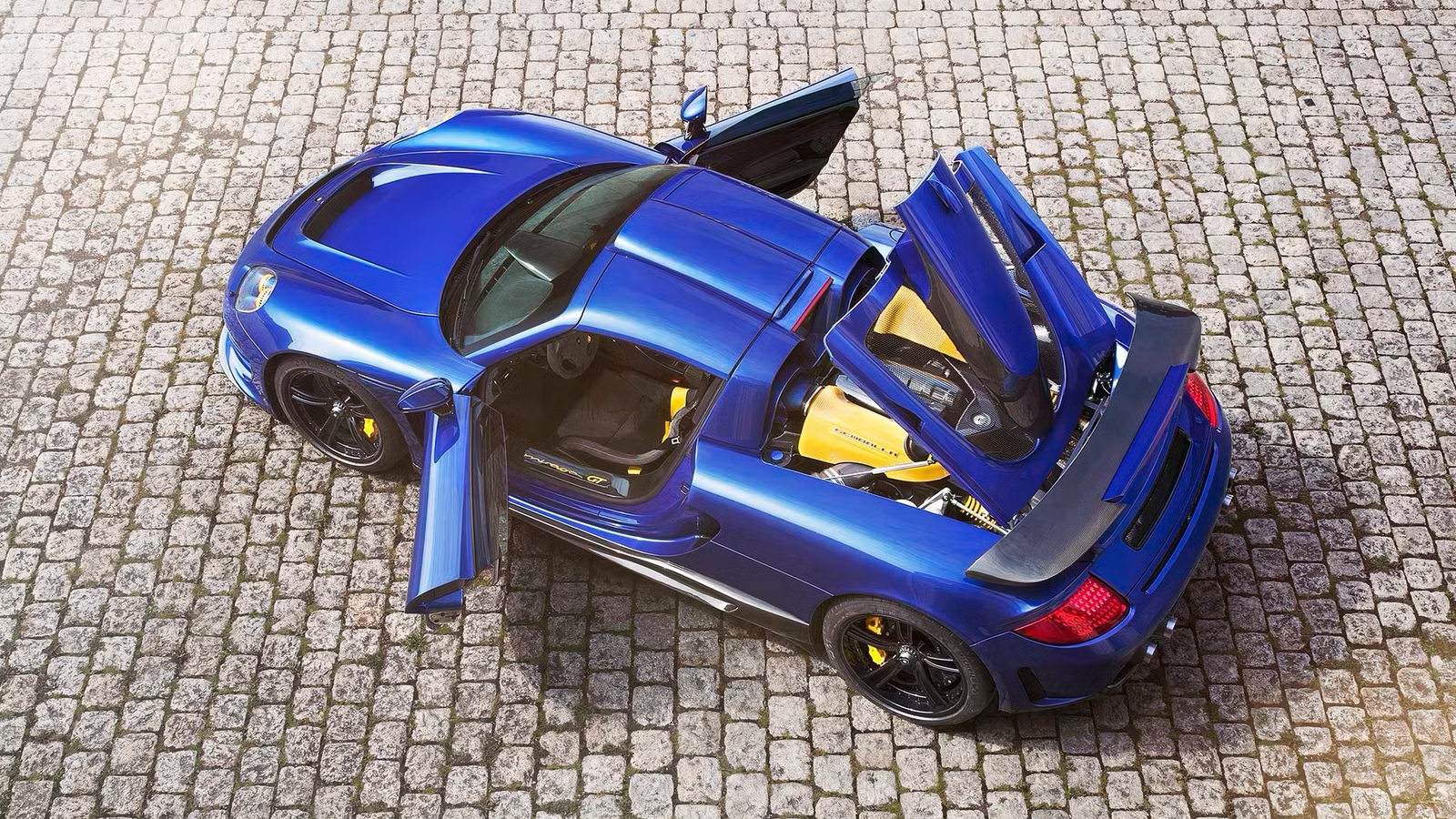
The Carrera GT may be a thoroughbred, but what Gemballa did to it in creating the Mirage GT makes it a breed of its own. Instead of preserving Porsche's carefully balanced supercar exactly as it left the factory, Gemballa made nearly every aspect of it wilder.
The Mirage GT looks more aggressive, sounds a lot angrier, and delivers an even more intense feel than the Carrera GT without losing the analog feel that made it a legend in the first place.
Porsche designed the GT's V10 with endurance racing precision in mind; Gemballa focused on making it feel more alive underfoot. The Mirage GT also gets a naturally aspirated V10, but it has been heavily tweaked, and horsepower and torque have been upped. It has the following specs.
Gemballa knew that the Type 980/01 V10 was one of the best Porsche engines ever built, so they didn't totally reinvent it; they just removed some of the factory restraint. The V10 used in the Mirage GT gets revised ECU mapping, a redesigned high-flow air intake, and Gemballa's signature ram-air setup that forces cooler, denser air directly into the intake at speed.
Combined with a freer-flowing stainless-steel exhaust rig and reduced back pressure, output is higher, and everything is designed to feel even more urgent and beastly. The Carrera GT sounds terrifying, but the sound of the Gemballa ram-air system pulling air directly into the engine behind your head, the whine of the drivetrain, and the crackling overrun from the exhaust make it sound even more visceral.
Gemballa also revised the transmission. In the Carrera GT, drivers have always said that it is notoriously unforgiving, so Gemballa added updated friction materials that slightly improve low-speed use, crucially, though, without diluting the raw feel. Combined with a six-speed manual transaxle, the Mirage GT is still designed to feel brutally mechanical, but with a far more intense edge.
Gemballa didn't simply modify the Carrera GT's exterior; they effectively re-clothed the carbon-fiber structure in a full aerodynamic re-body. The foundation remains untouched, the same carbon-fiber monocoque and core structural points are the same as the Carrera GT, but everywhere else has been reinterpreted, thanks to Gemballa's wind-tunnel testing and redesign to include a far more aggressive and motorsport-focused look.
The front end has been redesigned to include a deeper carbon-fiber bumper, larger air inlets across the full width of the nose, and a more pronounced front splitter to increase front axle stability. It also gets reshaped ducts to help manage pressure build-up around the front structure, while the side sections have been replaced by carbon-fiber panels that incorporate enlarged intake channels.
These channels are to increase airflow to the mid-mounted V10, which helps with cooling and intake breathing under heavy throttle use. The rear also gets the Gemballa treatment, with a bespoke roof scoop, fixed carbon-fiber wing, reworked diffuser dominating the tail, and wider bodywork giving it a more aggressive stance.
The Mirage GT still only weighs in at 3,042 pounds, and despite all the changes made by Gemballa, the core layout remains, meaning that the Mirage GT still behaves somewhat like a Carrera GT... just more extreme and lairy.
The new Slingshot ROUSH Edition is a collaboration between two American powerhouses
If you are lucky enough to spot a Carrera GT out in the wild, you are likely to spend some time looking at it. If you see a Gemballa Mirage GT, you are even luckier and will likely spend a lot more time looking at it. The Carrera GT gets a lot of attention, but the Mirage GT truly steals it.
One driver had a really expensive day a few years back when they crashed a Mirage GT in New York, which we are sure got attention for all the wrong reasons. However, we can see why it wouldn't be the hardest task to lose control of one.
The Carrera GT has been recorded hitting 60 mph in as little as 3.9 seconds and has a top speed of 205 mph. For most of us, that is plenty. However, the Mirage GT has been clocked sprinting to 60 in 3.7 seconds and has a top speed of 208 mph. While that isn't a huge amount faster, and plenty of cars and SUVs can now achieve these numbers, how the power is delivered makes it feel different.
The juiced-up yet still mechanical-feeling engine, revised aero package, and wider stance give the Mirage GT a more planted feel under acceleration, and nothing Gemballa has added is bolted on for effect. Instead, the changes are designed to work together as a system, making everything feel more stable and a little more confidence-inspiring compared to the more edgy character the Carrera GT can have.
Underneath all the carbon drama, the Mirage GT is still very much built on the Carrera GT's fundamentals, which is exactly why it works so well out on the track. It is low, light, wide, and has a heck of an engine sitting in the middle. It also has a rear-biased setup (42:58 front:rear), so you also get a lot of straight-line traction. It takes skill to drive, but it would be very rewarding once you're locked in.
The aluminum-heavy pushrod suspension layout remains intact, as does the core geometry that was originally developed with serious motorsport intent in mind. However, it is paired with a far more configurable system than the Carrera GT. The main upgrade is a race-style coil-over suspension with fully adjustable spring rates and independent damping control. Simply, it lets the Mirage GT be properly dialed in rather than locked into a single factory setting.
Gemballa also added an electro-hydraulic ride height system, which means that, at the touch of a button, you can raise ride height by around 1.8 inches; this was never an option for the Carrera GT, and makes the Mirage GT a more "usable" supercar on the road and more configurable on the track.
You may expect a custom supercar based on a relatively stripped-out, motorsport-esque Porsche to be equally or more stripped out. However, Gemballa didn't neglect the luxury side of things, and instead blended bespoke craftsmanship with driver-first cockpit design.
The bones of the Carrera GT remain; you still get a low-slung seating position, feet-out driving geometry, and a cockpit that wraps around you, but Gemballa originally offered fully bespoke options. Interior options originally included Alcantara leather, endless color combos, contrast stitching, and custom patterns. Carbon fiber is used everywhere, while small details like switchgear surrounds, console trim, and door panels could originally be refinished in custom materials.
The dials are still large and analog; a prominent tacho still takes center stage, and there is still a pure, no-nonsense look to it without the digital overloading we see in plenty of modern supercars. The steering wheel is thick-rimmed with minimal buttons, and while this is definitely a cabin made for a motorsport-derived car, Gemballa has given it a more custom "coach-built" feel all around.
Discover the strategic masterstroke behind Porsche's decision to build the 944, a car that defied expectations and redefined performance.
The Carrera GT may be an exceptionally rare and expensive Porsche, which is part of the appeal alongside what it can do, but at least there are still a fair few more of them around. Gemballa only built 25 Mirage GT models, so they are like hen's teeth to find. Originally, you had to provide a donor Carrera GT to have a Mirage made, which in the mid-2000s had a starting price of around $330,000. Then you had to pay Gemballa upwards of $325,000 for the conversion.
The final Gemballa Mirage GT rolled out of their factory in Germany in early 2015, and none have been made since. They are exceptionally rare to find for sale, and they are rarely publicly auctioned. One Mirage GT was sold back in 2020 at a Bonhams auction for roughly $850,000, while a low-mileage model is currently for sale (at time of writing) for $1.7 million with Esser Automotive.
The Mirage GT doesn't replace the Carrera GT experience; it just distorts it in the best possible way. The fundamentals are still pure Porsche, but the Gemballa layers a lot more aggression, presence, luxury, and customization onto it, which turns an already demanding and rare supercar into an even more extreme beast.
The Gemballa Mirage GT is loud, analog, direct, a lot more exciting to look at, and designed to be a lot more visceral behind the wheel than its Carrera GT donor. In this sense, it's a lot more "supercar" and no-filter than the already exceptional flagship Porsche supercar.
Found an error? Send it info@www.topspeed.com so it can be corrected.
Sources: Gemballa, Porsche, Esser Automotive, Bonhams, Classic.com.
Source: https://www.topspeed.com/rare-gemballa-mirage-gt/
Cars
The Rare Gemballa Mirage GT Is A Porsche Carrera GT Turned Up To 11
Article Top Ad Zone
Article Middle Ad Zone
Article Bottom Ad Zone
Original Source: www.topspeed.com
Share
Comments
Comment system is currently disabled.