Trends define the automotive industry, and like all trends, they come and go. Some eras last longer than others, but inevitably, just like life itself, everything comes to an end. As sad as that might sound, this fact makes us appreciate the fleeting moments still left in life.
Follow and Like top authors, topics, and trends
Browse with fewer ads across the site
Personalize your profile to showcase your activity
Get a content feed tailored to your interests
By creating an account, you agree to our Terms of Use and Privacy Policy. You also agree to receive our newsletters; you can unsubscribe any time.
*Required: 8 chars, 1 capital letter, 1 number
While performance cars are certainly more capable now than ever before, everything comes at a price. 15 years ago, we had more enthusiast platforms, and most of them focused specifically on driver involvement rather than raw performance figures.
After 2010, the enthusiast market underwent a significant strategic shift. Increasingly stringent emissions standards helped make turbocharging and engine downsizing the norm. There is no better example of the development of this trend than the BMW M5. The late 1990s brought us the legendary E39 M5, powered by a silky-smooth 4.9-liter naturally-aspirated V-8, available exclusively with a six-speed manual transmission. By the mid 2000s, BMW introduced the BMW E60 M5, which was powered by an iconic naturally-aspirated V-10 engine that screamed to 8,250 rpm.
Then, when the F10 M5 began production in 2011, we saw the first implementation of turbocharging in an M5 chassis with its 4.4-liter twin-turbo V-8 engine. The 2016 model year also marked the last time a manual transmission was offered for the M5 model. The F90 M5 that followed in 2017 also featured the same twin-turbo V-8 engine as the F10, and the G90 M5 that just debuted for the 2025 model year now features a plug-in hybrid twin-turbo V-8 powertrain. Indeed, the 2026 BMW M5 is faster than its V-10-powered predecessor, but it lost its soul along the way. It is clear that even for niche enthusiast platforms, automakers' priorities have changed to suit a more mass-market appeal.
Just because something is rare, does that automatically mean it has value? Not necessarily. Most classic cars aren't worth a dime and are sitting rotting away in abandoned yards across the globe. Even if there aren't many classics left, the fact is, only a certain group of people want them. The legendary vintage vehicles you end up hearing about selling for astronomical prices are the types of cars collectors actually desire. So what is the difference then? Well, cars that have real value are those that cannot be replicated. They represent a formula that was only made possible because of a certain set of conditions that no longer exist.
Take, for example, the 2010 Dodge Viper ACR Roadster. This 600-horsepower RWD V-10-powered roadster is effectively a mechanical deathtrap that could never exist in today's regulatory environment. Even without stricter regulations, whose idea was it to produce a limited-run hardcore track demon as a convertible? Even on paper, the ACR Roadster made no sense at all. Yet, this ridiculousness is exactly what makes it so appealing today to collectors. Nowadays, these 21 open-air ACR models are among the most valuable Dodge Viper models ever produced, and their value is only going up.
A street-tuned TRX with 777 horsepower would be the first serious heir to that legacy in two decades.
While it is clear that the performance sedan segment is slowly fading away as of 2026, it seems that Cadillac didn't quite get the message. There is one specific vehicle in Cadillac's lineup that refuses to modernize, and it is also looking to make its biggest splash yet.
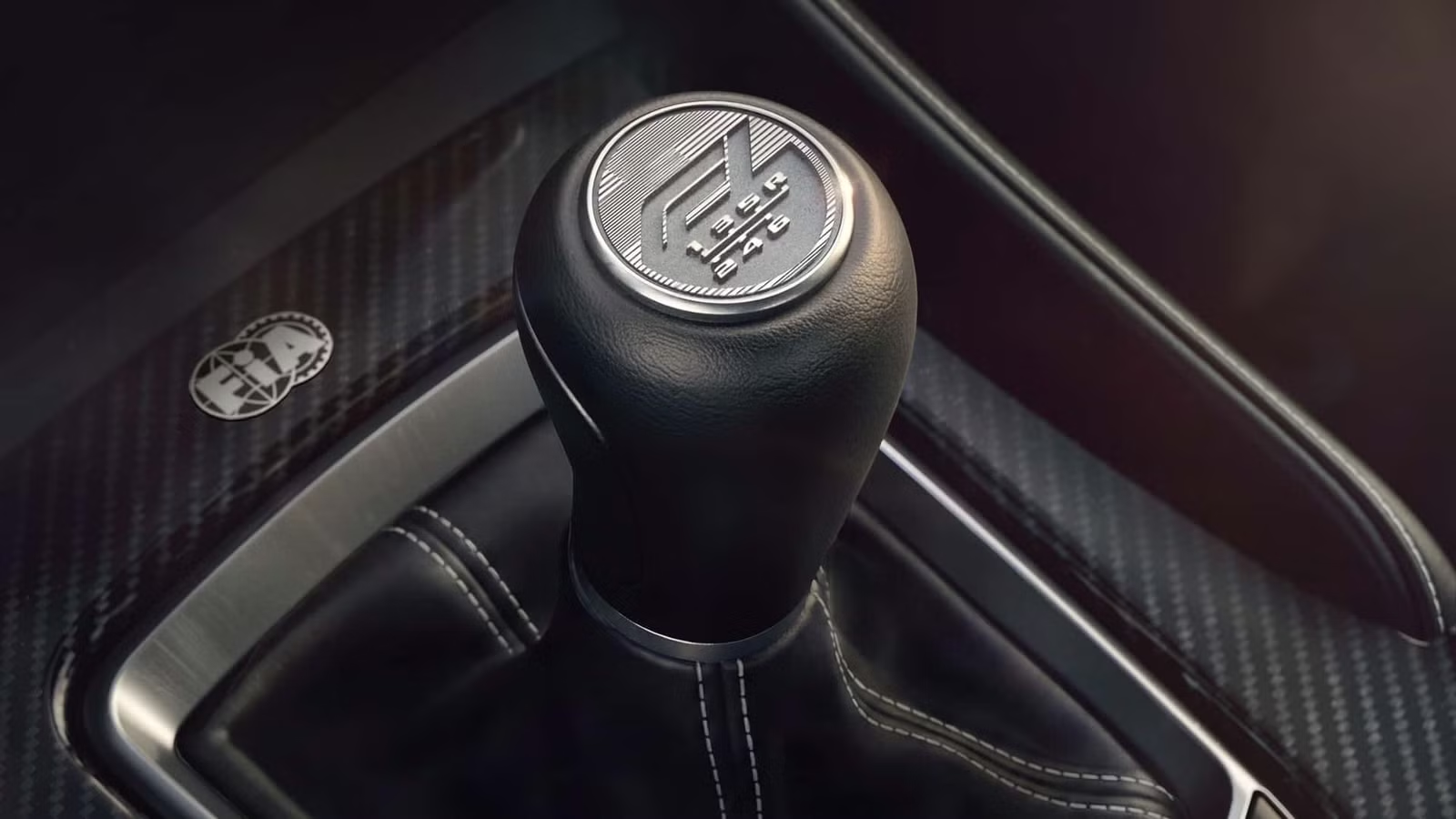
If we read you the spec sheet of this car, it sounds like a throwback from the past: a supercharged 6.2-liter V-8 that produces 685 horsepower and 673 pound-feet of torque. This vehicle is available with a six-speed manual, just like the revered E39 BMW M5. The drivetrain is rear-wheel drive only, as God intended.
Some of its standard features include carbon ceramic brakes, track-tuned MagneRide dampers, stiffer sway bars, and Michelin Pilot Sport Cup 2R tires. The hybrid system? There is none. If there is a new car on sale today that feels like it's from an entirely different era, it's this particular Cadillac. More incredible still, the engine featured in this performance sedan is the most powerful V-8 the brand has ever put into a production vehicle. This segment might be on its way out, but Cadillac is ensuring it goes out with a bang.
If you haven't guessed it already, the car in question is the 2026 Cadillac CT5-V Blackwing F1 Collector Series. Despite offering the most powerful Cadillac V-8 ever, the most spectacular detail is that it has been limited to only 26 units. Why 26? To mark the year that Cadillac entered the Formula 1 grid for the first time. It comes exclusively with a six-speed manual, and it is the most track-focused and hardcore realization ever produced of this Blackwing model. Remember what the BMW M5 looks like now? Yeah, it's a plug-in hybrid that only comes with an automatic transmission. The manual-only configuration makes the F1 Collector Series the most powerful manual car on sale in the U.S. right now. Is it the fastest car for sale today? Not quite. But goodness gracious, it has an unmatched nostalgic charm that almost sounds too good to be true.
The compact luxury sedan you’ve been overlooking might just deliver everything the BMW 3 Series promises.
Automakers adore using terms like 'limited-edition', but rarely is the end product as rare as they make it sound. For context, there were only 28 McLaren F1 GTRs ever produced. If Cadillac's F1 Collector Series can successfully apply a similar formula, it is certain to be one of the brand's most sought-after models.
Most limited-edition cars fail to appreciate meaningfully because they often lack the imbalance of demand relative to scarcity needed to meaningfully increase in value. The 2027 BMW M3 CS Handschalter is a perfect example that was just announced recently. BMW didn't even confirm an exact production number; they simply stated that it would be 'very limited numbers.' Such strategies are nothing more than marketing exercises. In reality, they don't have a good enough understanding of the actual demand to be set to a specific number. Even if the CS Handschalter was limited to only 500 units, there still may be enough supply to soften the secondary market.
Limiting a run to 26 confirmed units, however, is a different story entirely. This is the kind of level of exclusivity where your personal relationship with the dealer matters. Every car in this run will be known and documented as long as it is still around. These cars are closer to homologation specials than just a fancy limited-run trim package. The reason? Why not? Some things are best commemorated in metal and fire.
The choice for the Blackwing F1 Collector Series is manual-only, which tells you everything you need to know about this performance sedan's ethos. Most people, even enthusiasts, aren't as compelled by the allure of a manual transmission anymore. Indeed, a manual transmission is slower than a dual-clutch, less accessible, and harder to market.
That is why BMW got rid of the manual on the M5: the automatic was faster, and faster sells. The result is now that the highest-performing cars are the ones most insulated from analog feedback. The F1 Collector Series, however, is not one of those cars. This performance sedan is committed, in full, to the art of driving. Once you consider how most of Cadillac's lineup is now electrified, the F1 Collector Series stands out even more as a modern performance paradox.
From a $50,900 compact, urban-ready SUV to $100,000+ all-electric iteration of the iconic Escalade, the 2026 Cadillac electric SUV line-up is vibrant.
Although Cadillac has not officially announced the discontinuation of the CT5-V Blackwing, this F1 Collector Series might as well be called the 'Ultimate Edition'. A supercharged V-8-powered luxury sedan that only comes with a manual will not survive the regulatory pressures in store by the end of the decade.
The tightening grasp of emissions regulations only strengthens with every passing year. The supercharged V-8 in the CT5-V Blackwing is a modern engineering miracle, but it exists in opposition to the regulatory direction the automotive industry is heading. No matter how successful the F1 Collector Series ends up being, the sales volume of low-production performance sedans is only a drop in the bucket. Cadillac now even badges EVs like the OPTIQ-V and LYRIQ-V with V-Series logos, underscoring the brand's shift toward electrified performance. The F1 Collector Series is not the start of a new era; it is the mark of the end for uncompromising American performance sedans.
Cadillac could have added some power, some aero, thrown on a couple of badges, and called it a day. However, the F1 Collector Series means so much more than that to the American luxury brand. Despite being a blast from the past, it is a celebration of Cadillac's new beginnings as an active participant in Formula 1. Let's not forget, this is the most powerful Blackwing Cadillac ever produced. GM Motorsports developed a new supercharger kit just for these 26 units.
The F1 Collector Series is loud, unabashed, and blatantly excessive. Years from now, when analog performance sedans are a faint echo of the past, collectors will look at these 26 cars and know exactly why they exist and what they represent. The F1 Collector Series is not just the peak of Blackwing models, but the ultimate expression of the analog performance sedan that deserves an iconic sendoff.
Found an error? Send it info@www.topspeed.com so it can be corrected.
Sources: Cadillac, Cadillac F1 Team, BMW, McLaren, Dodge, Classic.com
Source: https://www.topspeed.com/685-hp-cadillac-only-manual-transmission/
BMW
The 685-HP Cadillac You Can Only Buy With A Manual Transmission
Article Top Ad Zone
Article Middle Ad Zone
Article Bottom Ad Zone
Original Source: www.topspeed.com
Share
Comments
Comment system is currently disabled.