The performance bike segment usually comprises sports bikes. And this fully faired segment in the USA has always been a compromise, whether manufacturers admit it or not. You either buy into the punishment that comes with a full-on supersport, or you compromise and get something that's pleasant to ride but doesn't quite scratch the itch when the road gets interesting.
Follow and Like top authors, topics, and trends
Browse with fewer ads across the site
Personalize your profile to showcase your activity
Get a content feed tailored to your interests
By creating an account, you agree to our Terms of Use and Privacy Policy. You also agree to receive our newsletters; you can unsubscribe any time.
*Required: 8 chars, 1 capital letter, 1 number
Balance is one of those words motorcyclists throw around constantly, but it means something very specific when you strip the marketing away. A balanced performance bike needs real power, but not just a headline number. It needs handling that feels accurate and confidence-building, not twitchy or overworked. And it needs enough everyday friendliness that riding it on ordinary roads does not feel like a punishment. A stiff chassis transmits every road imperfection straight to your spine. And when manufacturers try to walk back those compromises, they often overcorrect by softening the suspension, detuning the engine, adding weight until the bike loses its identity entirely.
The common failure modes are easy to spot. Some inline-four sports bikes give you all the excitement only after the revs are soaring, but demand a lot from your wrists, back, and patience before that happens. Others, especially entry-level twins, are pleasant and approachable, yet flatten out too early and never really deliver that “special” feeling people expect from a sports bike.
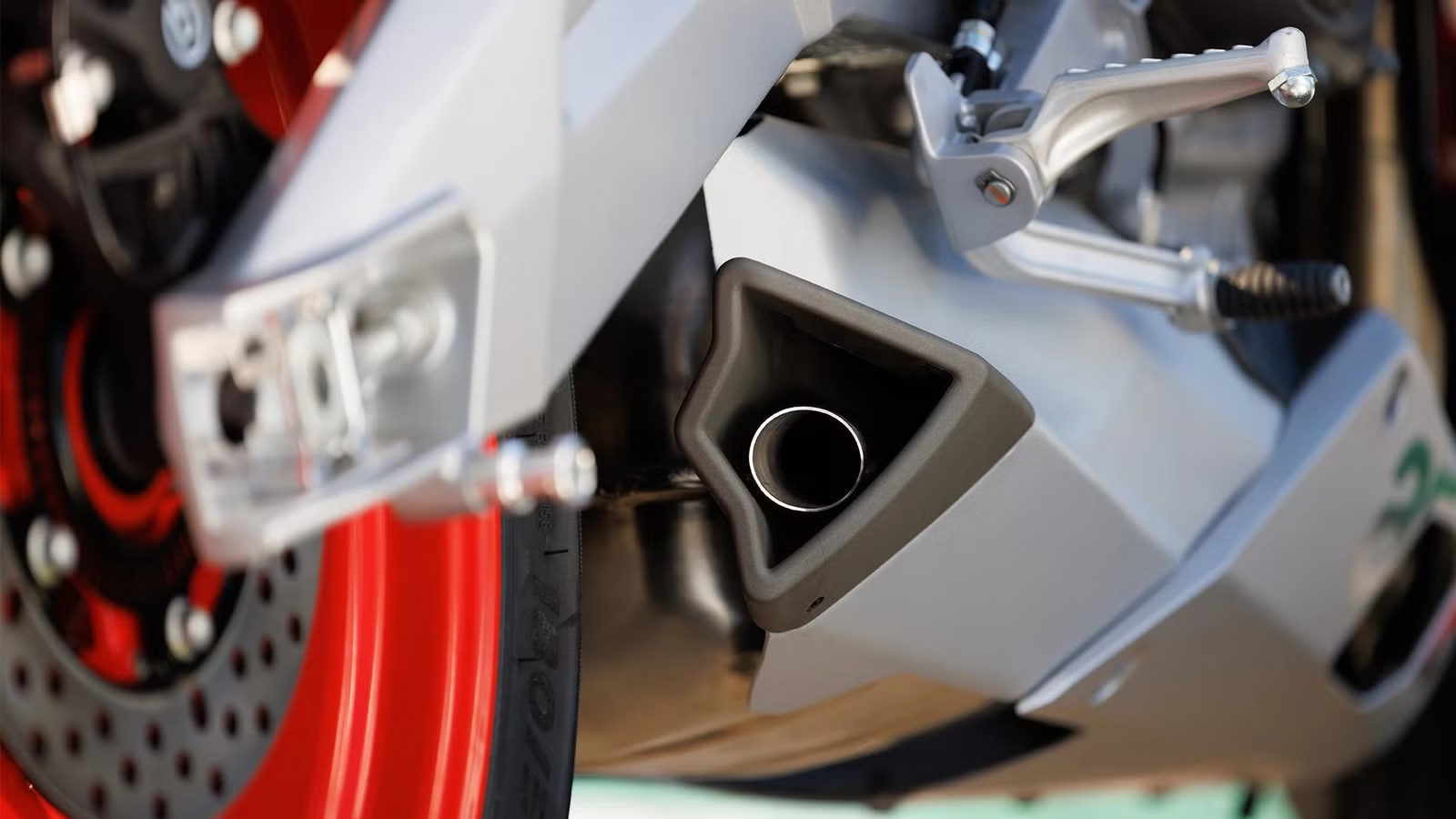
The Aprilia RS 660 is built around the idea that you should not have to choose one of those extremes. It is Aprilia’s answer to riders who want something sharp, engaging, and genuinely usable without feeling like they bought a weekend-only toy. In the U.S., Aprilia currently lists the RS 660 at $11,849. It isn’t cheap by any means, but it is also not pretending to be a stripped-back entry bike. That price starts to make more sense once you look at the hardware and electronics on offer. In other words, the RS 660 is priced like a serious middleweight, but it brings equipment that would have been exotic on a sports bike not very long ago.
A road sofa with a rocket’s heart, this tourer turns long miles into easy memories, where speed hums softly and comfort never clocks out.
The 659cc parallel-twin is the heart of the RS 660. This engine pumps out 105 hp at 10,400 rpm and 51.6 lb-ft of peak torque at 8,400 rpm. Aprilia gives it a 270-degree crank character that helps it feel punchier and more instinctive than a sterile, generic twin. That is an important part of the RS 660’s personality: the power delivery is lively, but not frantic, and the engine is built to feel useful instead of merely impressive on a spec sheet.
On paper, 105 hp is enough to sound serious. On the road, what matters more is how that power arrives. The RS 660’s engine is praised for strong low-end and mid-range response, which is exactly what street riders actually use most of the time. That makes it easier to short-shift in traffic, easier to roll on for freeway passes, and more rewarding when you are chasing a flowing road. Just as importantly, the broad and tractable torque delivery helps keep the bike calm over longer rides, rather than tiring you with unnecessary vibration or peaky behavior. This proves to be a big advantage for the RS 660.
Aprilia has never been shy about electronics, but the RS 660 uses them in a way that feels useful rather than intimidating. The bike gets five riding modes, launch control, traction control, wheelie control, cruise control, and a quick-shifter as part of the APRC package. Cornering ABS and traction control logic are tuned for real-road use here. Separately, Aprilia’s MIA system is designed to connect a smartphone to the bike via Bluetooth and expand the onboard functionality.
The functionalities mentioned above are controlled via a full-color TFT display and backlit switchgear. The broader electronics suite is clearly meant to be accessible rather than opaque. The result is a bike that feels modern without becoming annoying to live with, which is a much harder balance to strike than it sounds. Most users of the RS 660 have consistently described the electronics as confidence-inspiring rather than intrusive.
The Norton Manx R is arguably the most exciting fresh superbikes we've had in recent times, and it delivers on nearly all the promises it makes
The RS 660’s chassis is a big part of why the bike feels so sorted. A twin-spar aluminum frame, a 41 mm KYB upside-down fork, and a KYB monoshock with adjustability all deserve credit here. The numbers are straightforward, but the payoff is the way the bike turns: light enough to feel eager, stable enough to avoid nervousness. Aprilia also lists the RS 660 at 403 pounds in running order with 90 percent fuel, which is still very light for a fully faired performance motorcycle with this level of equipment.
That weight and chassis tuning matter most when the road gets messy. It should feel nimble in tighter sections, yet planted and composed at higher speeds. It is the kind of bike that can flick through a series of bends without feeling nervous, then settle down on the highway without wandering or shaking its confidence away. In practice, that means you are more likely to ride it more often than not, because it does not demand ideal pavement or an ideal mood to be enjoyable.
Aprilia lists a 32.2-inch seat height, which is tall enough to preserve a sporty stance but not so extreme that it turns the bike into a full race-crouch proposition. The RS 660’s handlebars are relatively high, and the footpeg position is more relaxed than a hard-edged supersports. It still feels purposeful, but the ergonomics are not trying to punish you for riding it on an ordinary Tuesday. That makes a real difference, especially in the U.S., where riders often want one motorcycle that can do a commute, a weekend ride, and the odd longer trip without changing character completely.
This middleweight Yamaha naked bike prioritizes fun and engagement above all else.
The RS 660 is compelling because it does not dominate just one category and then stumble everywhere else. It has a genuine performance engine, a chassis that rewards precise riding, electronics that add value rather than burden, and ergonomics that make daily use realistic. In a market full of performance machines that overcommit to one personality, the Aprilia feels unusually complete. That is why the RS 660 keeps coming back into the conversation whenever riders talk about the “right” performance bike for real life.
Found an error? Send it info@www.topspeed.com so it can be corrected.
Source: https://www.topspeed.com/performance-bike-balances-power-handling-practicality/
Cars
The Performance Bike That Balances Power, Handling, And Everyday Practicality
Article Top Ad Zone
Article Middle Ad Zone
Article Bottom Ad Zone
Original Source: www.topspeed.com
Share
Comments
Comment system is currently disabled.