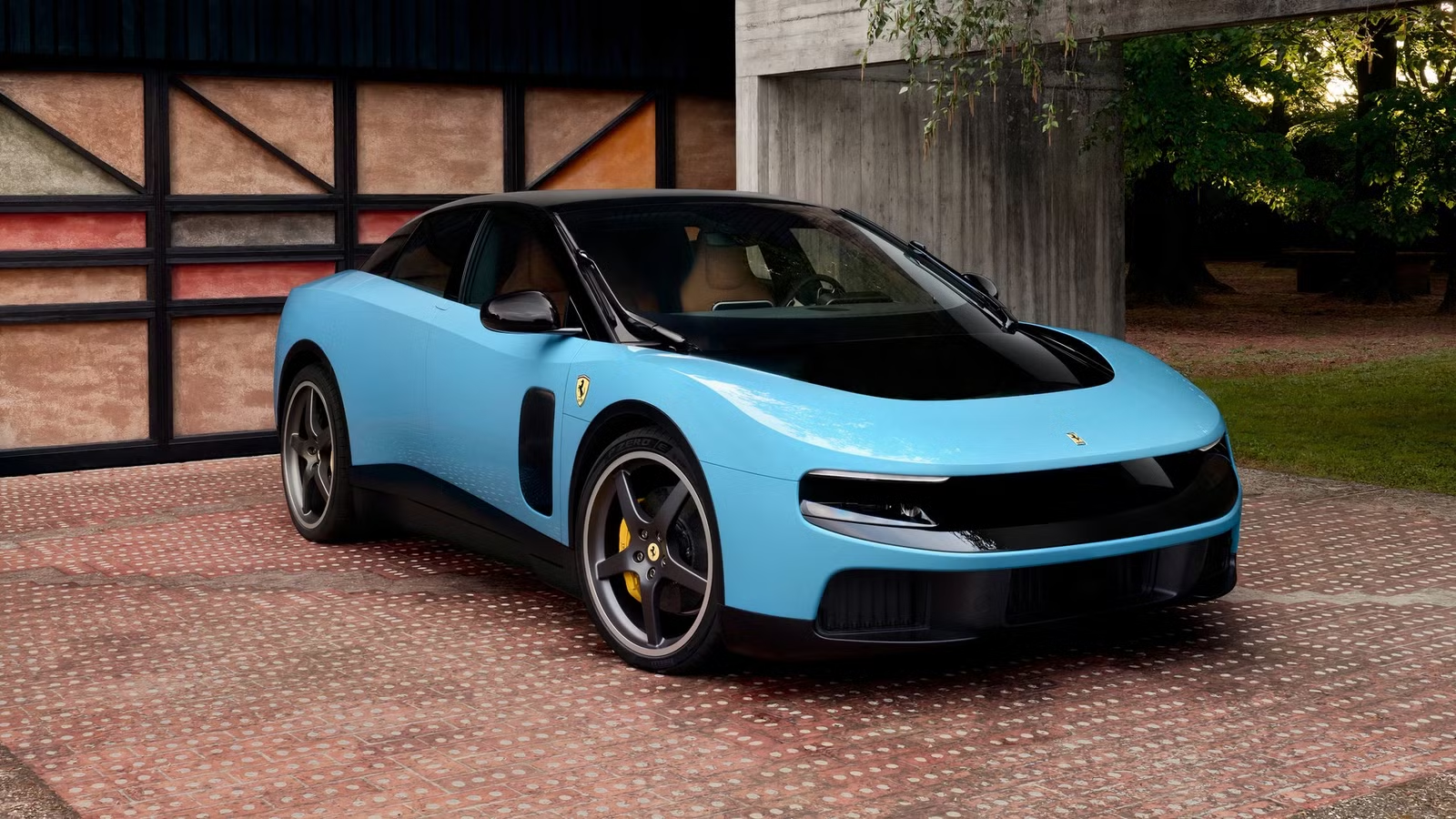
Ferrari unveiled the Luce in Rome today—its first fully electric production car, and the most consequential new model the Maranello marque has introduced in decades. The numbers alone are striking: 1,050 cv (roughly 1,035 hp) from four wheel-mounted electric motors, a 0–100 km/h sprint in 2.5 seconds, a top speed of 310 km/h, and a range estimated at over 530 km from a 122 kWh battery pack.
Follow and Like top authors, topics, and trends
Browse with fewer ads across the site
Personalize your profile to showcase your activity
Get a content feed tailored to your interests
By creating an account, you agree to our Terms of Use and Privacy Policy. You also agree to receive our newsletters; you can unsubscribe any time.
*Required: 8 chars, 1 capital letter, 1 number
The Luce's electric architecture unlocks proportions no Ferrari has offered before. Four doors and five seats make it only the second four-door model in the brand's history—and the first ever with a fifth seat, which the transaxle layouts of previous front-mid-engine models made impossible. The battery pack sits integrated into the floorpan, eliminating the central tunnel entirely and freeing up interior space that feels, Ferrari says, substantially larger than the car's exterior suggests.
All-wheel drive is also a brand first for a production Ferrari road car. Each of the four permanent magnet synchronous motors—derived from those developed for the F80 supercar—drives a single wheel independently. The rear motors spin to 25,500 rpm and the fronts to 30,000 rpm, all on an 800-volt architecture. That independent torque control enables full torque vectoring on both axles simultaneously, which Ferrari's engineers describe as a level of precision unattainable with any mechanical differential system. The wheels themselves set another record: 23 inches at the front and 24 at the rear, the largest staggered diameters ever fitted to a series-production Ferrari.
LoveFrom's involvement goes well beyond a styling exercise. Ferrari gave the collective—whose principals shaped the iMac, iPod, iPhone, and Apple Watch—full philosophical and design autonomy from the concept stage, something the Maranello studio has never ceded to an outside party. The guiding principle was simplification: smooth, shell-like forms with no recesses or abrupt surface breaks, a glass house that extends below the belt line, and floating aerodynamic wings front and rear that appear to hover around the body rather than grow from it.
The interior follows the same logic. Precision-machined aluminum buttons, dials, and toggles sit alongside custom OLED displays developed exclusively with Samsung Display. The steering wheel is machined from 100% recycled aluminum. The key—a Corning Gorilla Glass object with an E Ink display, a claimed automotive first—docks into the center console to start the car and triggers a surge of Ferrari yellow across the interface. Every material choice, Ferrari notes, was treated as an individual product decision rather than a trim specification. The result is a cabin that reads less like a traditional supercar cockpit and more like an exercise in considered industrial design.
One of the Luce's most unusual technical achievements has nothing to do with acceleration. Ferrari spent five years and 40,000 km of dedicated track testing developing an authentic sound system—one that captures the actual vibration of the rotating axle components rather than synthesizing or simulating engine noise.
A precision accelerometer mounted at the center of the rear axle housing picks up the mechanical vibration traveling through the metal in real time. That signal is then filtered, equalized, and amplified—Ferrari compares the process directly to how an electric guitar amplifier works. The result is a living, continuously evolving sound with micro-variations that change with speed, torque delivery, and driver inputs. Sound output is tied to the e-Manettino driving mode selector: in Range mode, the cabin is near-silent; in Performance mode, the acoustic signature is fully expressed both inside and outside the car. Ferrari filed a patent on the system.
The Luce was revealed at the Vela di Calatrava in Rome—a venue chosen deliberately. Seventy-nine years ago today, a Ferrari 125 S won the Gran Premio di Roma at the Baths of Caracalla, the brand's first-ever race victory. Ferrari returning to Rome to open what it calls a new chapter carries the kind of symbolism the brand rarely leaves to chance.
Source: https://www.topspeed.com/ferrari-first-ever-all-electric-car/
Cars
Ferrari Just Unveiled Its First-Ever All-Electric Car—And Jony Ive Designed It
Article Top Ad Zone
Article Middle Ad Zone
Article Bottom Ad Zone
Original Source: www.topspeed.com
Share
Comments
Comment system is currently disabled.