Traditional cruisers have always been about that wind-in-the-hair feeling while you watch the landscape go by. It evokes images of Easy Rider and cruising down a boulevard on a warm summer's evening. Traditional cruisers have ideas about how they want to look as well: lots of chrome, big presence in the form of large dimensions, and obviously the throb of a large-displacement V-twin.
Follow and Like top authors, topics, and trends
Browse with fewer ads across the site
Personalize your profile to showcase your activity
Get a content feed tailored to your interests
By creating an account, you agree to our Terms of Use and Privacy Policy. You also agree to receive our newsletters; you can unsubscribe any time.
*Required: 8 chars, 1 capital letter, 1 number
There was a time in the late 1990s and early 2000s when everybody wanted to have a large, very quick cruiser in the lineup. These were power cruisers, but the best of them were more like dragsters designed for the quarter mile rather than cruising down a road enjoying the sights and sounds. The two most famous products in this genre were the Yamaha V-Max and the Harley-Davidson V-Rod. Since they both have retired, there hasn't been any direct replacement for them.
That doesn't mean that the power cruiser segment has died out. The traditional power cruiser tried to ape large-displacement American cruisers that had a lot of performance, and they were all more or less similar. Today's power cruiser has moved away somewhat from the traditional setup of lots of chrome with the large V-twin and the monstrously wide rear tire. They use different paths to reach the same destination.
The Rocket 3 is a key example. This is a premium motorcycle, no doubt about it, with superbike levels of power and torque. Considering the amount of kit and sheer size of the motorcycle that you get, the base price is quite good value. It is also a design icon because it looks like nothing else and is instantly recognizable as the Rocket 3 — this is possibly the most complete power cruiser you can have today.
Then, we have the XDiavel, which is fast, comfortable, and surprisingly comfortable. This is one of the fastest accelerating motorcycles on the planet, but it does it with a sports bike-type frame, sports bike-type electronics, and it even has a counterrotating crankshaft, just like a sports bike! But it has the looks and rider triangle of a cruiser, so that’s what it is.
Harley-Davidson does have descendants of the Revolution engine that powered the V-Rod in its lineup today. But its power cruiser doesn't use it; it opts for Milwaukee-Eight motor power instead. The Breakout definitely looks the part, being one of the most aggressive-looking cruisers on sale today. With its dragster-like look, it has performance that backs up the looks as well. Likewise, the Low Rider S is another great example. It has the most powerful Milwaukee-Eight 117 engine right now, while also bearing properly sporty underpinnings.
The most affordable cruiser bike here is a middleweight Kawasaki that shares its engine with sport bikes, streetfighters, and touring bikes.
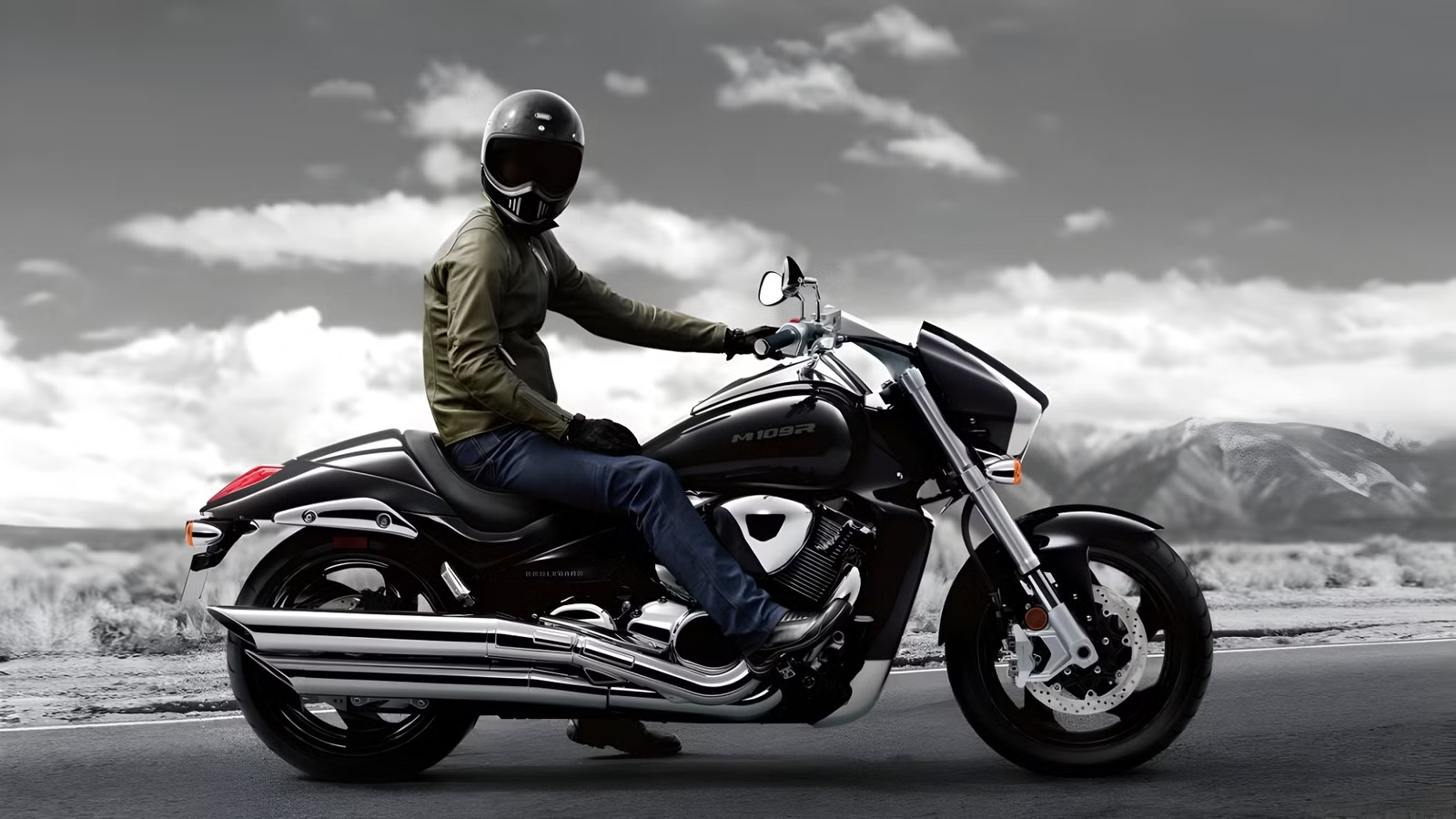
While all of the above are special bikes in their own right, the Boulevard M109R is what boasts Japanese dependability and American road presence. It is from the 2000s, when the Japanese were trying to get a share of the American cruiser pie, which has now made it a smart alternative to traditional American cruisers.
As a result, it has a massive V-twin engine, a really wide rear tire, and the long and low look, but Suzuki has given it a couple of twists that make it uniquely Suzuki and Japanese. It hasn't changed over the decades that it has been on sale, which is also why it is now extremely reliable, giving it a unique combination of Japanese dependability and American road presence.
We weren't kidding when we said that it hasn't changed over the decades. The Boulevard M109R is exactly the same today as it was during its launch some 20-odd years ago, which is why you don't need Harley money for it. Instead, it competes with pretty much no other power cruiser at $15,799. You could make an argument for the Harley-Davidson Sportster S, which is priced very similarly, but that has a different ethos behind its design and engineering. In the same vein, the Indian 101 Scout has a much smaller displacement engine.
These bikes combine the best of both worlds - the laid-back attitude of a cruiser with mighty powerful powerhouses
This engine was developed when having a large-displacement V-twin engine was essential to show your dominance in the segment. As such, this 54-degree V-twin has a displacement of 1,783 cc and a compression ratio of 10.5:1. It is designed to look air-cooled with cooling fins on the cylinders, but it is actually wholly liquid-cooled, and it even has a DOHC setup with four valves per cylinder.
The result is a peak power of 123 horsepower at 6,200 RPM and a peak torque of 118 pound-feet at 3,200 RPM, making it the most powerful Japanese cruiser on the market today. The difference in revs between peak torque and peak horsepower shows exactly how flexible this engine is. All you need to do for freight-train-like acceleration is to open the throttle, no matter what gear you're in. Speaking of gears, the Boulevard M109R sends all this power and torque through a wide-ratio five-speed gearbox and shaft drive to the rear wheel.
Here, too, the Boulevard doesn't seem as old as you might expect it to be. This is a traditional steel double-cradle frame, but it has a single rear shock hidden under the seat to make it look like a hardtail. The front suspension is even more advanced; Suzuki has derived it from the GSX-R liter superbike, which means it has 46 mm cartridge-type inverted forks.
The front brakes also come from that same sport bike (twin 310 mm floating discs with radial four-piston fixed calipers). At the rear, there is a 274 mm disc with a two-piston floating caliper. 18-inch alloy wheels with tubeless radial tires are present, which aid the ride and handling. It is worth mentioning that at launch, this bike had the widest rear tire of any production motorcycle of the time (matching that of the Rocket 3) to handle the engine's immense torque. The modern bits of the chassis are part of the reason it is still rolling strong today.
The Boulevard's brooding headlamp styling and organic lines, along with the slash-cut exhausts, make it the most aggressive-looking V-twin cruiser today. But a large part of its presence is its sheer size. It is 95.5 inches long, 34.4 inches wide, and has a wheelbase of 67.3 inches. It has an appreciable ground clearance of 5.1 inches. And we must commend the fact that the seat height is just 27.8 inches. What you need to be prepared for is the 764-pound curb weight. This is a heavyweight, no matter which cruiser you compare it with.
The Boulevard's feature set doesn't quite live up to the promise of its classic American presence, and that is because Suzuki hasn't updated the bike in decades. The instrument cluster is a two-part setup: the part mounted on the handlebar has a digital tachometer and gear indicator, whereas the tank-mounted cluster has an analog speedometer and two LCDs. Aside from that, you don't get any ABS or rider aids, either.
Harleys are great – but their price usually is the opposite of great. Here are ten options that won’t break the bank.
The Boulevard M109R is an anachronism because it comes from a time when bigger was better, even if bigger didn't really make much sense. But over the years, it has changed into a dependable cruiser that also offers the presence of an American premium cruiser and the performance of one as well. And all of this at pricing that is almost that of mid-size cruisers, making it the most overlooked cruiser bargain out there. If you want a Japanese muscle cruiser, there is no real option to the Suzuki Boulevard M109R.
Found an error? Send it info@www.topspeed.com so it can be corrected.
Source: https://www.topspeed.com/power-cruiser-with-japanese-dependability-american-road-presence/
Cars
The Power Cruiser That Combines Japanese Dependability With American Road Presence
Article Top Ad Zone
Article Middle Ad Zone
Article Bottom Ad Zone
Original Source: www.topspeed.com
Share
Comments
Comment system is currently disabled.