The modern sports car segment has experienced a dramatic shift over the past few decades, primarily centered on performance and practical usability. Sports cars of previous eras typically focused more on driver engagement and performance than many modern models. This is because brands marketed them as weekend cars that you'd only take out for a fun drive.
Follow and Like top authors, topics, and trends
Browse with fewer ads across the site
Personalize your profile to showcase your activity
Get a content feed tailored to your interests
By creating an account, you agree to our Terms of Use and Privacy Policy. You also agree to receive our newsletters; you can unsubscribe any time.
*Required: 8 chars, 1 capital letter, 1 number
The modern sports car segment in the United States has undergone a significant shift toward livable performance. The traditionally stark compromise between track-ready agility and daily utility has been largely mitigated by advanced engineering, except for a few bespoke track-only models.
Modern designs prioritize adaptive suspensions and high downforce components. These allow a vehicle to transform from a rigid, corner-carving machine to a compliant commuter at the touch of a button, sometimes with the option to customize your own level depending on road conditions.
You can't really have a conversation about the modern sports car without mentioning BMW. Since the Bavarian brand's inception as an aircraft engine manufacturer, it has represented the sports car segment through an engineering-first philosophy that has long favored its straight-six engine layout.
Historically, the brand focused on perfecting a sports car that offers the balance and feedback of dedicated performance within a usable body configuration. Today, BMW approaches the segment by leaning into a bold and polarizing visual aesthetic for the sake of drawing attention. Thankfully, it remains the gold standard for prioritizing driver engagement with the benefit of practicality.
As of 2026, BMW blends futuristic software integration with its core driving engagement philosophy. In doing so, it has successfully evolved from a niche purveyor of analog driving tools into a lifestyle-driven performance powerhouse that dominates the modern enthusiast market.
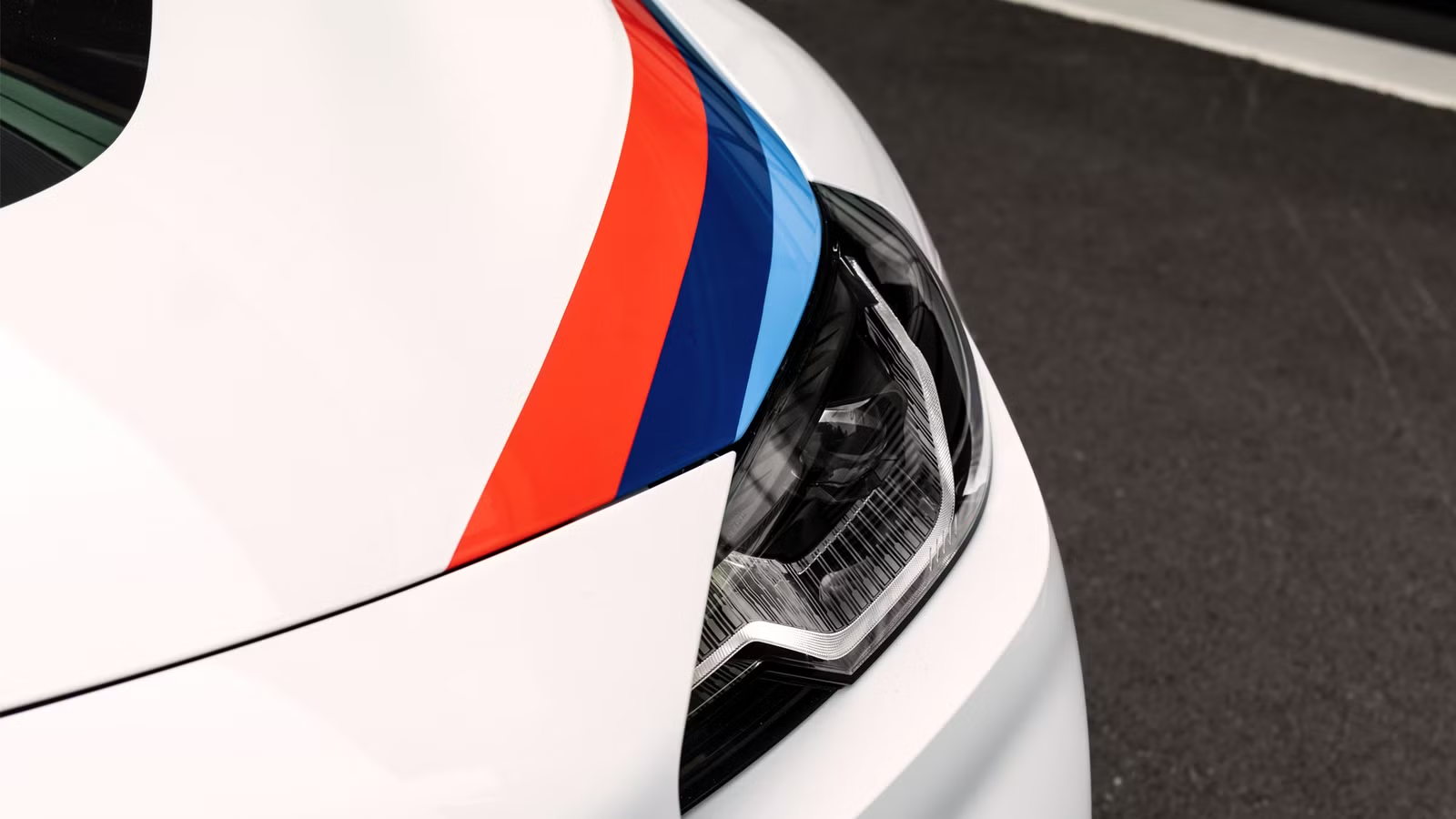
The 2026 BMW M2 isn’t just another compact performance coupe—it’s one of the last true driver’s cars in a market that keeps leaning toward automation.
The 2026 BMW M2 is the poster child of the brand's compact high-performance lineup, competing in a shrinking segment of premium, track-ready sports coupes. In the U.S. market, it has proven to be a vital enthusiast-driver for the brand’s performance division, contributing to BMW M's record-breaking sales years by offering the ultimate purist entry point into the world of full-fledged M power.
BMW perfected the formula for the M2 to be a razor-sharp weapon by prioritizing raw aggression. The Bavarian brand does so by applying a stiffened, track-tuned adaptive M suspension system that delivers relentless cornering grip and immediate chassis feedback. The M2 is highly praised by its users. According to the Edmunds consumer review portal, it currently holds a 4.8/5-star average, based on four submissions. Key strengths include its driving experience, value, and overall practicality.
The heart of the 2026 BMW M2 is the brand's legendary, race-bred S58 twin-turbo 3.0-liter straight-six engine. This unit produces 473 horsepower, increased to 523 horsepower in the specialized CS variant. For pure engagement, the brand offers a six-speed manual transmission with 406 pound-feet of torque. You can opt for the eight-speed M Steptronic automatic, which increases torque to 442 lb-ft. This features steering-wheel-mounted paddle shifters with an integrated launch control function.
Power is sent exclusively to a traditional rear-wheel-drive setup. When equipped with the automatic transmission, the M2 accelerates from 0 to 60 MPH in 3.9 seconds. The manual configuration achieves the sprint in 4.1 seconds. On the drag strip, the automatic model typically clears the quarter-mile in 11.8 seconds at a trap speed of 119 MPH, depending on track conditions. BMW limits the standard top speed to 155 MPH, which the optional M Driver's Package raises to 177 MPH.
The special 2026 BMW M2 Turbo Design Edition pays tribute to the 1974 2002 turbo with retro styling, manual gearbox, and 473-hp performance.
The BMW S58 twin-turbo straight-six is widely regarded as a modern masterpiece because it is completely over-engineered for extreme track use while maintaining daily drivability. The M-developed S58's design consists of a heavy-duty closed-deck aluminum block. This design surrounds the cylinder walls with solid metal for maximum structural rigidity, giving it the ability to handle immense boost pressures and increasing combustion loads.
The rotating assembly features a forged steel crankshaft, forged connecting rods, and lightweight pistons as standard. This architecture provides the massive mechanical headroom that has made the S58 the absolute darling of the modern tuning community. Unlike standard BMW engines, the S58 opts for two dedicated mono-scroll turbochargers, each of which handles three cylinders.
It's joined by an intricate, 3D-printed cylinder head that features optimized cooling channels impossible to manufacture with traditional casting. The real secret to the S58's unrelenting power delivery is its massive liquid-to-air intercooler mounted directly on top of the engine, ensuring stable intake temperatures during grueling track days.
For 2026, BMW further elevates this power plant by integrating its M Ignite pre-chamber ignition technology. Borrowed from Formula One, this system utilizes a secondary combustion chamber with its own spark plug to prevent engine knock and lower exhaust temperatures under heavy loads. This thermal discipline, combined with a high-pressure 350-bar fuel injection system and an upgraded oiling system designed to prevent starvation under intense lateral g-forces, creates a unique balance where the hardware is durable enough to exceed 700 hp on stock internals.
The 2026 BMW M2 sits on a heavily reinforced, motorsport-derived chassis that pairs a double-joint spring strut front axle with a five-link rear axle. Both of these feature M-specific aluminum components and elastokinematics. The Bavarian brand engineers this widened track setup to maintain a near-perfect 50:50 weight distribution.
To maximize circuit-level precision without completely sacrificing road usability, the M2 features a standard Adaptive M suspension system. This setup incorporates specialized body bracing, rigid rear-subframe mounting, and electronically controlled dampers that adjust in milliseconds based on real-time telemetry.
You can adapt the car's behavior via customizable drive profiles by selecting Comfort, Sport, and track-optimized Sport+ modes. Cornering dynamics are managed by the standard Active M Differential. This electronically controlled limited-slip system prioritizes explosive traction and throttle-steer stability on exit corners.
Stopping power is delivered by massive M Compound brakes featuring six-piston fixed calipers clamping down on cross-drilled rotors at the front. BMW mates this to staggered 19-inch front and 20-inch rear M light-alloy wheels wrapped in ultra-high-performance tires.
In both price and performance, there are very few cars that can rival the BMW M2, but here are a few we found.
Priced at $69,000, the 2026 BMW M2 balances its track-focused aggression with a premium, tech-forward cabin designed for modern daily usability. Inside, the M2 comes standard with a high-end luxury foundation, featuring dual-zone automatic climate control, Comfort Access keyless entry, customizable ambient interior lighting, and heated power-adjustable M Sport seats wrapped in premium Vernasca leather with illuminated M2 logos.
For entertainment, the centerpiece of the cabin is the striking BMW Curved Display. This houses a 12.3-inch digital instrument cluster and a 14.9-inch central touchscreen running the updated BMW Operating System 8.5. BMW's digital setup integrates the standard, premium Harman Kardon surround-sound system, satellite radio, Bluetooth, and cloud-based BMW Maps navigation.
Smartphone connectivity is completely seamless via standard wireless Apple CarPlay and Android Auto. Furthermore, the number of physical buttons is minimized by the integration of the BMW Intelligent Personal Assistant, allowing drivers to intuitively adjust climate control settings or the standard heated seats entirely through voice commands.
The standalone options and packages for 2026 allow buyers to pivot the M2 into either a more luxurious grand tourer or a stark, hardcore track machine.
Convenience can be upgraded via the Live Cockpit Professional, which projects a head-up display directly onto the windshield and adds an Augmented View reality overlay for the navigation system. A wireless smartphone charging pad is also available.
The cockpit layout shifts for 2026 with a new flat-bottomed sport steering wheel designed to improve knee clearance. While the front seats offer 41.8 inches of legroom, the coupe layout means the rear two seats remain best suited for shorter trips or children, though daily practicality is saved by a generous 13.8 cubic feet of trunk space.
For driver assistance, you can add an automated parking assistant and adaptive cruise control, the latter exclusive to models equipped with the automatic transmission. On the comfort and styling front, you can opt for a heated steering wheel or replace the standard glass sunroof with a weight-saving M Carbon fiber roof. If you're an ultimate enthusiast, the optional Carbon Package completely swaps out the front chairs for aggressive, race-ready M Carbon bucket seats, trims the cabin in raw carbon fiber, and adds the M Driver's Package.
Found an error? Send it info@www.topspeed.com so it can be corrected.
Source: https://www.topspeed.com/sports-car-supercar-daily-driver/
BMW
The Sports Car That Feels Like A Supercar But Works Like A Daily Driver
Article Top Ad Zone
Article Middle Ad Zone
Article Bottom Ad Zone
Original Source: www.topspeed.com
Share
Comments
Comment system is currently disabled.