Motorcycles built for the long haul are not always the ones with the biggest spec sheets or the flashiest technology. Longevity often comes down to something just a bit simpler: the engine should be able to take punishment, shrug off miles and miles of road, and keep delivering the same kind of pull long after competitors begin to start showing signs of age. This is where Indian Motorcycle comes in with some of the best-built cruisers, baggers, and tourers on the market today.
Follow and Like top authors, topics, and trends
Browse with fewer ads across the site
Personalize your profile to showcase your activity
Get a content feed tailored to your interests
By creating an account, you agree to our Terms of Use and Privacy Policy. You also agree to receive our newsletters; you can unsubscribe any time.
*Required: 8 chars, 1 capital letter, 1 number
Built for endless miles, this American grand tourer blends V‑twin muscle, plush comfort, and advanced touring tech for effortless long rides.
The Indian Chief Dark Horse carries one of the most durable engines in modern motorcycling. At 1,890 cc, the air-cooled Thunderstroke 116 delivers 120 pound-feet of torque and a character that is deeply mechanical. What makes this bike so special is the engine’s simplicity. While many rivals depend on layers of electronics and complex cooling systems, the Thunderstroke 116 remains relatively straightforward. The pushrod architecture has fewer moving parts than the overhead-cam designs, and that means there are fewer potential failure points over time. Air-cooling also eliminates components like radiators, coolant pumps, and hoses, which reduces the risk of leaks and breakdowns in particularly hot climates.
The Chief’s primary competition comes from the Low Rider S with the Milwaukee-Eight 117 engines. However, the Chief feels just a bit overbuilt. Take a look at the ownership forums, and you frequently see riders saying the bike never feels stressed. An engine that doesn’t need to push itself constantly has little that can go wrong over the long term. As far as the chassis goes, suspension comes from a 46 mm telescopic front fork and dual rear shock absorbers with preload adjustment. Braking duties are handled by a 300 mm semi-floating rotor up front with a 4-piston caliper and a 300 mm floating disc with a 2-piston caliper in the rear.
If the Chief Dark Horse was the Thunderstroke 116’s stripped-down form, the Indian Springfield is its bagger cousin. Built for long-distance comfort and classic American touring, the Springfield uses the same engine but asks it to handle heavier loads, passenger duties, and hundreds of highway miles without complaining. You have the Dark Horse variant in the Springfield as well, but the base version was chosen specifically because of how good it looks. Honestly, add tassels to the handlebars and the Springfield will look like it jumped out of an old movie.
It’s the same 1,890 cc as the Indian Chief Dark Horse, but on the Springfield, this engine produces 126 pound-feet of torque. It is a minor bump-up, but it is substantial enough to feel it on the open highways. As far as reliability goes, the Thunderstroke is widely praised in the riding community, and this goes for both the Springfield and the Chief. Mechanical issues are usually minimal as long as routine maintenance is followed, but the V-twin air-cooled platform is also easier to work with should something go wrong. Competing against the Indian Springfield is the Harley-Davidson Road King, and while the Milwaukee Eight 114 is a great engine, too, the Thunderstroke 116 is just built with extra durability factored in.
Ten years of owner-documented mileage reveals what the Indian Scout's engineering decisions were designed to do
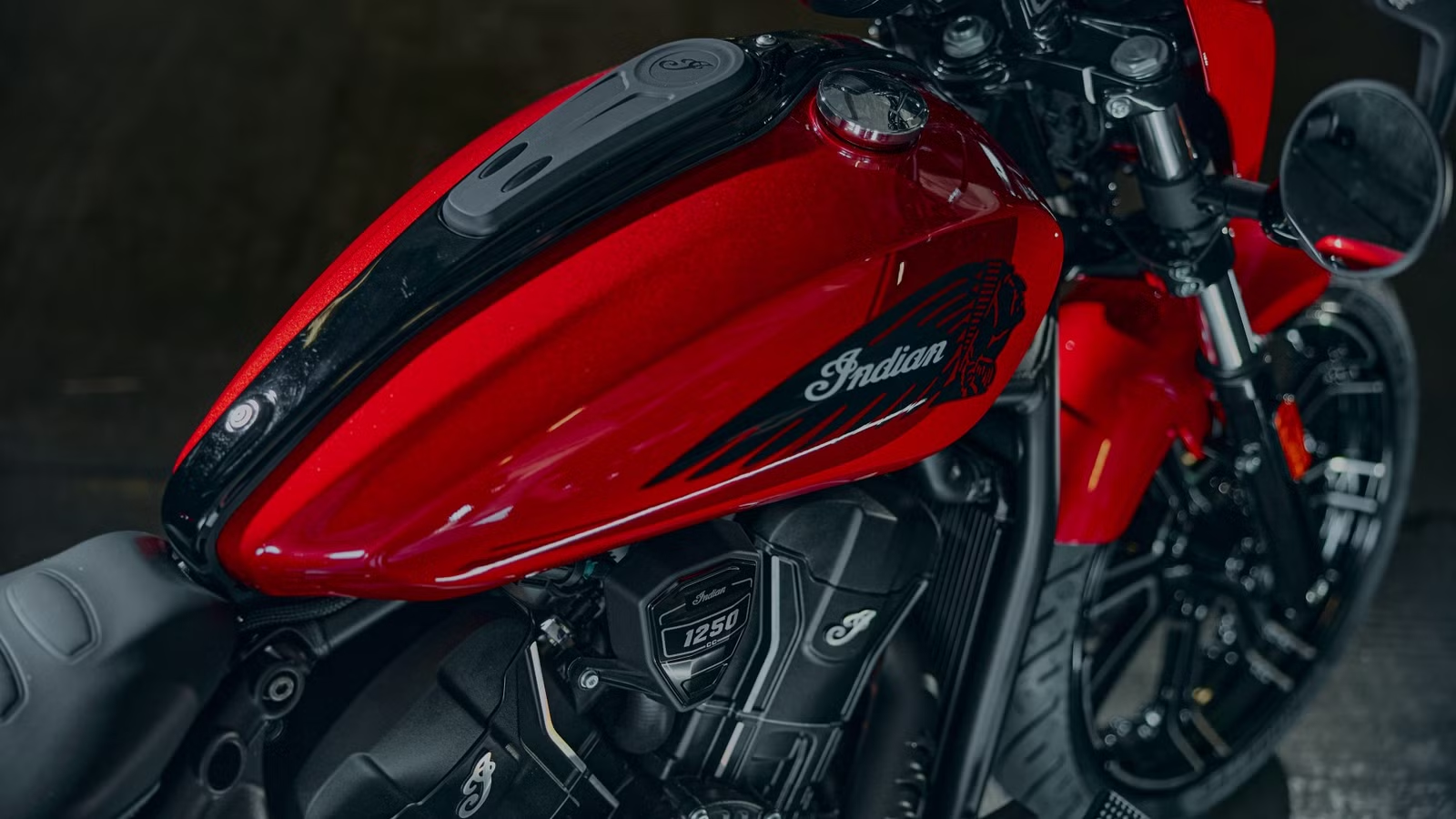
The SpeedPlus 1250 is the newest engine on this list, but it is also the most promising. Doing duty on the Indian Scout Classic, this liquid-cooled V-twin produces 105 horsepower and 82 pound-feet of torque. Now, this engine doesn’t have a long history behind it. In fact, it is just about two years old now, but there is one thing that shouldn’t go unnoticed: Indian Motorcycle recommends a service interval of 10,000 miles. While most brands recommend an 8,000-mile servicing schedule, this longer maintenance interval likely suggests usage of better components, improved materials, and even higher tolerances.
The Indian Scout Classic competes with the Harley-Davidson Nightster and Triumph Bonneville Bobber. While H-D already has its own legacy, the Nightster’s performance isn’t as good as the Scout's. Its service interval is also a lot shorter. The Bonneville Bobber, on the other hand, is a little different. Despite a similarly sized engine, it produces less power but a massive amount of torque. So there is a difference in riding dynamics and styling you might want to consider here, because even the maintenance schedule is similar to the Scout Classic.
When Indian introduced the PowerPlus 108 engine back in 2020, it marked a significant milestone. While it wasn’t the first liquid-cooled power plant in Indian’s lineup, it was their first liquid-cooled big twin. Producing 122 horsepower and 128 pound-feet of torque, this bike has a few years to its name. Owners mostly praise the bike’s durability, and so far, there aren’t many cases of catastrophic mechanical failures. The Indian Challenger is marketed as a performance bagger, and it lives up to that reputation because of the kind of engineering that went into making this engine.
Rivals for the Indian Challenger include the likes of the Harley-Davidson Road Glide and Street Glide. They feature bigger engines but lower power figures. Harley also still runs traditional air-cooled setups for all of their big touring bikes, and that’s where the Indian Challenger’s advantage lies. Better cooling and engineering of liquid-cooled engines mean components remain at stable operating temperatures for longer periods of time.
A road sofa with a rocket’s heart, this tourer turns long miles into easy memories, where speed hums softly and comfort never clocks out.
The Indian Pursuit is essentially the Challenger but with a top box. Like the Challenger, it also gets two engine options. For the Challenger, we went with the smaller PowerPlus 108 because of its already proven reliability. On the Pursuit, we chose the PowerPlus 112 option. This is a new engine, even when compared to the SpeedPlus 1250 we already spoke about. However, it is built on the PowerPlus 108’s platform, which means reliability and longevity are already baked into the mix.
Like the Challenger, the Pursuit also competes with Harley-Davidson Road Glide and Street Glide in their 'Limited' variations or even 'CVO' Limited variations. Same story here again. Bigger air-cooled engines, but smaller power figures and similar torque numbers. The Indian Pursuit takes the cake here because of the modern liquid-cooled engine. This gives it tighter temperature control, allowing for consistent performance regardless of weather, traffic, or even terrain.
Found an error? Send it info@www.topspeed.com so it can be corrected.
Source: https://www.topspeed.com/indian-motorcycles-outlast-competition/
Cars
5 Indian Motorcycles That Outlast The Competition
Article Top Ad Zone
Article Middle Ad Zone
Article Bottom Ad Zone
Original Source: www.topspeed.com
Share
Comments
Comment system is currently disabled.