Citroën’s confirmation that a new affordable electric city car inspired by the legendary 2CV is on the way immediately raised one question: can an EV truly honor the philosophy of a car that famously weighed less than 500 kilograms?
Follow and Like top authors, topics, and trends
Browse with fewer ads across the site
Personalize your profile to showcase your activity
Get a content feed tailored to your interests
By creating an account, you agree to our Terms of Use and Privacy Policy. You also agree to receive our newsletters; you can unsubscribe any time.
*Required: 8 chars, 1 capital letter, 1 number
That makes Citroën’s promise especially ambitious. The real challenge isn’t whether the new car looks like a 2CV. It’s whether it embraces the same philosophy of radical simplicity.
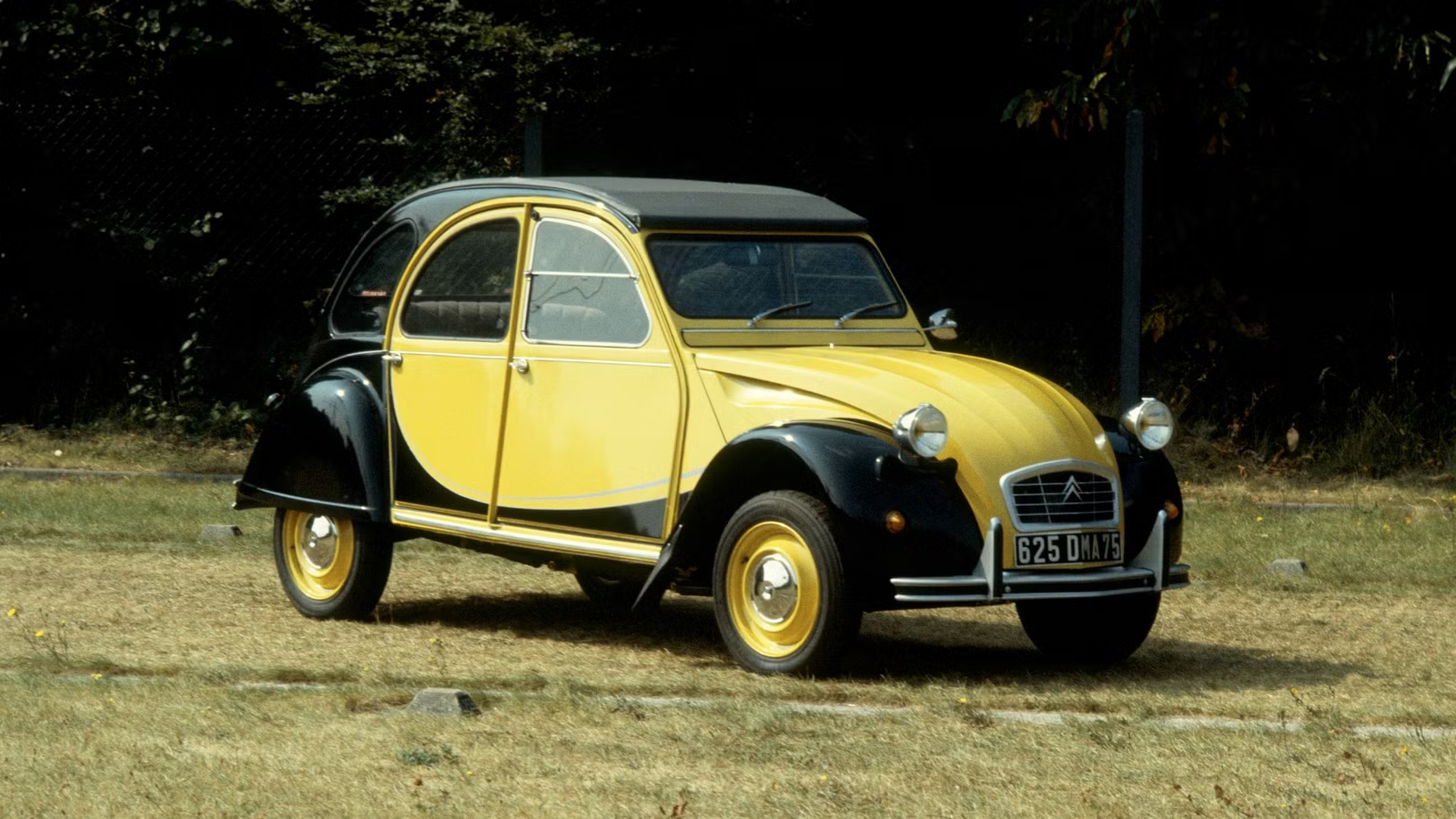
The 2CV was designed around an incredibly basic brief: carry four people and some cargo cheaply and efficiently across rural France. To achieve that, Citroën engineers focused obsessively on weight reduction.
At launch, the 2CV weighed roughly 490 kilograms and used a tiny 375cc flat-twin engine producing just 9 horsepower. By modern standards, that sounds absurdly underpowered, but the car didn’t need more because it weighed almost nothing.
Every component reflected that thinking. The body panels were thin and simple. The roof was made of roll-back canvas instead of steel. The seats were little more than fabric slings stretched over tubular frames. Even the suspension was engineered to minimize unnecessary mass while maximizing comfort on rough roads.
The brilliance of the 2CV came from what engineers now call a reverse weight spiral. A lighter car needs less power. Less power requires a smaller engine. A smaller engine needs less cooling and structural support, which further reduces weight. The entire design reinforced itself.
That philosophy is far harder to replicate in the EV era.
The biggest obstacle isn’t simply battery chemistry—it's modern vehicle structure.
A battery pack isn’t just a collection of cells. It also includes thermal management systems, structural protection, monitoring electronics, and reinforced mounting points integrated into the vehicle floor. Even compact EV battery packs can weigh 250 to 400 kilograms on their own.
Then there are crash regulations. The original 2CV came from an era before modern crumple zones, side-impact testing, and roof-strength requirements. Today’s safety standards require reinforced pillars, door beams, and complex structural engineering that inevitably adds weight.
That’s why even relatively small electric cars often weigh well over 1,300 kilograms. Citroën’s own Ami proves a sub-500-kilogram EV is technically possible, but only because it’s classified as a quadricycle rather than a full passenger car. It’s limited to low speeds and exempt from full crash-testing standards.
A true 2CV successor — one capable of highway driving and carrying four passengers safely — simply cannot weigh 500 kilograms under current regulations.
The more realistic target for a modern electric 2CV probably falls between 750 and 900 kilograms. That would still make it dramatically lighter than most EVs on sale today.
To get there, Citroën would need to embrace genuine minimalism. That means a small battery pack, likely around 20 to 30 kWh, prioritizing affordability and efficiency over massive range numbers. It would also mean aggressively cutting unnecessary features.
No oversized infotainment display. Minimal sound insulation. Lightweight seating. Fewer electronic luxuries. In other words, the same ruthless focus on necessity that defined the original 2CV.
Battery chemistry also matters. Lithium iron phosphate (LFP) batteries make the most sense for a vehicle like this. They’re cheaper, more durable, and thermally stable, even if they sacrifice some energy density compared to premium EV battery chemistries.
A smaller LFP battery delivering around 150 to 200 kilometers of real-world range would align closely with the original 2CV’s philosophy: give people exactly what they need, not more.
The engineering challenge is significant, but the bigger obstacle may be market expectations.
Modern buyers have become accustomed to judging EVs by maximum range, giant touchscreens, and feature lists. A genuinely lightweight EV would deliberately reject many of those priorities. Every feature added — larger batteries, premium audio systems, powered seats — increases weight and cost.
That’s exactly the trap Citroën must avoid.
The original 2CV succeeded because it ignored conventional expectations and focused entirely on practical transportation. It was mocked when it debuted in 1948, yet it went on to sell millions because it delivered precisely what its buyers needed.
If Citroën can resist the urge to overcomplicate this revival, the new electric 2CV could become one of the most interesting small EVs in years. But if it arrives overloaded with luxury features and excessive weight, it risks becoming little more than retro-inspired styling wrapped around the same compromises every other EV already makes.
Source: https://www.topspeed.com/2cv-weighed-500kg-can-citroen-electric-revival-actually-honor-that-legacy/
Citroen 2CV
The 2CV Weighed 500kg. Can Citroën’s Electric Revival Actually Honor That Legacy?
Article Top Ad Zone
Article Middle Ad Zone
Article Bottom Ad Zone
Original Source: www.topspeed.com
Share
Comments
Comment system is currently disabled.