Stellantis announced this week a partnership with British AI company Wayve to bring a Level 2++ hands-free driving system to its vehicles by 2028 — and the headline claim isn't just another highway-assist feature. The system is designed to operate on city streets as well as highways, targeting what the companies call door-to-door supervised automated driving. That city-capable piece is the real differentiator, and it's worth unpacking what it actually means.
Follow and Like top authors, topics, and trends
Browse with fewer ads across the site
Personalize your profile to showcase your activity
Get a content feed tailored to your interests
By creating an account, you agree to our Terms of Use and Privacy Policy. You also agree to receive our newsletters; you can unsubscribe any time.
*Required: 8 chars, 1 capital letter, 1 number
It will be Ram's first midsize pickup since the last Dakota went six-feet under in 2011.
SAE Level 2 is the familiar baseline: the car handles steering and acceleration/braking simultaneously, but the driver must remain engaged and ready to take over at any moment. Level 2++ is an informal industry designation that sits above standard Level 2 but below Level 3—the car can manage hands-free operation in a defined set of conditions, including taking eyes off the road briefly in some implementations, but the driver is still legally and operationally responsible for monitoring the environment. Think of it as a meaningful step beyond Super Cruise or BlueCruise, not a leap to full autonomy.
The critical distinction here is the operating domain. GM's Super Cruise and Ford's BlueCruise are both highway-only systems that depend on pre-mapped roads—they work well on interstates and divided highways where the environment is relatively predictable, but they disengage the moment you exit onto surface streets. Stellantis and Wayve are targeting a system that stays active through city driving: traffic lights, intersections, pedestrians, and the general chaos of urban roads. If the 2028 rollout delivers on that promise, it would represent a genuine capability gap over the current competition.
Wayve is not a traditional Tier 1 automotive supplier. The London-based startup builds its autonomy stack around AI and camera-based perception rather than the high-definition map dependency that defines most current Level 2+ systems. That matters because HD-map systems are inherently limited by coverage — they only work where the map exists and has been validated. A vision-first AI approach, in theory, can generalize to roads it has never explicitly mapped, which is exactly what city driving requires.
By folding Wayve's software into the STLA AutoDrive platform, Stellantis is essentially betting that AI-driven perception can handle the unpredictability of urban environments better than rule-based, map-dependent systems. It's a similar philosophical direction to what Tesla has pursued with its neural-network approach, though Wayve's partnership model means the technology will deploy across Stellantis's full brand portfolio rather than a single marque.
Dodge officially confirms a new SRT sports car with a historic name and aggressive styling that targets the Mustang GTD.
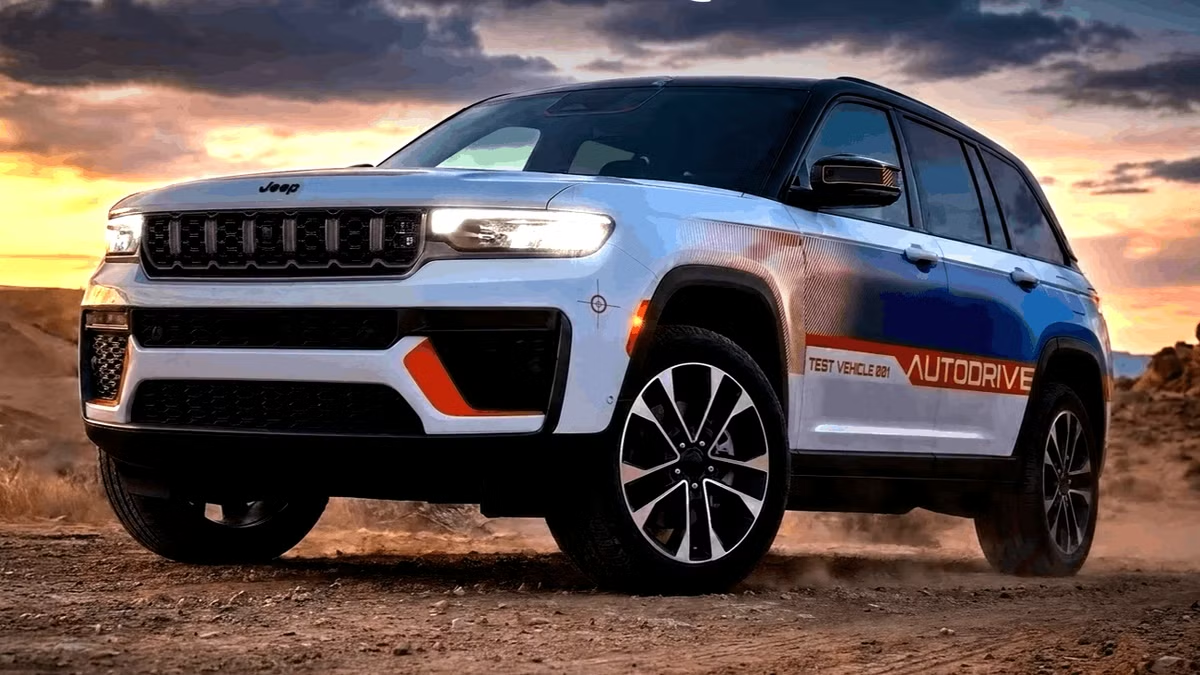
Stellantis hasn't published a confirmed model-by-model rollout list yet, but the STLA AutoDrive platform is already embedded in the brand's higher-volume, higher-trim vehicles. The Jeep Grand Cherokee and Ram 1500 are the most logical early candidates in North America—both sit at the top of their respective segments, both carry the technology content that supports advanced driver-assistance features, and both have the transaction prices that make a premium hands-free system commercially viable as either standard equipment or an option package. In Europe, the Peugeot 3008—recently relaunched as one of Stellantis's flagship technology showcases—is a reasonable inference for early adoption given its positioning as a tech-forward crossover.
The 2028 target gives Stellantis roughly two years to validate the system across real-world conditions. That timeline is aggressive for city-capable hands-free driving, but it's not implausible given that Wayve has been developing and testing its AI stack in dense urban environments, including London, for several years.
For drivers who've been waiting for hands-free capability that actually survives the commute home—not just the highway stretch in the middle—the Stellantis-Wayve system is the most concrete near-term answer on the table. Two years is close enough to matter. The question is whether city-capable Level 2++ in production trim performs as advertised, or whether the fine print shrinks the operating domain back toward the highway-only norm. That answer comes in 2028.
Source: https://www.topspeed.com/stellantis-hands-free-driving-city-streets-not-just-highways/
Cars
Stellantis Level 2++ Hands-Free Driving Coming to City Streets
Article Top Ad Zone
Article Middle Ad Zone
Article Bottom Ad Zone
Original Source: www.topspeed.com
Share
Comments
Comment system is currently disabled.