Three-row SUVs have become incredibly expensive. What was once a practical family purchase has slowly become a near-luxury expense, with many new SUVs comfortably pushing past the $50,000 mark before options even begin to stack up. And with manufacturers loading vehicles with larger screens, more driver assistance systems, and increasingly complex technology, prices continue to climb higher every year.
That’s exactly why the idea of buying brand-new is starting to lose its appeal. Take the 2027 Volkswagen Atlas, for example. It continues to position itself as one of the more spacious family SUVs on the market, offering strong practicality, modern technology, safety, and plenty of curb appeal. But as pricing continues to rise, buyers are beginning to ask an important question: Is buying new really worth it anymore?
Sitting quietly on the used market is another rival—a Japanese SUV that can go toe-to-toe with the Volkswagen Atlas while costing thousands less. And unlike many used family SUVs, this one still stands out as a premium choice several years later.
The modern SUV market has changed dramatically over the past few years. Three-row family SUVs were once positioned as attainable alternatives to luxury vehicles. Today, many mainstream models are priced dangerously close to premium territory. Once options, trim upgrades, and dealer markups come into play, the gap between mainstream and luxury becomes surprisingly small. The 2027 Volkswagen Atlas is a perfect example. Current Atlas pricing already stretches from roughly $40,000 for lower trims to over $55,000 for flagship SEL Premium variants.
Add panoramic sunroofs, premium audio systems, larger infotainment displays, and advanced driver-assistance features, and the final price rises quickly. And while the Atlas certainly delivers strong practicality and plenty of interior space, buying new also means absorbing the harshest part of depreciation almost immediately. That’s the part many buyers are beginning to reconsider.
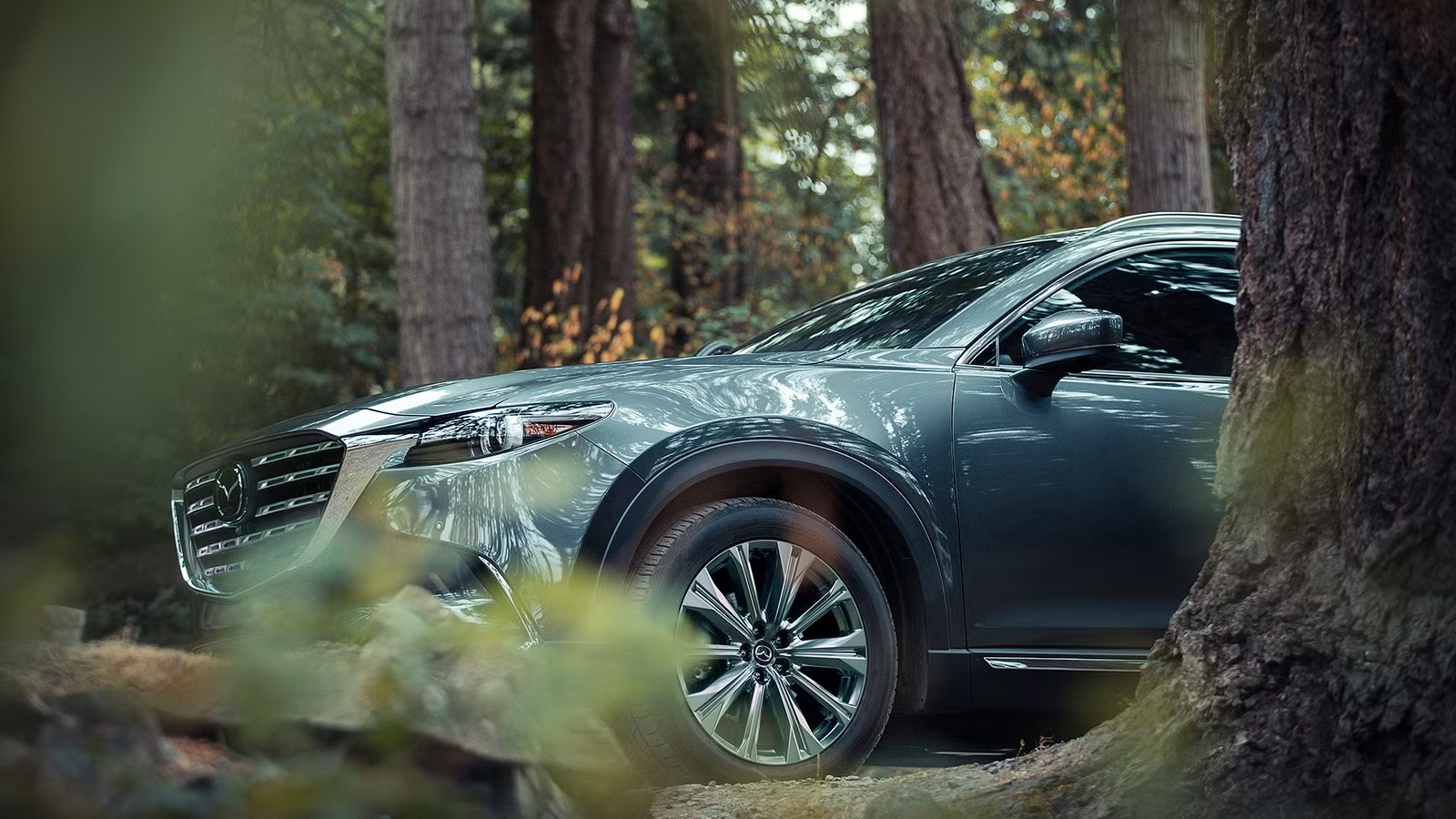
Instead of spending heavily on a brand-new SUV, the used market now offers something arguably more appealing: vehicles that have already taken their major depreciation hit while still delivering premium levels of refinement and comfort. That SUV is the Mazda CX-9.
The gap between mainstream and premium SUVs is shrinking, and this Mazda is leading the charge.
The Mazda CX-9 quietly became one of the most underrated three-row SUVs of the last decade. As automotive journalist Nigel Evans from CarBuzz notes, “Mazda was always pushing uphill in the conservative segment when trying to market its mainstream CX-9 for nearly luxury money.” And that was largely true. When new, higher-spec CX-9 models pushed deep into the $40,000 range, placing them dangerously close to entry-level luxury SUVs. For many buyers, that felt ambitious for a Mazda badge. But several years later, the used market has transformed the CX-9 into something far more compelling.
Clean 2019 to 2021 examples can now be found comfortably in the low-to-mid $20,000 range, while higher-mileage models occasionally dip below the $20,000 mark. Even newer 2023 examples still undercut many rivals from the same era. That dramatic depreciation is precisely what makes the CX-9 such an attractive buy today. Particularly in the 2021–2023 form, the CX-9 is still modern and relevant. The design remains elegant and understated, avoiding the overly aggressive styling that many modern SUVs lean into. Slim headlights, clean proportions, and Mazda’s signature grille give it a far more upscale appearance than its pricing now suggests.
The cabin combines soft-touch materials, layered dashboard designs, quality leather upholstery in higher trims, aluminium accents, and tasteful wood trim to create an interior atmosphere that is surprisingly close to that of entry-level luxury SUVs. In many ways, the CX-9 is like a near-luxury SUV hiding behind a mainstream badge.
Reliability also strengthens the CX-9’s appeal. While some competitors struggled with problematic transmissions or questionable electronics, the CX-9 built a fairly solid reputation for long-term durability, particularly in later model years. The Mazda CX-9 also performed reasonably well in J.D. Power dependability and reliability studies, especially in later model years. Recent J.D. Power scores include:
2023 Mazda CX-9: 80/100 overall consumer rating
2022 Mazda CX-9: 83/100 overall consumer rating
2021 Mazda CX-9: 79/100 Quality & Reliability score, 81/100 overall consumer rating
2020 Mazda CX-9: 77 overall consumer rating
2019 Mazda CX-9: 77/100 Quality & Reliability score
The Mazda CX-5 delivers BMW-like driving excitement at Honda-level prices, making it one of the most rewarding compact SUVs in its segment.
One of the biggest surprises about the CX-9 is just how complete the overall package is. Nigel Evans also praised the richness of the Mazda CX-9 Signature trim, noting that it delivers a level of interior quality rarely found elsewhere in a mainstream SUV.
Evans wrote that Mazda avoided the overly glossy, screen-heavy layouts that many competitors adopted during this era. Instead, the CX-9’s cabin feels clean, layered, and surprisingly mature several years later. For used-car money, buyers are still getting three-row practicality, strong technology, upscale interior quality, and a genuinely refined driving experience. Upper trims offer:
Mazda’s restraint has helped the interior age gracefully. And while the Atlas still offers slightly more third-row space and outright cargo capacity, the CX-9 counters with something equally important: quality. Even today, the CX-9 remains one of the most premium cabins in the mainstream three-row SUV segment.
The CX-90 succeeds the CX-9 as Mazda's next midsize CUV chapter and moves even further upmarket. Just be ready to pay for it.
Under the hood, the CX-9 uses Mazda’s turbocharged 2.5-liter Skyactiv-G four-cylinder engine. Producing up to 250 horsepower and 320 pound-feet of torque on premium fuel. It’s paired with a six-speed automatic gearbox that remains well regarded for its smoothness and predictability.
Evans further adds that the CX-9 delivers “a nice mid-range surge that some other naturally aspirated V6 rivals couldn’t match.” But what really separates the CX-9 from many rivals is how it drives. Evans also observed that while most three-row SUVs feel competent, many lack genuine steering feel or composure. The CX-9, however, feels noticeably more tied together. Body roll is controlled without ruining ride comfort, while the steering feels deliberate and surprisingly precise for a large family SUV.
The differences may appear subtle on paper, but reviewers have often highlighted how composed the CX-9 feels compared to softer-driving competitors. The Atlas prioritizes outright space and comfort. It’s larger and more focused on practicality. And to its credit, it excels in that role. But the CX-9 is more polished overall. Fuel economy is respectable for the segment, with all-wheel-drive models typically returning combined fuel economy in the low 20s MPG.
Are you looking for a large SUV that won't break a tight budget? Here are 10 big options with small used prices.
The biggest advantage the CX-9 has today isn’t just its design, refinement, or driving experience — it's value. When new, a fully loaded CX-9 Signature costs close to $47,000. Today, many of those same vehicles can be found in the high-$19,000 to low-$20,000 range, depending on mileage and condition.
That’s a substantial depreciation swing in a relatively short period of time. And while depreciation often hurts new-car buyers, it creates tremendous opportunities on the used market. Compared to similarly aged rivals like the Toyota Highlander, the CX-9 often costs thousands less while still delivering premium materials, strong driving dynamics, and modern technology.
In many ways, as Nigel Evans suggests, the market may finally be pricing the CX-9 correctly. Mazda ultimately replaced the CX-9 with the newer Mazda CX-90 in 2023, meaning there are only a finite number of CX-9s left on the market. And because depreciation has erased much of the original price penalty while leaving the substance intact, the CX-9 has quietly become one of the smartest used-SUV buys available today.
It’s practical without feeling oversized. Premium without becoming unaffordable. And refined without sacrificing usability. For families looking to maximize value without sacrificing quality, the CX-9 makes an incredibly convincing argument—especially before the next wave of increasingly expensive new SUVs arrives at dealerships.
Found an error? Send it info@www.topspeed.com so it can be corrected.
Sources: J.D. Power, Consumer Reports, Mazda USA, Kelly Blue Book, The EPA
Source: https://www.topspeed.com/three-row-suv-buy-used-before-vw-atlas/
BMW
Mazda CX-9: The Underrated Used SUV That Beats New VW Atlas in Value
Article Top Ad Zone
Article Middle Ad Zone
Article Bottom Ad Zone
Original Source: www.topspeed.com
Share
Comments
Comment system is currently disabled.