Off-road riding demands long-travel suspension, high ground clearance, and an engine that delivers usable torque at low speeds rather than peak power at the top end. A purpose-built off-road machine handles all of that precisely, but tends to be impractical everywhere else. Oh, and let’s not forget the race-spec maintenance intervals (usually in hours instead of miles) and no provision for street legality.
So what do you do as a rider who wants one machine for both worlds? You inherently face a compromise. One that comes with engineering a motorcycle with capable off-road hardware that demands regular workshop attention, or a simpler machine that keeps costs down but runs out of ability the moment the trail turns serious. The dual-sport category exists to navigate between those two requirements with minimal compromise and offer bikes with a good balance of power and practicality.
Service interval is the first criterion that experienced dual-sport riders return to when considering a platform for long-term ownership. Dual-sports have historically been based on dirt-bike origins, and the more performance-oriented ones require maintenance measured in hours of operation. Yes, they’re known for their infallible toughness.
But a bike that’s used year-round, alternating between trail weekends and weekday commutes, accumulates hours faster than a machine kept for seasonal or sport use. An oil change interval calibrated to street-bike standards and low-friction ownership experience is essential in the dual-sport world. Take, for instance, the Honda CRF450RL, which is a capable on-off-road machine, but it’s more of a street-legal race bike that’ll require more frequent maintenance.
Parts accessibility follows from there. A platform with a decade or more of production history carries an ecosystem of common wear items at predictable prices through mainstream dealer networks. And the more analog these machines are, the better they last over thousands of worry-free miles.
Then comes suspension capability as the third variable, and it separates the dual-sport category from everything adjacent to it. Ten inches of front travel on a purpose-built trail chassis behaves differently on an adventure bike's taller, heavier platform. And the last criterion is power delivery. A dual-sport that runs out of torque below 6,000 rpm forces constant gearwork on trail sections where the rider’s attention belongs on the terrain.
These are the coolest things about buying and owning a dual sport motorcycle
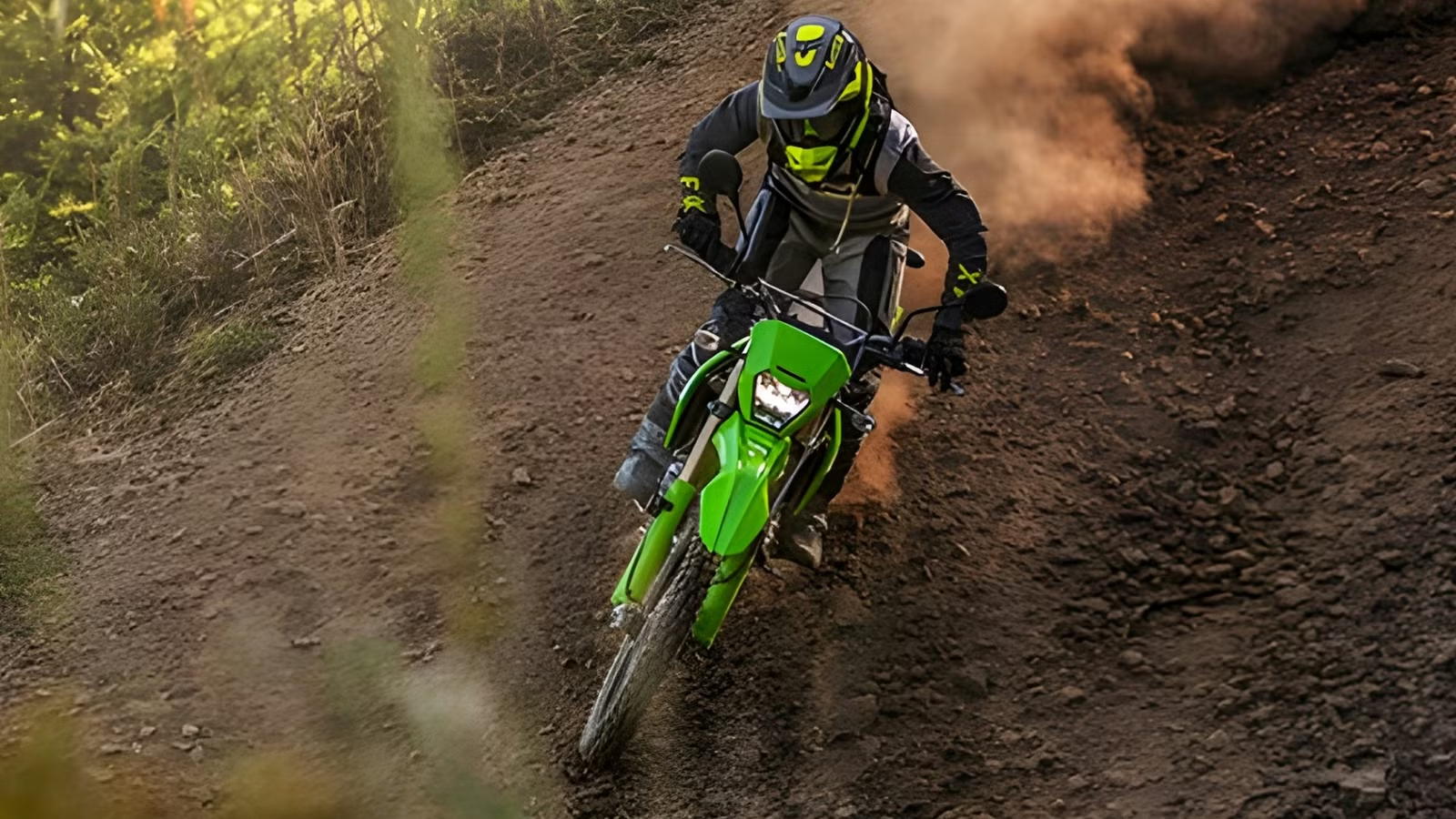
Enter the Kawasaki KLX300. First introduced in 2021, Kawasaki offered notable updates to the KLX300 platform in 2024. Drawing the engine from its enduro lineage rather than building a street single with trail aspirations, Kawasaki managed to produce one of the toughest dual-sport bikes for daily riding. Moreover, five model years of consistent production have built a parts and service network that extends to independent shops well outside the dealer network. At $5,649 for the Lime Green variant and $5,449 for the Bright White, the 2026 KLX300 sits $100 to $300 below the Honda CRF300L across comparable configurations, a margin that widens once suspension adjustability is factored into the comparison.
The 292cc DOHC liquid-cooled single runs a 34 mm Keihin throttle body through Kawasaki's digital fuel injection system, producing 25 horsepower at 8,000 rpm and 18.1 lb-ft of torque at 7,000 rpm. Those figures are at the segment average, but the architecture behind them is what the long-term ownership case rests on. Liquid cooling manages thermal cycling, which means heat buildup in stop-and-go traffic or at slow trail speeds stays within consistent operating parameters.
A wet multi-disc manual clutch feeds a six-speed gearbox with a return shift mechanism, keeping ratios accessible through technical sections. Kawasaki designed the engine around sustained, varied use rather than short competitive sessions followed by workshop teardowns. With no electronic aids, fewer intervention systems mean fewer components with failure potential, which is the reason the KLX platform has accumulated its reliability record across multiple generations of ownership.
That reliability record connects directly to the chassis that Kawasaki built around the engine. A slim, box-and-tubular-section high-tensile steel perimeter frame carries the engine as a stressed member, establishing a 26.7-degree rake angle over a 56.7-inch wheelbase. Ground clearance measures 10.8 inches, enough to clear technical terrain and features that would catch the undercarriage of a heavier adventure platform. And there’s even more for the rider who prefers the solitude of dirt riding over traffic-filled roads.
Suspension is where the KLX300 most clearly separates itself from similarly priced competition. The 43mm inverted cartridge-style front fork offers 10.0 inches of travel with adjustable compression damping, not just preload, which is uncommon at this price point. The rear Uni-Trak gas-charged shock delivers 9.1 inches of travel with adjustable compression damping, rebound damping, and spring preload, all done without specialized tools.
These dual-sport bikes take the ‘dual’ part seriously.
At 302 pounds curb weight, the chassis makes for less physical effort than the heavier dual-sports. The seat height measures 35.2 inches, consistent with a trail-biased chassis that prioritizes ground clearance. These are traits that would be appealing to the new trail rider, but Kawasaki's own buyer data shows the largest group purchasing the KLX300 is not beginners but experienced riders with approximately two decades of saddle time. That profile explains the bike's lightweight design priorities.
Furthermore, mid-mount footpegs position the rider in an upright stance that distributes weight evenly between the contact points, and a radiator fan directs hot air downward and away from the rider's legs, addressing one of the persistent complaints against liquid-cooled singles in slow-traffic conditions. However, the 2.1-gallon tank is the KLX300's clearest limitation for longer-distance use, keeping a practical range at roughly 80 to 100 miles before a fuel stop. Then again, for a rider using the bike primarily on trails with tarmac transitions rather than as a cross-state machine, that capacity is reasonably adequate.
With a 56.7-inch wheelbase and 10.8 inches of ground clearance, the KLX300 navigates narrow singletrack without the constant repositioning that wider, heavier dual-sports require. In fact, its abilities are even better than the new rider-friendly and accessible KLX230 Sherpa that’s just 2 pounds shy of the 300’s curb weight. The perimeter frame's lateral rigidity is said to hold a predictable line through loose corners without requiring active correction on exit, and the 21-inch front wheel rolls over obstacles with ease.
These 10 Dual-sports will outlive even their owners
The Honda CRF300L at $5,749 is the natural rival, sharing the same displacement class, the same six-speed layout, and a similarly trail-focused suspension spec with 10.2 inches of front travel. Where they diverge is in rear suspension adjustability. The CRF300L's Pro-Link rear shock offers preload adjustment only, against the KLX300's full three-axis rear adjustability.
The KTM 390 Enduro R at $6,049 raises the performance ceiling with a more powerful 399cc engine, ride modes, and a TFT instrument display, but its price reflects a different ownership proposition, one oriented toward maximum performance extraction over low-friction daily use. For the rider who is on the lookout for a budget dual-sport, the KLX300's simpler architecture, lower entry price, and range of suspension adjustability build an ownership experience that no amount of electronics at a higher price fully counters without drawbacks.
Found an error? Send it info@www.topspeed.com so it can be corrected.
Source: https://www.topspeed.com/dual-sport-with-reliability-simplicity-off-road-performance/
Cars
The Dual-Sport That Balances Reliability, Simplicity, And Off-Road Performance
Article Top Ad Zone
Article Middle Ad Zone
Article Bottom Ad Zone
Original Source: www.topspeed.com
Share
Comments
Comment system is currently disabled.