Compared to the other Japanese manufacturers, Suzuki arrived to the big-bore inline-four party relatively late. By the late 60s, Honda rolled out the game-changing CB750, and Kawasaki followed shortly after with the Z1 in 1972. The GS750 would only arrive four years later, in 1976.
Follow and Like top authors, topics, and trends
Browse with fewer ads across the site
Personalize your profile to showcase your activity
Get a content feed tailored to your interests
By creating an account, you agree to our Terms of Use and Privacy Policy. You also agree to receive our newsletters; you can unsubscribe any time.
*Required: 8 chars, 1 capital letter, 1 number
The CB750 was Genesis for the Universal Japanese Motorcycle, setting a new precedent upon arrival
With the benefit of hindsight, we all now know the pitfalls of the infamous Wankel rotary engine, but back in the early 70s, it looked like the future. It seemed especially well-suited to motorcycles, delivering an impressive power-to-weight ratio and almost no vibrations. From an engineering perspective, it seemed like an elegant solution, and Suzuki was not the only manufacturer that invested heavily in this doomed technology. The other Japanese manufacturers all had rotaries in various stages of development. Fatefully, only Suzuki was brave enough to put the RE-5 into full production.
While Suzuki cites “the oil shock of the autumn of 1973, increasing demand for more fuel-efficient models,” that was only one part of the story. While the poor fuel efficiency of rotaries is well documented, the fact that no manufacturer has ever been able to make these engines even slightly reliable is arguably more relevant. Apex seals failed regularly, and even while they worked, oil was still fed into the combustion chamber to lubricate them.
The design was also a little unconventional for the time, having enlisted famed automotive designer Giorgetto Giugiaro. It did not resonate with buyers, nor did its steep price tag. It turned into a huge financial disaster for the brand and only lasted one model year. Suzuki almost went bankrupt because of this one motorcycle, but it forced a rethink, and necessity is the mother of invention.
After the rotary debacle, another failure would almost certainly have been terminal. With all the other Japanese brands making money hand over fist with their various UJMs, Suzuki finally hopped on the bandwagon. When the GS750 came out, it wasn’t just the first big-bore inline-four; it was one of the first four-stroke motorcycles of any kind (along with the GS400) Suzuki had built in over two decades. With so little room for error, nothing was left to chance, and both of these motorcycles were completely overbuilt. Pricing was also competitive, and the formula that had already proven so effective for the other Japanese brands worked a treat once more.
The relatively simple DOHC air-cooled inline-four was not the only thing the GS750 had going for it. The other UJMs on the market had built a reputation for being fast and reliable, but were not known to handle particularly well. In fact, if anything, the opposite was true, with the Z1 in particular proving tricky to ride fast anywhere other than an arrow-straight bit of tarmac. The GS750 offered superior handling to the other UJMs of the era, and this was enough to set it apart from a decidedly similar-looking crowd. While it was not the only Suzuki that sold well in the late 70s, this indestructible inline-four certainly played its part in saving the brand from potential financial ruin.
This Suzuki comes with integrated side cases, a touring-focused fairing, a bi-directional quick-shifter, and several more premium features.
By the mid-80s, Suzuki was ready to try something a little different once again. Almost a decade of producing conservative, yet highly effective models had helped rebuild the company, but the only way to get ahead would be to offer something the other brands were not. A genuine race replica. While the old air-cooled DOHC inline-fours had proven to be rock solid, the decision was made to add oil-cooling to improve performance. While liquid-cooling was a more common solution, the weight that it would add was a concern. In an effort to maximize its 99 horsepower, which was ample for the time, weight was kept to a bare minimum. This necessitated the development of a lightweight aluminum chassis. Even by modern supersport standards, a dry weight of 395 pounds is pretty light.
The end result was what is widely regarded as the world’s first true sport bike. A motorcycle that was ready for track use straight from the factory, offering a full fairing, an aggressive riding position, and dynamic handling. It proved to be just as much of a game-changer as the CB750 was several years prior. Not only was it fast, but it was also reliable, largely thanks to the hard lessons the brand had already learned in the previous decade. The powertrain was a simple product of evolution; it didn’t require extensive development, yet delivered on its power targets.
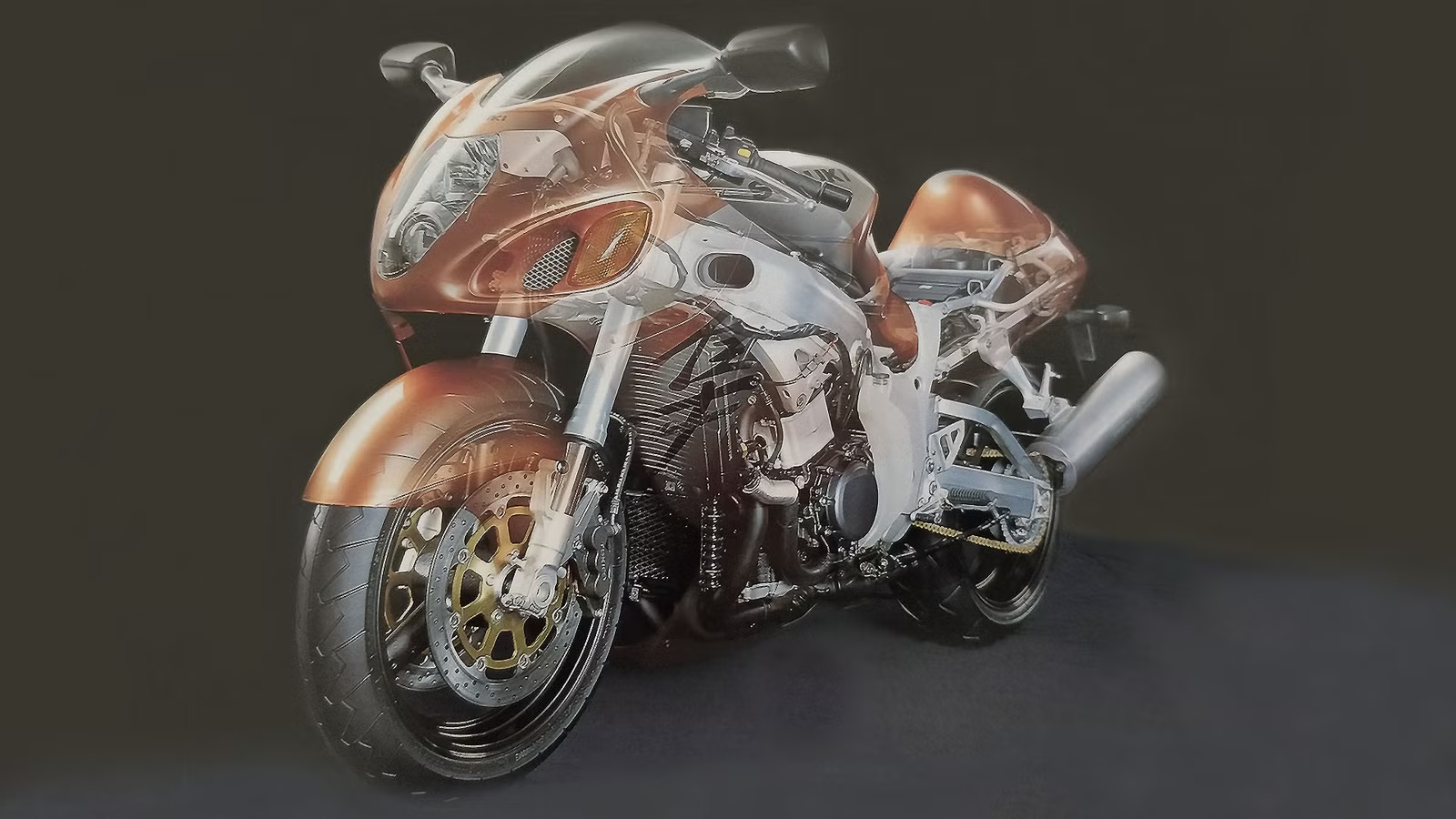
Towards the back end of the 90s, Suzuki changed the game once again. Few motorcycles are as distinctive as the Hayabusa, and no matter how ugly it might be, its distinctive looks have become a symbol of speed within the motorcycle industry. While the design was revolutionary, underneath the proverbial “hood” lay a robust, but otherwise unremarkable powertrain. By this time, Suzuki had long since moved towards liquid-cooling, and as much as fuel-injection was still uncommon back then, it wasn’t exactly unheard of. It was just a big, powerful inline-four that delivered the necessary power to claim the speed record, for what would turn out to be the final time.
Hayabusa is the name of a peregrine falcon indigenous to Japan. Famous for its ability to close in on its prey at 300 km/h, Hayabusa is truly an ultimate predator.
Over the years, this speed queen has won over legions of fans. With it being developed to handle the rigors of 200 MPH, everything is completely overbuilt for regular street use. Most bikes never actually get to do a proper top-speed run. Even for those who do, it will only happen a handful of times at most, unless it is converted into a drag bike. As a result, these engines stay metronomically reliable for literal decades, and are able to accumulate hundreds of thousands of miles.
Suzuki has since stagnated a little, but not before giving us a long line of other equally impressive inline-fours. The latest liter-bikes owe much of their lineage to the aforementioned GSX-R750, and the Hayabusa has made it into a third generation. None of these bikes reinvented the wheel. A simple process of evolution means that they are all built to last.
Found an error? Send it info@www.topspeed.com so it can be corrected.
Source: https://www.topspeed.com/why-suzuki-inline-fours-are-indestructible/
Cars
Why Suzuki Inline-Fours Are Practically Indestructible
Article Top Ad Zone
Article Middle Ad Zone
Article Bottom Ad Zone
Original Source: www.topspeed.com
Share
Comments
Comment system is currently disabled.