Every few years, automakers release a special edition model of one of their vehicles that sends the automotive world into a tizzy. Think early 2000s Ford Mustang SVT Cobra — nicknamed the "Terminator." It packed a 390-horsepower punch that made it supercharged power-wise for the time. Unfortunately, years later, you could find them on lots for around $30,000. They weren't the investment or rare crown jewel they originally hoped for.
Follow and Like top authors, topics, and trends
Browse with fewer ads across the site
Personalize your profile to showcase your activity
Get a content feed tailored to your interests
By creating an account, you agree to our Terms of Use and Privacy Policy. You also agree to receive our newsletters; you can unsubscribe any time.
*Required: 8 chars, 1 capital letter, 1 number
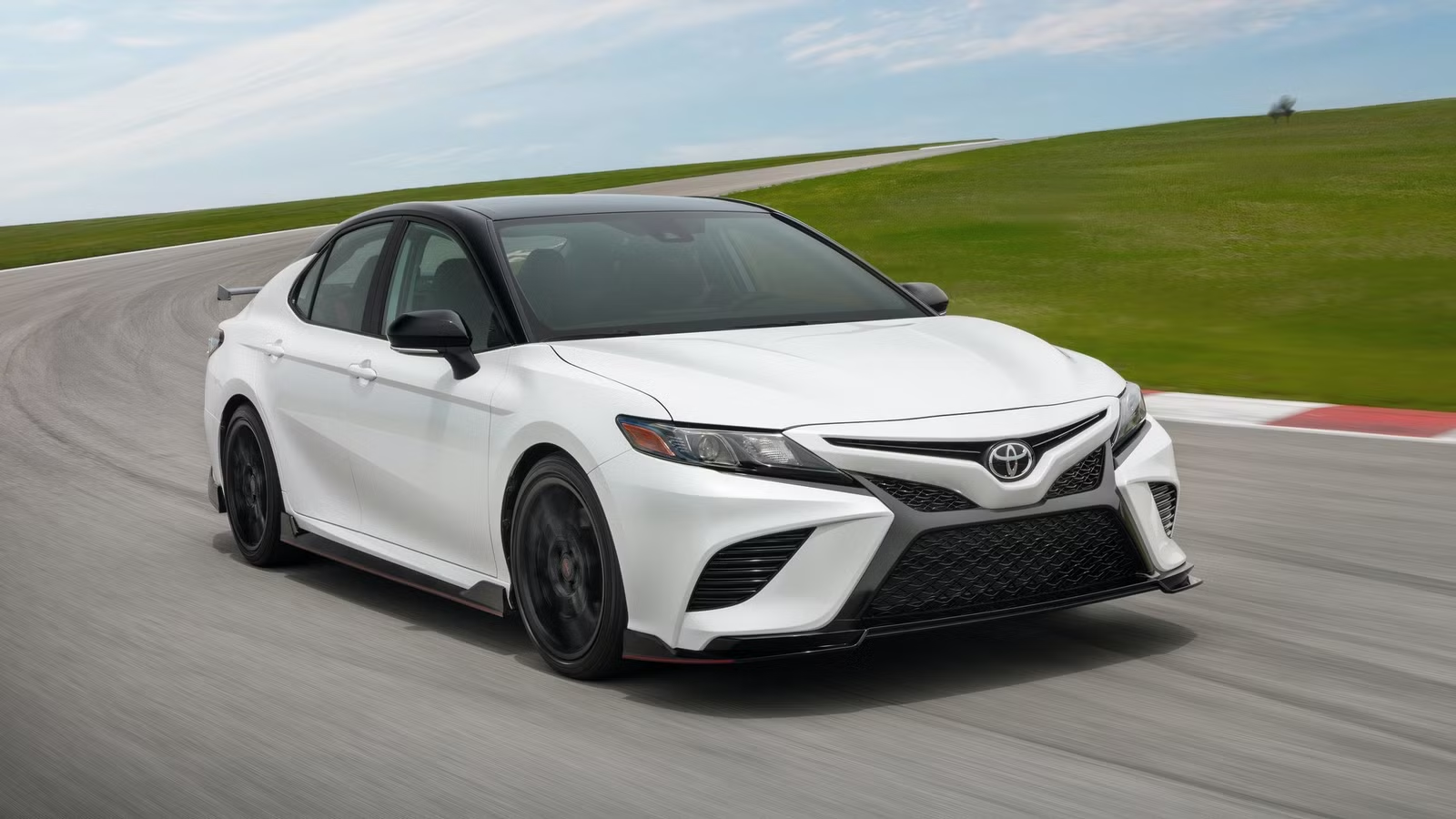
A sensible car turned near sleeper performance tuned pavement commander seems very on par for the American market. It just didn't seem likely for the most sensible car in the US. This is also not the first time Toyota has offered a TRD option for the Camry. From 1997 through 2000, Toyota offered an upgraded supercharger kit for the V6 models that bumped up the horsepower to an impressive 247. Then, in 2020, Toyota decided to turn the volume up to 11 itself with their special edition TRD Camry. We think it makes sense for the way this generation (XV70) Camry looks, as it was by far the sportiest-looking Camry up until that point.
To be fair, calling a Camry boring is the farthest thing from an insult in Toyota's eyes. It's practical, it's reliable, it gets you where you have to go, and there are no frills or fuss — ostensibly, it is the textbook definition of an automobile. It also ages really well, no matter the generation. Toyota, however, recognized that there was a small group of buyers who wanted the sensibility aspect of their products coupled with the brute force that the V6 could be tuned to offer.
In terms of how trims are concerned, the TRD package didn't last very long. It only had a round for about four model years (from 2020 to 2024). Even though the ninth-generation Camry actually looks even sportier, it only runs on a hybrid powertrain that gets a slight bump in power with the all-wheel drive added on. Toyota is taking a page from Honda's book: Honda's not big on big engines and, as a result, Toyota is essentially phasing out large-displacement engines for the sake of sensible hybrid ones. This has left Toyota and TRD enthusiasts and the like, pining for these engines once again, even if it wasn't that long ago.
We may love a good turbo today, but they had to start somewhere - here are the first 10 production cars to boast a turbocharged engine under the hood.
Shopping for a Camry TRD right now might cast a wider net of pricing than you might first expect. On CARFAX, a used 2024 Camry TRD lists them from somewhere between $32,499 to close to $36,000. A 2022 Camry LE on the same site, but 110,000 miles, is going for $15,000. The average price of a reasonable Camry goes for around $20,000 to $25,000. Kelley Blue Book has determined that the dealer trade-in value is far less, at around $24,000 to $28,000, depending on its condition. These differences in price between private and trade-ins aren't a surprise to anyone. No matter what, though, it consistently outsells.
The deals are more or less going to be found in the older models, between 2020 and 2021. These have at least 60,000 miles or more on them and can be anywhere between $33,000 and $35,000. This is also dependent on add-on features like the navigation package, ventilated seats, etc. For the more expensive ones, these are going to be the 2024 models that have fewer miles and are closing in on $40,000. Act quickly, though, they're flying off dealer lots.
This just comes down to basic economics. The supply isn't there, but the demand is high. It's a sportier four-door mid-size sedan that has a good ride and a great reputation. Why wouldn't anyone who likes Toyotas and fast cars want something like this? Plus, there's no official word from Toyota on whether they'll be releasing any TRD Camrys for the newest generation any time soon, even though the newest iteration of the RAV4 has since received one with its update. When supply is fixed, and the demand stays steady, prices aren't going anywhere.
Camrys sold in the US are, more often than not, bought by people who have little to no interest in what the powertrain's output is. They want good gas mileage, reliability, and something that won't give or get them into trouble. The four-cylinder has done that for years. The TRD, on the other hand, was built for an entirely different clientele. The TRD Camry doesn't just look different with its aggressive body cladding and rear spoiler. It also sounds and drives like no other Camry has before.
The Camry TRD is in such a unique position because Toyota ripped out the V6 after eight generations of it in their most popular sedan. They have put the newest generation in sportier clothes, though. It's also their most powerful version of an engine that, even though it declined in popularity, was a good option to have alongside the 4-cylinder. Here's what makes the TRD's engine worth keeping in mind:
NA 3.5-liter V6 with dual injection
The engine alone should justify the price bump, but there's a smattering of other sport-tuned features that come equipped in the TRD Camry that make it worth the price. There's the TRD Cat back exhaust system that gives it a throatier vibrato, the TRD-tuned suspension that lowers it by 0.6 inches, including stiffer coil springs and sway bars that increase roll stiffness by 44% in the front and 67% in the back. The front and rear brakes are also upgraded to 12.9-inch rotors up front and 12.0-inch rotors in the back. The front features dual piston calipers, while the back features a single piston. Did you know there's also a forgotten Camry TRD?
This question ultimately comes down to a subjective assessment of the Camry TRD and begets another question: what are you buying it for? The engine is virtually the same. Here's how much a regular 5-year-old one costs. The major difference is in the body cladding and the way the suspension is tuned to handle fierce driving. If you're buying it to act like, say, a Dodge Charger Scat Pack or a Chrysler 300C SRT, then you might want to look elsewhere. If you want a cool-looking Camry that can actually keep up with the best of them from a handling standpoint, then go for it.
Ultimately, you are getting a much better car than, say, if you were to purchase the XSE Camry with the four-cylinder engine. It comes with a moaning CVT and has almost 100 fewer horsepower. That's not fun! You could also get the XSE with the V6 and have the same power as the TRD, but you wouldn't have the same corner carving capability, just the straight-line acceleration. They're possibly the most reliable car on the market, too. They also don't run that differently from a price perspective, so if you can stomach a rear spoiler, you can stomach the TRD.
What could be tricky with the TRD Camry is the cost of maintenance. Sure, it's going to end up being a reliable sports car, but the parts are going to end up being more expensive than the more pedestrian models. Tires for it alone could cost in the thousands, depending on what kind of tires you end up getting to replace. Not to mention, 12.9-inch rotors are huge and could be equally expensive. Thankfully, the V6 engine is the most reliable aspect of it. Hopefully, you can spot a high-quality one.
Found an error? Send it info@www.topspeed.com so it can be corrected.
Source: https://www.topspeed.com/how-much-toyota-camry-trd-worth-today/
Cars
Toyota Camry TRD Used Car Prices and Value Guide 2024
Article Top Ad Zone
Article Middle Ad Zone
Article Bottom Ad Zone
Original Source: www.topspeed.com
Share
Comments
Comment system is currently disabled.