Honda and Ducati have spent decades at opposite ends of the naked motorcycle market, staying true to their individual lineages. Ducati builds around the emotions of motorcycling, with its bikes donning edgy designs. Think of the years that the Ducati Monster has evolved, yet it retains the raw theme it has always been based on. And it's the riding experience of one that justifies a Ducati’s ownership costs.
Follow and Like top authors, topics, and trends
Browse with fewer ads across the site
Personalize your profile to showcase your activity
Get a content feed tailored to your interests
By creating an account, you agree to our Terms of Use and Privacy Policy. You also agree to receive our newsletters; you can unsubscribe any time.
*Required: 8 chars, 1 capital letter, 1 number
The Italian approach to a character-rich naked relies on two primary choices that have proven difficult to separate from one another in this price range. An exposed trellis frame handles lateral loads through triangulated tube geometry, keeping the chassis rigid without adding weight through wall thickness. A 90-degree V-twin eliminates counterbalancing masses, producing an engine that makes its mechanical state through sound and feel rather than silencing it away. And combined, these engineering choices produce a bike that responds sharply to a rider’s input.
Although Italian V-twins, built for character and feel, have carried heat management compromises, electrical gremlins, and warranted more than frequent workshop visits. The ownership economics have historically favored the Japanese, but manufacturers attempting to match the Italian characteristics at $10,000 or below have produced either heavier, uninteresting machines or parallel-twins that never earned the same comparison. The gap between what a Monster makes a rider feel and what a Honda costs a rider to own has remained stubbornly open.
Wanting both from a single motorcycle has historically meant an unwanted compromise or a significantly higher budget. Yet when Suzuki launched the SV650 in 1999, the brief was to build a machine that takes on the original Ducati Monster on its own terms, at a price and reliability standard that Honda would tip its hat to. Twenty-six years of continuous production since its inception suggests the attempt landed well and good.
The Suzuki naked that benefits from the last mover's advantage in perfecting the middleweight naked formula.
Suzuki identified that gap in 1999, by which time the Monster had already made the trellis-frame V-twin iconic, and chose not to pick a side. Rather than choosing between Italian flair and Japanese reliability, the SV650 borrowed the Monster's mechanical identity and Honda's service philosophy to build them into the same bike. Suzuki has kept that nameplate in continuous production ever since, a solid 26-year run that has made the SV650 iconic in its own right. The 2026 U.S.-spec SV650 ABS at a base MSRP of $8,149 puts it at the floor of the sub-$10,000 naked segment and answers the character-versus-cost question without making either priority secondary.
The 645cc DOHC engine runs a 90-degree bank angle between its cylinders. This geometry produces perfect primary balance without requiring additional rotating mass, keeping the engine narrow within the chassis. Ten-hole long-nose injectors on each throttle body improve fuel atomization for consistent combustion, while the Suzuki Dual Throttle Valve system uses servo-controlled secondary throttles to regulate intake charge at low rpm. Both cylinder heads run Dual Spark Technology, i.e., two plugs per cylinder.
Suzuki designs each piston through Finite Element Method analysis for optimal rigidity-to-weight ratio. It also fits resin-coated skirts and tinned sliding surfaces for long-service friction reduction, and uses L-shaped piston rings to cut blow-by gas further. All this helps build durability into the architecture from the get-go.
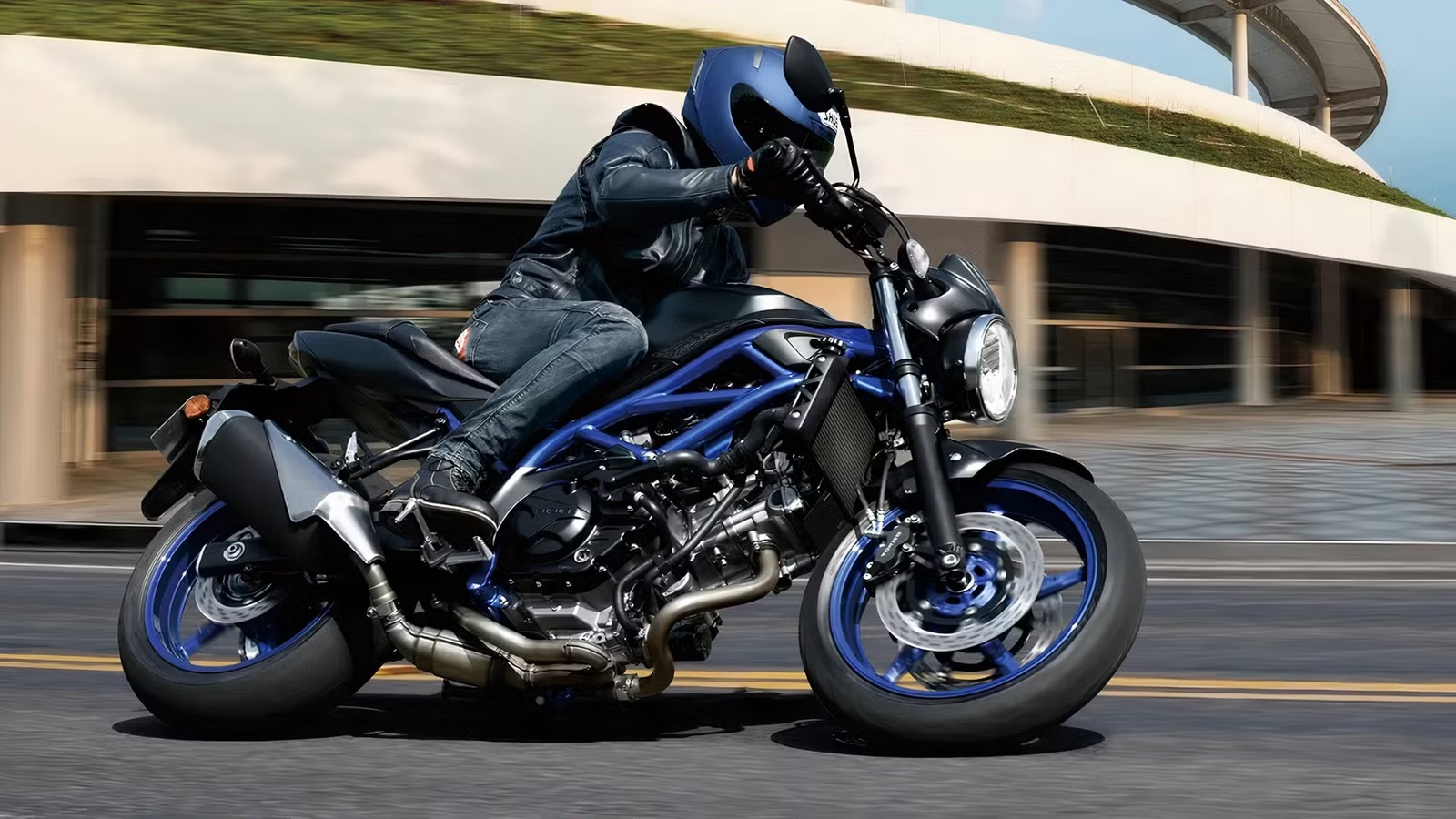
That engine sits inside an exposed trellis frame, finished in blue for 2026 alongside Pearl Vigor Blue bodywork and five-spoke cast-aluminum wheels. The trellis construction uses triangulated tube geometry to carry lateral loads, keeping sections thinner and chassis mass lower than pressed aluminum alternatives allow. At 437 pounds curb weight over a 56.9-inch wheelbase, the SV650 ABS should change direction without the hesitation that heavier machines produce at equivalent speed.
There’s no eye-catching single-sided swingarm here, but that keeps the costs in check while still keeping handling as a priority. The combination of low engine mass centralization and rigidity from the trellis translates handlebar input into lean angles with immediacy. Looks and handling prowess are just a couple of reasons that make the SV650 one of Suzuki’s best bikes ever.
The same frame and engine combination that produces the agile chassis behavior also determines how often the owner visits a shop for non-consumable work. Suzuki runs wet-sump lubrication, keeping the oil circuit simple and accessible to any independent shop without proprietary tooling. Liquid cooling manages thermal cycling across stop-and-go conditions, limiting the heat-driven seal and valve wear that an air-cooled counterpart accumulates over high-mileage ownership. To top things off, a 12-month limited warranty covers the purchase, with Suzuki Extended Protection available beyond that period.
The accessibility of components extends to the brake and suspension hardware. Up front, a 41mm fork with 4.9 inches of travel handles road compliance without softening the front end's directional feedback. Tokico calipers aren’t regarded the same as the likes of Brembo, but the units are dual 4-piston, clamping 290mm fully floating stainless-steel rotors, and along with ABS, they offer good stopping power. At the rear, a link-type single shock with a 2.5-inch stroke runs seven-stage spring preload adjustment, enough range to accommodate a pillion or luggage load without a spring change.
The most powerful motorcycle under $10,000 packs a four-cylinder engine that produces over 120 horsepower.
At $8,149, the SV650 has two direct challengers in the U.S. market. The 2026 Yamaha MT-07 costs $450 more and fits 41 mm inverted KYB forks with 5.1 inches of travel, radially-mounted 4-piston calipers and dual 298mm discs, and a TFT display with Y-Connect App connectivity. Yamaha Ride Control adds three preset throttle maps and switchable traction control, neither of which the SV650 has. And at 403 pounds wet, the MT-07 is 34 pounds lighter, too. But what it lacks is the feel and character of a V-twin. The MT-07's 689cc parallel-twin does produce competent linear power but has none of the grunt of the SV650's 90-degree V-twin below 4,000 rpm.
The 2026 Kawasaki Z650RS ABS at $8,999 is yet another bike riding the retro bandwagon, pairing a trellis frame like the SV650, but with a 649cc parallel-twin. The Z650RS adds a slipper clutch and a traction control system at its $850 premium, but like the MT, it lacks the character and purity that the SV brings with its V-twin. The MT-07 wins on electronics. The Z650RS wins on retro aesthetics. But the SV650 wins because of the reason most riders buy naked bikes for in the first place. At $8,149, the SV650 ABS asks less money for more soul.
Found an error? Send it info@www.topspeed.com so it can be corrected.
Source: https://www.topspeed.com/street-bike-honda-reliability-ducati-inspired-handling/
Cars
The Street Bike With Honda Reliability And Ducati-Inspired Handling
Article Top Ad Zone
Article Middle Ad Zone
Article Bottom Ad Zone
Original Source: www.topspeed.com
Share
Comments
Comment system is currently disabled.