Toyota is one of those brands that is synonymous with reliability and churning out cars, SUVs, and trucks that are likely to see high mileage. They are famous for conservative engineering, constant improvements, adding things that we actually need and aren't as complex as they could be, and generally, building them right the first time around.
Follow and Like top authors, topics, and trends
Browse with fewer ads across the site
Personalize your profile to showcase your activity
Get a content feed tailored to your interests
By creating an account, you agree to our Terms of Use and Privacy Policy. You also agree to receive our newsletters; you can unsubscribe any time.
*Required: 8 chars, 1 capital letter, 1 number
According to the 2026 U.S. Vehicle Dependability Study (VDS), Toyota currently experiences 185 problems per 100 (PP100) vehicles, while the market average is 204 PP100. They have dropped several places since last year, which saw them only experience 162 PP100, but their luxury arm, Lexus, is still at the top of the table with the fewest PP100 (151).
RepairPal also says that, overall, Toyota is rated 4 out of 5 for reliability, making it the eighth most reliable brand they monitor. They say that it will also only cost you, on average, $441 a year to maintain, making it somewhat cheaper than the market average of $652. So, in short, a lot of people and organizations applaud Toyota as a bulletproof brand.
Then there are the models that have seen hundreds of thousands and millions of miles. The highest mileage Toyota model is a 2008 Toyota Tacoma owned by a North Carolina driver. It has been verified that this Tacoma has been driven over 1.6 million miles, with 1.3 million miles driven on the original transmission, and all 1.6 million miles driven with the original engine.
Another owner, of a 1993 Corolla, has driven over 1.3 million miles with the original engine and transmission; a Prius was recorded back in 2024 with over 500,000 miles on the clock, and it is not unusual to see models like the Sequoia, Tacoma, Land Cruiser, and Tundra all hit 300,000+ miles routinely with simple maintenance.
While some may bemoan how modern vehicles are built and are not as reliable as the good old ones, there are still some 2026 Toyota models that are predicted to still see high mileage.
iSeeCars predicts that the two brands that are most likely to produce models that will see 250,000+ miles are Toyota and Lexus. They say that Lexus builds vehicles that are 12.8 percent likely to see 250,000+ miles, or 2.7 times more likely than the market average, while they say that Toyota builds vehicles 17.8 percent likely to see the same mileage, or 3.7 times the market average. The top Toyota cars, SUVs, hybrids, and trucks likely to see high mileage are as follows.
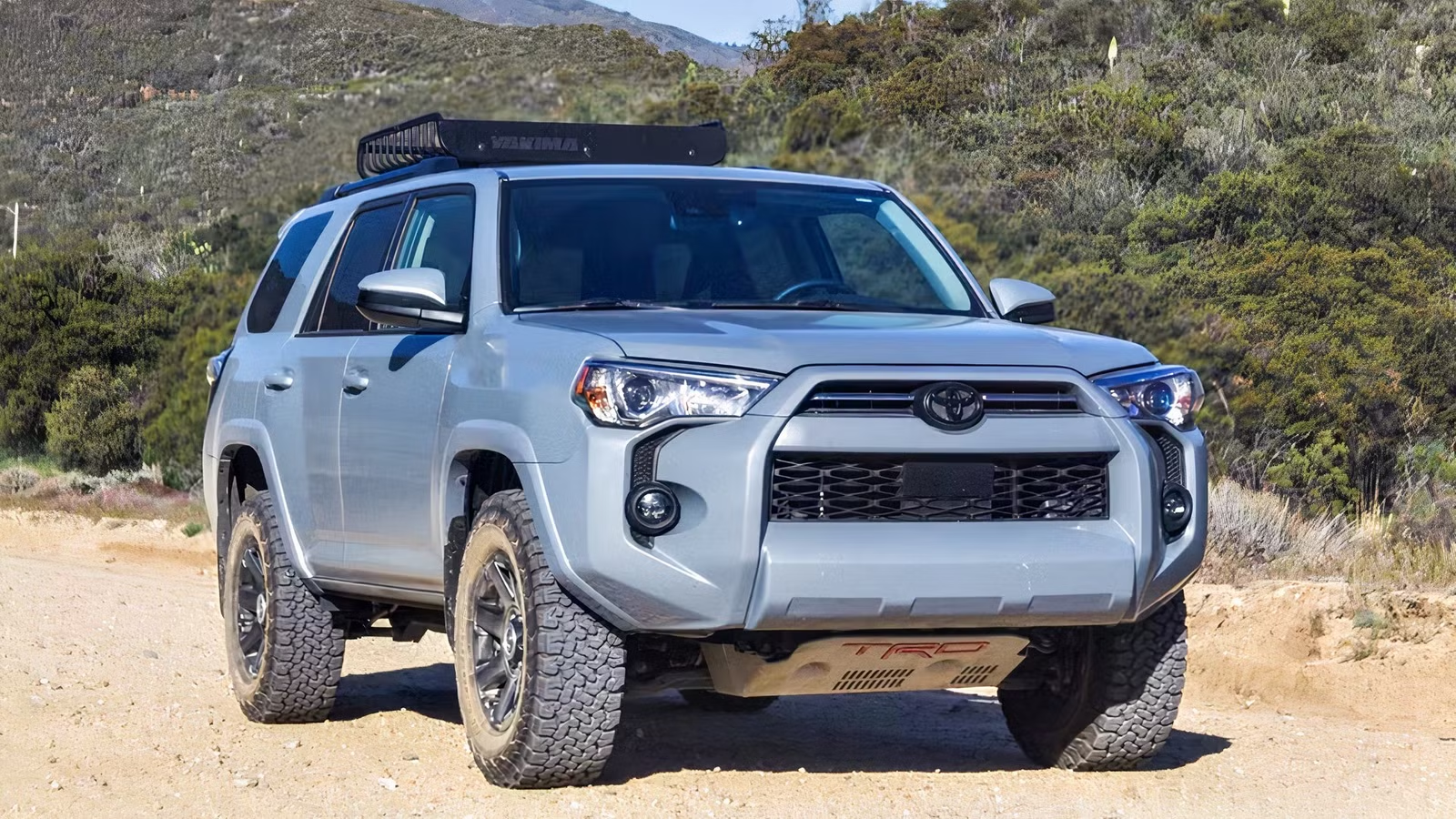
The 2026 Toyota 4Runner is available with two engine choices: a 2.4-liter i-FORCE MAX hybrid inline-four and a 2.4-liter i-FORCE inline-four. It is the non-hybrid engine choice that is predicted to last you the longest. The 4Runner is built on the proven TNGA-F platform; it has a simple eight-speed auto box; the inline-four is overbuilt with a beefy cooling system, forged internals, and dual injection, and, much like the older 4Runners, it is relatively mechanically simple.
The new Toyota Sequoia also boasts a hefty engine, this time a 3.4-liter bi-turbo i-FORCE MAX V6 good for 437 horsepower and 583 pound-feet of torque. Torque is delivered low at 2,400 rpm, so it keeps stress low; the Sequoia is built on a fully-boxed body-on-frame platform, and the i-FORCE MAX hybrid system that is used has been tested and tweaked over the years to make sure it works properly over the long run.
We all want a vehicle that can go the miles; these 10 SUVs boast solid reliability reputations and should see you good for 100s of thousands of miles.
As we have mentioned, RepairPal says that it will only cost just under $450 a year to maintain. Bear in mind, though, that this is an average. As vehicles get older, more will go wrong, regardless of what brand you buy from, and that will likely mean spending more money at the garage. Of course, the more you keep on top of basic maintenance like fluid changes, oil changes, plug changes, and filter changes, the higher the chance of keeping a vehicle going past 300,000 miles. However, it is still going to cost you some money, regardless.
J.D. Power says that the maintenance schedule for a Toyota model generally includes servicing at 5,000 miles or six months, 10,000 miles or 12 months, 15,000 miles or 18 months, 30,000 miles or 36 months, and 60,000 miles or 72 months. RepairPal gives estimates of how much each Toyota service will cost you, but with slightly different service intervals. They are as follows.
Over 150,000 miles for a Toyota, that comes to an average top-end servicing estimate of $6,983. For 300,000 miles, the average servicing cost estimate is $13,966. Bear in mind, though, this is just for servicing, so for jobs like brake changes, oil changes, fluid changes, air-con servicing, etc. If you need to replace parts, it can come to an awful amount more, depending on what part is needed.
CarEdge estimates that the average Toyota will cost $5,470 to maintain over 10 years, which, depending on how much you drive around the country, could be plenty of time to rack up 300,000 miles. That makes them, on average, $2,768 cheaper to maintain over 10 years than other automakers.
According to these CarEdge estimates, the cheapest Toyota models to maintain over 10 years are the Camry, the Corolla, the Prius, the bZ, and the Mirai, with estimates between $3,180 and $4,581. The outright cheapest is estimated to be the Mirai, which will cost you the lowest estimate.
It is worth noting, though, that the Mirai has only been available since 2016, so high-mileage models are few and far between compared to more established models like the Corolla, for which we have seen multiple 300,000-plus-mile models. It is estimated to cost you $4,199 over the first ten years of service to maintain a Corolla.
CarEdge also estimates that the most expensive Toyota models to maintain over 10 years are the Land Cruiser, the Sequoia, the Tacoma, and the Tundra. These models are the largest, heaviest, and most likely to be used for hard work; that means your servicing is likely to be a bit more expensive, and parts, if they need replacing, are likely to be more as well.
The most expensive Toyota model to maintain over 10 years is the Tundra, with an estimated cost of $7,226. Some model years of the Tundra are renowned for being reliable and tough companions. An owner named Victor Sheppard has successfully put over a million miles on two Tundra models, and while the likelihood of one seeing 250,000+ miles is high, it will also likely cost you the most out of any other Toyota model. RepairPal says that it will cost you, on average, $606 a year to maintain, but that is still cheaper than the market average.
They share common traits—straightforward engineering, abundant parts availability, and loyal owner communities.
In recent years, Toyota has not been the only brand turning out fuel-efficient models across its car, SUV, and truck lineups; everyone is aiming for it at the moment. However, many hybrid and non-hybrid models (there are still a few left) made by Toyota strike a good balance between efficiency and sturdiness.
Toyota is also one of the most affordable brands to insure per year, on average. According to CarEdge, the average yearly insurance cost for a Toyota model is $2,421. The cheapest is Chrysler, at $2,000, so Toyota is not that far behind.
The most fuel-efficient hybrid Toyota model you can buy in 2026 is the Prius. FuelEconomy.gov says that it can achieve 57 combined mpg (57 mpg city/56 highway) and will cost you $1,050 a year for gas. This means you could save up to $5,500 on gas over five years compared to the average modern vehicle. If we use this average, 10-year fuel costs would equal $10,500.
The most fuel-efficient plug-in hybrid Toyota model is the Prius PHEV SE, which FuelEconomy.gov says will achieve 127 MPGe and give you a tank range of 600 miles. They estimate that it will cost you $750 a year for gas and electricity, or savings of around $7,000 over five years. Over 10 years, this comes to $7,500 for gas and electricity.
According to FuelEconomy.gov, the two least fuel-efficient Toyota models this year are the Tacoma and the Sequoia. Despite the Tacoma being equipped with an inline-four and the Sequoia getting a V6, at their least efficient, they both achieve 20 combined mpg. It is estimated that the Tacoma will cost you $3,000 a year for gas, while the four-wheel-drive Sequoia will cost you $3,450. It is more expensive because it is recommended that you use premium gas. Over 10 years, this equates to $30,000 and $34,500, respectively.
We also have models like the 2026 Corolla Hybrid that can achieve 50 combined mpg, costing you $1,200 a year for gas; the Corolla hatchback achieves 35 combined mpg, costing you $1,700 a year, and the RAV4 Hybrid achieves 43 combined mpg, which will cost you $1,400 a year for gas. There are a good number of Toyota models this year that sip away at fuel, but it is worth noting that fuel economy tends to drop a bit over high miles, so while the numbers look good today, they are likely to decrease at 300,000 miles.
Not all 300,000-mile Toyotas are treated equally by insurance companies. A tired old Corolla is usually cheap, predictable transportation, while a lifted Tacoma or juiced-up Supra can trigger much higher premiums thanks to expensive repairs, theft risk, and accident statistics.
Even with Toyota's lineup, insurers look at models very differently. Hybrids like the Prius may benefit from their reliability reputation, but they also carry extra risk in areas where catalytic converter theft is still common. While an older Toyota's market value can help reduce costs, insurers know that high-mileage cars are more likely to need repairs after even small accidents.
Then there's your driving record, which matters just as much as the badge on the grille. A clean driving record, low annual mileage, and a stock vehicle can make rates surprisingly reasonable, even with six digits on the clock. When you start adding lift kits, oversized wheels, or performance modes, things get expensive.
The good thing about Toyota is that insurers generally trust them; parts are everywhere, repair shops know them inside and out, and Toyota's bulletproof reputation makes even a 300,000-mile model a little less risky than you'd think. Below are the most expensive and least expensive Toyota models to insure, as per CarEdge's average pricing estimates.
Looking for a reliable ride that goes the distance? Check out one of these high-mileage cars that worth a look even with many miles on the odometer.
The real answer to what it costs to own a 300,000-mile Toyota in 2026 is annoying: it depends on what model you buy, if servicing and maintenance have been upkept, and if a previous owner has treated it well. There's a big difference between a carefully maintained Camry with a folder full of service receipts and a neglected Tacoma that has spent its life towing, off-roading, and skipping oil changes.
At high mileage, condition matters more than the model. Even Toyota's famously durable drivetrains can become expensive if suspension components, cooling systems, transmissions, and seals have been ignored for years.
That said, though, there is a reason high-mileage Toyotas are still everywhere. Models like the Corolla, Prius, and RAV4 can often run for years with relatively predictable costs, especially compared to luxury rivals or heavily turbocharged models loaded with complicated electronics.
A Tundra, Sequoia, Land Cruiser, or 4Runner can absolutely chew through tires, brakes, suspension parts, and fuel once mileage climbs deep into six figures, but they also retain their value very well. CarEdge estimates consistently show models like the Tacoma, Land Cruiser, and 4Runner among the best vehicles for long-term resale value, which, if you want to sell them later on, offset some of the higher running costs.
A 300,000-mile Toyota is not always the cheapest vehicle to own outright, but it can still be one of the smartest. If the maintenance history is solid, and you stay ahead of preventive repairs, these cars, trucks, and SUVs can remain dependable daily drivers long after most vehicles are good for scrap. The Toyota badge carries a lot of weight for a reason. An owner review of a 2005 Camry on Kelley Blue Book sums it up nicely.
Found an error? Send it info@www.topspeed.com so it can be corrected.
This has been by far the best and most reliable car I have ever owned. I have 281,000 miles on it and still going strong. All features are still working. Just replaced the struts all around and have replaced the starter about every 100,000 miles. Fuel mileage runs around 32 mpg.
Sources: Toyota, RepairPal, CarEdge, Kelley Blue Book, iSeeCars, and J.D. Power.
Source: https://www.topspeed.com/costs-to-own-300000-mile-toyota/
Cars
How Much It Will Cost You To Own A 300,000-Mile Toyota In 2026
Article Top Ad Zone
Article Middle Ad Zone
Article Bottom Ad Zone
Original Source: www.topspeed.com
Share
Comments
Comment system is currently disabled.