For years, Toyota and Lexus occupied very different spaces in the motoring world. Toyota built its reputation on reliability, efficiency, and sensible transportation, while Lexus focused on refinement, quietness, and premium comfort. One brand appealed to practical buyers; the other catered to those wanting a luxury experience without the headaches often associated with European rivals.
Follow and Like top authors, topics, and trends
Browse with fewer ads across the site
Personalize your profile to showcase your activity
Get a content feed tailored to your interests
By creating an account, you agree to our Terms of Use and Privacy Policy. You also agree to receive our newsletters; you can unsubscribe any time.
*Required: 8 chars, 1 capital letter, 1 number
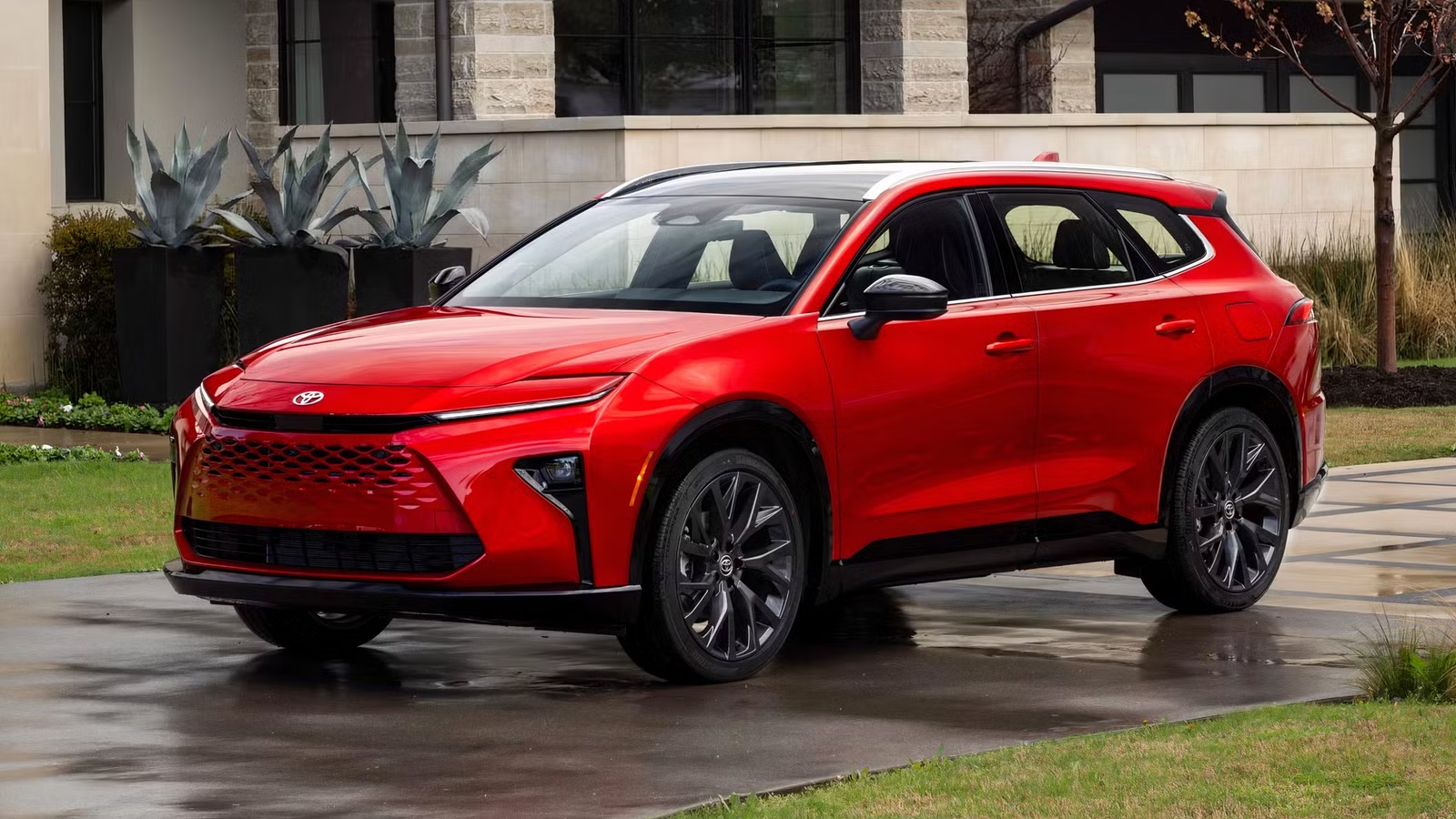
At first glance, the 2026 Toyota Crown Signia doesn't really look like a traditional Toyota SUV at all. It sits lower than a Highlander, avoids the rugged styling trends dominating the segment, and leans more heavily into sleek wagon-like proportions and understated luxury. And honestly, after spending time looking deeper into what Toyota has built here, the Crown Signia starts looking less like a normal crossover and more like a Lexus alternative hiding behind a Toyota badge.
Toyota has spent the last few years slowly moving parts of its lineup further upscale, and the Crown Signia may be the clearest example of that strategy yet. Positioned above many traditional Toyota crossovers, the 2026 Toyota Crown Signia effectively replaces the old Venza while also acting as a more premium and style-focused alternative to boxier SUVs like the Highlander or Grand Highlander. Unlike those larger family-oriented models, the Crown Signia is geared towards comfort and refinement rather than outright practicality.
Its shape immediately gives that away. The design sits somewhere between a wagon, crossover, and luxury touring vehicle. The roofline is sleeker, the body sits lower to the ground, and the proportions are more elegant than rugged. In many ways, it almost resembles something Volvo or Lexus might build, rather than a traditional Toyota SUV. Toyota also intentionally limited the lineup to two well-equipped trims: XLE and Limited. Even the base XLE arrives with:
wireless Apple CarPlay and Android Auto
That alone changes the perception of the vehicle. Instead of feeling like an entry-level crossover with a handful of optional luxury features, the Crown Signia has been geared to be premium from the start. The Limited trim pushes things even further with:
Pricing also reflects Toyota's more upscale ambitions. The 2026 Toyota Crown Signia starts at $44,490 and climbs to $50,485 depending on trim and equipment. That places it well above many traditional Toyota models and surprisingly close to entry-level luxury territory. And honestly, that positioning may initially sound slightly ambitious for a Toyota badge. But once you begin looking beneath the surface, the reasoning starts making far more sense.
This underdog redefines premium for Toyota, blending refined design, comfort, and intuitive tech to rival luxury SUVs like the Mercedes GLC.
The biggest reason the Crown Signia feels so Lexus-like is that much of its engineering philosophy overlaps heavily with Lexus products. The Crown Signia rides on Toyota's TNGA-K platform, which also underpins several Lexus and Toyota models that focus heavily on comfort and refinement. More importantly, the entire driving experience has clearly been tuned for smoothness and quietness rather than sportiness or excitement, according to reviews. Under the hood sits a naturally aspirated 2.5-liter four-cylinder hybrid powertrain paired with three electric motors and a continuously variable transmission.
Combined output stands at 240 horsepower and 178 lb-ft of torque from the hybrid system, while all-wheel drive comes standard across the lineup. On paper, those figures might not sound particularly exciting. TopSpeed contributor Max O’Neil described the Toyota Crown Signia as a smart balance between efficiency and everyday usability. He noted that the hybrid setup delivers “brisk acceleration,” while its “real party trick is efficiency,” achieving an impressive 36 MPG combined despite the vehicle’s size.
O’Neil also highlighted that the Crown Signia prioritizes fuel economy over outright power compared to the more expensive Lexus RX350h, while still offering “ample performance for everyday driving scenarios” and a respectable 2,700-pound towing capacity. The Crown Signia isn't trying to go head-to-head with sporty German rivals. Instead, Toyota focused on delivering a calm, relaxed, and highly efficient driving experience. According to Car and Driver testing, the Crown Signia reaches 60 mph in roughly seven seconds, which is perfectly respectable for a comfort-focused hybrid crossover.
What matters far more is how the vehicle behaves in everyday driving. Car and Driver noted that while the CVT can introduce some engine drone under heavier acceleration, the Crown Signia otherwise maintains a quiet and refined cruising demeanor. Efficiency is also a major strength, with EPA estimates rated at 39 mpg city, 37 mpg highway, and 38 mpg combined. Those are strong figures for a midsize all-wheel-drive crossover. And unlike many luxury SUVs chasing ever-larger horsepower figures, the Crown Signia is perfectly content, leaning into its calm, refined character. In many ways, that mindset feels very Lexus-like.
2.5L naturally aspirated hybrid inline-4 + 3 electric motors
Toyota has improved interior quality across much of its lineup recently, but the Crown Signia takes things a noticeable step further. The dashboard design appears clean and mature; there is very little excessive clutter, and many surfaces are padded or softly finished in ways that may genuinely surprise buyers expecting a more conventional Toyota cabin. Even Car and Driver noted the Crown Signia's wide front bucket seats, padded interior surfaces, and pleasant dashboard design.
O’Neil also added that while the interior may not rival a Rolls-Royce or Bentley, the Crown Signia still gives Lexus surprisingly close competition for the money. Physical controls are still present, while the dual 12.3-inch displays integrate cleanly into the dashboard without overwhelming the cabin.
Rear-seat passengers benefit from 37 inches of legroom, and Cargo practicality remains solid as well, with 25.8 cubic feet of luggage space behind the rear seats. This gives the Crown Signia a nice balance between wagon practicality and SUV versatility. Car and Driver managed to fit 10 carry-on suitcases behind the rear seats and 24 with the rear seats folded.
The Crown Signia doesn't scream luxury in the same way a Lexus RX might. Instead, it delivers a quieter and more understated premium experience focused heavily on comfort, long-distance refinement, and relaxed everyday usability. That subtlety is part of the appeal.
This hybrid SUV has not taken the market by storm and hasn’t presented itself to be a threat, but it has all the potential to disrupt the market.
Toyota’s long-standing hybrid reliability reputation also strengthens the ownership argument significantly. Hybrid systems across Toyota’s lineup have consistently developed strong reputations for long-term durability, while brands like Lexus have benefited heavily from that same engineering philosophy for years. J.D. Power reliability studies and Consumer Reports data have consistently ranked Toyota among the strongest mainstream automakers for dependability and owner satisfaction. Because the Toyota Crown Signia shares much of its engineering with Toyota’s proven hybrid systems, buyers can reasonably expect similar long-term reliability confidence here as well.
TopSpeed contributor Max O’Neil also noted that Toyota’s reliability reputation further strengthens the Crown Signia’s appeal. While the Lexus RX350h holds a slightly higher J.D. Power reliability score at 85/100 compared to the Crown Signia's 81/100, O'Neil pointed out that ownership costs are expected to favor Toyota. Projected ten-year maintenance costs are estimated at roughly $5,445 for the Crown Signia—around $2,400 less than the Lexus equivalent—thanks partly to Toyota's broader service network and lower servicing costs. Still, the vehicle isn't perfect.
Car and Driver noted that the CVT can introduce some engine drone under heavier acceleration, creating a slight disconnect between engine noise and outright performance. Likewise, Max O’Neil acknowledged that while the Crown Signia delivers ample everyday performance, it prioritizes fuel efficiency and refinement over outright sportiness.
Buyers seeking sharper handling or more aggressive acceleration may still gravitate toward alternatives like the BMW X3, Genesis GV70, or Mazda CX-70. However, those vehicles also sit in noticeably different price brackets, with many well-equipped BMW X3 and Genesis GV70 models pushing beyond $55,000, compared to the Toyota Crown Signia starting closer to $44,000.
But that isn't really the point of the Toyota Crown Signia. Its appeal lies in how effortless, quiet, and refined it is in daily driving, particularly during longer highway journeys and relaxed commuting situations.
The Toyota RAV4 Hybrid sets the standard for compact hybrid SUVs, but these often overlooked models beat the RAV4 in some key areas.
This is where the Crown Signia becomes interesting. While it might not fully replicate the experience of a Lexus RX, it quietly overlaps with it far more closely than many buyers might expect. The pricing gap alone is significant. A well-equipped Crown Signia lands in the mid-$40,000 range, while comparably equipped Lexus RX models can easily climb well beyond $55,000 or even $60,000, depending on trim and options. And yet, many of the qualities buyers associate with Lexus are already present in the Toyota: hybrid smoothness, quiet cruising manners, premium interior design, comfortable seating, strong reliability expectations, and relaxed long-distance refinement.
Ownership costs also remain more approachable. Toyota dealerships are everywhere, maintenance costs should remain lower than many luxury rivals, and insurance premiums will likely undercut equivalent Lexus models as well. Buyers also avoid some of the badge-driven pricing inflation that naturally accompanies luxury brands. This balance makes the Crown Signia feel unusually smart. It delivers much of the calm, refined, near-luxury experience many buyers actually want without fully stepping into luxury-brand pricing territory. And honestly, this might be exactly why the Crown Signia works so well.
Rather than trying too hard to reinvent Toyota's identity, the Crown Signia simply expands it. The result is a crossover that quietly blends Toyota reliability with many of the comfort-focused characteristics buyers traditionally associate with Lexus. And in today’s increasingly expensive SUV market, that combination feels more appealing than ever.
Found an error? Send it info@www.topspeed.com so it can be corrected.
Sources: TopSpeed, CarBuzz, J.D. Power, Consumer Reports
Source: https://www.topspeed.com/toyota-crown-signia-lexus-alternative-in-disguise/
BMW
2025 Toyota Crown Signia: A Premium Lexus Alternative
Article Top Ad Zone
Article Middle Ad Zone
Article Bottom Ad Zone
Original Source: www.topspeed.com
Share
Comments
Comment system is currently disabled.