When we look for a pickup truck, nine out of ten times, we want something that can tow, get muddy, and most importantly, keep on rolling for years. Models like the Toyota Tacoma have proved themselves worthy, with the highest-mileage model having over a million miles on the clock; the Ford F-150 is built using military-grade aluminum, and the Chevrolet C/K series laid the hardworking foundations for the Silverado.
Follow and Like top authors, topics, and trends
Browse with fewer ads across the site
Personalize your profile to showcase your activity
Get a content feed tailored to your interests
By creating an account, you agree to our Terms of Use and Privacy Policy. You also agree to receive our newsletters; you can unsubscribe any time.
*Required: 8 chars, 1 capital letter, 1 number
If you are looking at buying a truck for the work site, for off-road fun, for towing for years, and for road trips, the higher the chance of longevity, the more appealing they are. Older models like the 2005 Tacoma have a reputation for never stopping, with a 4.8 out of 5 Kelley Blue Book reliability rating; the 2014 Frontier is used to seeing over 200,000 miles; the second-gen Ram 2500 with a diesel engine routinely hits 500,000 miles, and the F-150 models with the 5.0-liter Coyote V8 are renowned for longevity.
From the 2024 and 2025 pickup truck markets, the most reliable models (according to J.D. Power) are the Nissan Frontier, the Chevrolet Silverado 1500, the Silverado 2500HD, the Ford F-250, the Toyota Tundra, and the GMC Sierra 1500. They have the following reliability ratings.
While not all trucks are reliable, they are inherently designed to be used in tougher scenarios than crossovers, some SUVs, and especially cars. Alongside the generally overbuilt design of trucks and higher-strength materials used, it is the engines that keep them rolling on.
Not all truck engines are made equal; engines like the 6.0-liter Ford Power Stroke diesel V8 are renowned for suffering from head gasket and fuel injection failures, while the GM L84 and L87 V8s have faced recalls for crankshaft and connecting rod issues. However, other engines will just keep going and going with proper maintenance.
The Cummins 5.9-liter turbo-diesel inline-six has a forged steel crankshaft, hardy connecting rods, and a deep-skirt cast iron block that provides exceptional bottom-end strength. It also has a gear-driven timing system, which eliminates timing chain stretch or belt failure, and its low redline and high torque output mean less internal stress over time. It isn't unusual to see these mills go after 500,000 miles, with well-looked-after examples pushing past 1,000,000 miles.
Another workhorse is the GM 6.0-liter Vortec V8. Built with a cast iron block with aluminum heads, it has a simple overhead valve design with fewer moving parts than DOHC engines. This reduces wear points and makes repairs simpler, while its conservative tuning allows it to handle heat, towing, and abuse. Models like the Silverado 2500HD regularly do 300,000 miles of hard work.
In recent years, especially with the rise of turbocharged engines and more complex powertrains, a lot of truck owners have said that they aren't made like they once were. Unfortunately for recent Tundra owners, the V6 option is disrupting Toyota's bulletproof reputation and putting some off prospective owners from a truck that was renowned for being bulletproof.
However, some newer pickup trucks (from the last six years) are still made to last the miles. We may not have seen many high-mileage numbers yet, but models like the 2020 to present Silverado 2500HD with the 6.6-liter Duramax L5P V8 and the 2020 to present Nissan Frontier with the 3.8-liter V6 under the hood have the right mechanical foundations to go the distance.
The V8 in the 2500HD has a deep-skirt cast iron block for rigidity, a forged steel crankshaft, and heavy-duty rods to handle pressure. It also has piston oil squirters and advanced cooling circuits to control heat when you are towing. You also get a variable geometry turbo that delivers smooth boost, while torque levels of between 910 and 975 pound-feet (year dependent) at 1,600 rpm keep low-end stress low.
The VQ38DD V6 under the hood of the Frontier is even simpler; it is naturally aspirated, which lowers heat and pressure compared to turbo engines, while an equipped timing chain instead of a belt means you don't have to change it out. Conservative tuning, a simple design, and VQ engine family heritage all point in the direction of a long life.
This engine family wasn't just a success; it changed the entire narrative of Japanese engineering forever.
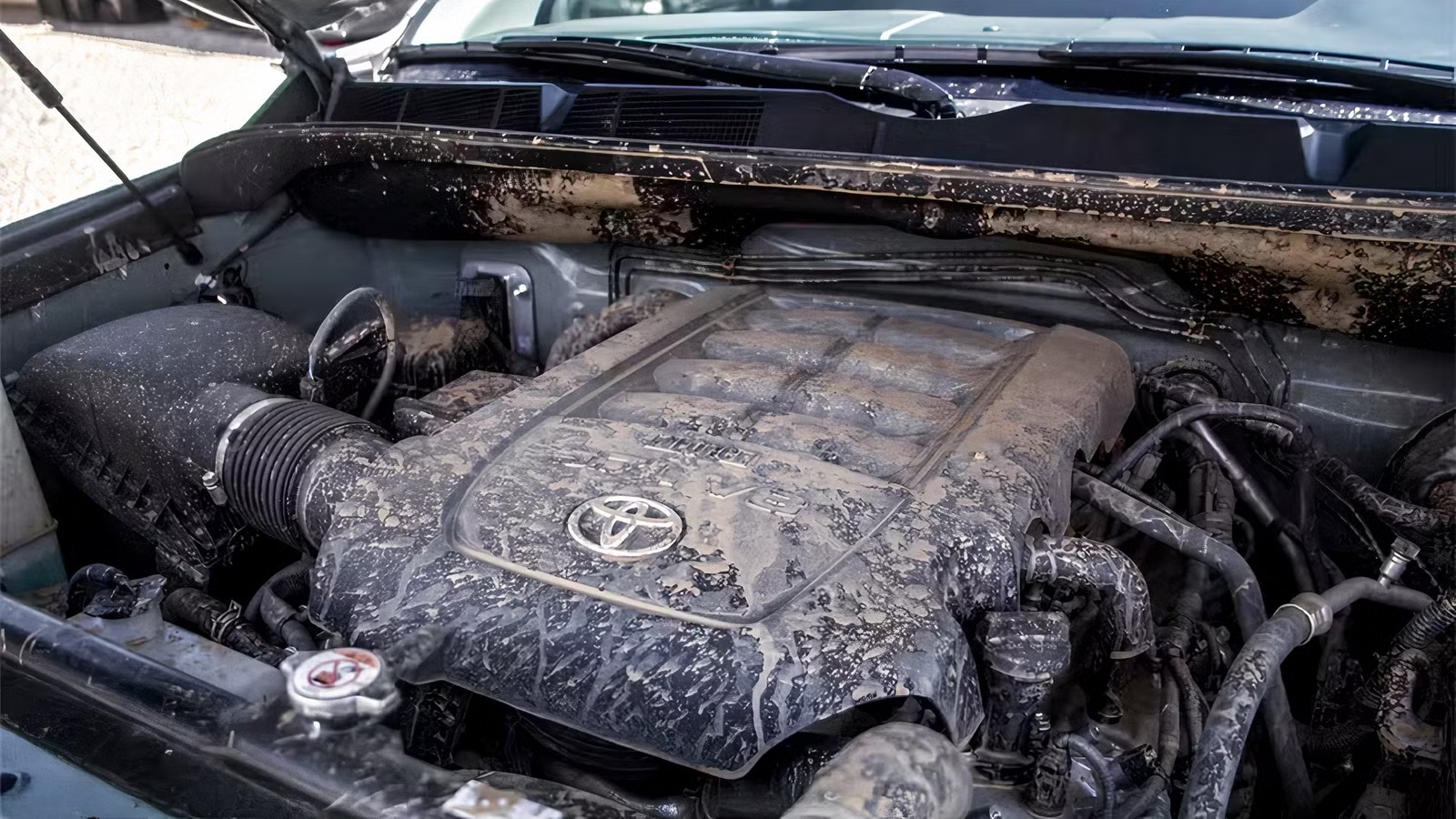
If there is one modern pickup truck engine that has quietly built a bulletproof legacy for itself without needing headlines, it is the 5.7-liter 3UR-FE V8. Found under the hood of the 2007 to 2021 Toyota Tundra, this hardy V8 became the backbone of a truck that gained a reputation for durability over chasing trends.
Even though this legendary mill has since been dropped from the Tundra lineup, much to the annoyance of many, for a while, Toyota wasn't chasing trends with smaller turbocharged engines; they stuck with displacement and simplicity. The 3UR-FE V8 was never about class-leading efficiency or cutting-edge tech, but more about consistent power under load, towing, hauling, and, most importantly, trust from truck owners.
The 3UR-FE V8 certainly never made a name for itself through spec sheets or marketing hype; the maximum stock horsepower output in a Tundra is just 381. The 3UR-FE made a name for itself by being overbuilt in areas that actually matter. Toyota designed it with long-term durability as a priority, not peak output, which means internal components are rarely operating near stress limits.
It also benefits from Toyota's conservative approach to engineering. Throttle responses, fueling, and ignition timing are all tuned for smooth, predictable power delivery rather than outright performance. That means lower shock loads through the crankshaft and valvetrain, which helps components wear more evenly over time.
The 3UR-FE was engineered for durability first and performance second, and this is very apparent in its build. The 5.7-liter displacement means it doesn't have to work particularly hard to make power, with up to 401 pound-feet of torque wound out without relying on aggressive boost pressure or high compression (the compression ratio of a 3UR-FE V8 is 10.2:1, which is lower than we typically see for a smaller turbocharged engine). More importantly, though, a lot of that torque arrives low in the rev range (peak output at around 3,600 rpm), allowing the Tundra to tow and haul without constantly climbing toward the redline.
Lower RPMs mean fewer combustion cycles, lower piston speeds, and reduced stress on bearings and valvetrain components over the miles. The bottom end is also massively overbuilt for a half-ton truck. The deep-skirted aluminum block wraps around the crankshaft for rigidity, while six-bolt main bearing caps keep the crank stable under load.
Toyota pairs this with a forged-steel crankshaft, while the pistons are oil-cooled from below via oil squirters, helping keep temperatures where they need to be when you are towing or driving at higher revs. Large coolant passages help to prevent hotspots around the cylinder and heads, while the overall simplicity of the engine makes it a durability legend.
The 3UR-FE V8 uses a timing chain rather than a belt, designed to last the life of the engine with minimal maintenance. Its port injection system is a little old-school compared to direct injection setups, but it keeps intake valves cleaner and delivers predictable combustion over time. Plus, the lack of a turbocharger means that there is less complexity and fewer things to go wrong than in some more modern engines.
There have been many legendary engines in Toyota's history, but none quite as impactful as this one.
So, the 3UR-FE V8 is overbuilt, simple, and delivers torque in the low rev range. However, what really makes it a truck engine that owners trust to put hundreds of thousands on it with ease (with routine maintenance) is the vast number of examples still on the road that have done just that. Since its first use in 2007 under the hood of the second-gen Tundra, this engine has become one of the most celebrated truck engines for getting the job done with minimal fuss.
Over the years, Toyota refined the 3UR-FE without dramatically changing the formula. Early versions are paired with a heavy-duty six-speed automatic transmission; by this point, it already had Dual VVT-i, so you get good torque delivery and relative efficiency without mechanical complexity.
As Toyota does best, improvements to the 3UR-FE were useful instead of being huge overhauls. Cooling systems, ECU calibration, and transmission mapping were gradually improved to manage loads, while later versions got a revised intake and exhaust timing for smoother power underfoot.
Most importantly, here, Toyota resisted market trends for a long time. When other truck makers started to downsize and turbocharge engines, they stuck with a large displacement engine that uses a well-proven core architecture, and this dedication to large and simple engineering matters a lot for those who like to use their trucks properly.
The biggest reason why the 3UR-FE has such a loyal following is that owners continue to prove its durability in the real world. Across Tundra forums, Reddit threads, and high-mileage owner groups, it is packed with examples of Tundra trucks comfortably racking up 300,000+ miles while still running on their original engine and transmission.
Many owners report nothing more than water pumps, starters, or routine wear, despite years of towing and off-roading. Then there is how these bulletproof Tundra pickups are used; models with the 5.7-liter V8 under the hood have become firm favorites among contractors, long-distance drivers, and off-roaders because it delivers low-end torque that constantly works.
Though we wouldn't recommend it, the 3UR-FE V8 also survives neglectful maintenance. Some owners have admitted to missing maintenance schedules for the 3UR-FE V8, and it still won't give up. That says a lot about how forgiving the mill is mechanically, and has solidified the older V8 Tundra models as nearly indestructible.
Not like they need it, but if Toyota ever wanted an advert for their reliability, there is just one truck owner to turn to: Victor Sheppard. He owned a 2007 Tundra with a 2UZ-FE 4.7-liter V8 under the hood that racked up over one million miles. Reportedly, Victor drove 125,000 miles a year for work (a lot of the time on the highways), and when Toyota bought back the truck from him for research, they found that, apart from the predictable wear and tear, the '07 Tundra was still in good condition, and most importantly, with the original V8 under the hood.
The seats were unbowed and still bolstered; most of the features were still functional; the interior was still in good condition, and the engine was still ticking over nicely. Only the rear suspension was replaced. Even more impressively, Victor did it again. He then owned a 2014 Tundra, this time with a 3UR-FE V8 under the hood. Again, he drove over 100,000 miles a year in it and pushed this Tundra past a million miles as well.
Victor Sheppard's million-mile V8 Tundras are the most famous high-mileage models, but there is no shortage of V8 Tundra owners claiming hundreds of thousands of miles of driving without any fuss. It is this kind of consistency that has really cemented the 3UR-FE V8's and Tundra's reputation as one of the toughest pickup trucks ever made.
The biggest Toyota engine in 2026 isn't as big as the biggest engines it produced in the past, but it's still mighty capable.
No engine is a perfect engine, and the Toyota 3UR-FE V8 does have some downsides. FuelEconomy.gov says that the last MY of the Tundra to have this engine can only achieve 14 combined mpg, which certainly makes a case for the new Tundra Hybrid, which can achieve up to 20 combined mpg. Also, some owners have said that secondary air injection pump failures can be expensive when they happen; others have mentioned that it is not the most refined engine ever, and others have suffered from cam tower oil leaks.
However, with the recent V6 Tundra problems, the old way looks to be the safest at the moment. It is still going to cost you between $7,500 and $47,800 for a 3UR-FE V8-quipped Tundra (age-dependent, with the newer models costing the most), but it is the high towing capacity (up to 10,200 pounds), mechanical simplicity, understressed work rate, low-end grunt, and everyday usability from their engines that make them such appealing trucks.
In a modern pickup truck market dominated by complex systems, turbocharged engines, and dependency on nannies, the older V8 Tundra offers a more "pure" trucking experience, freer from the headaches that modern systems can cause. Toyota got the formula right with the 3UR-FE V8, and the millions of miles that have collectively been put on these engines are proof of it.
Found an error? Send it info@www.topspeed.com so it can be corrected.
Sources: Toyota, Kelley Blue Book, J.D. Power, Bring A Trailer, FuelEconomy.gov
Source: https://www.topspeed.com/truck-engine-owners-trust-past-300000-miles/
Cars
The Pickup Truck Engine Owners Trust Past 300,000 Miles
Article Top Ad Zone
Article Middle Ad Zone
Article Bottom Ad Zone
Original Source: www.topspeed.com
Share
Comments
Comment system is currently disabled.