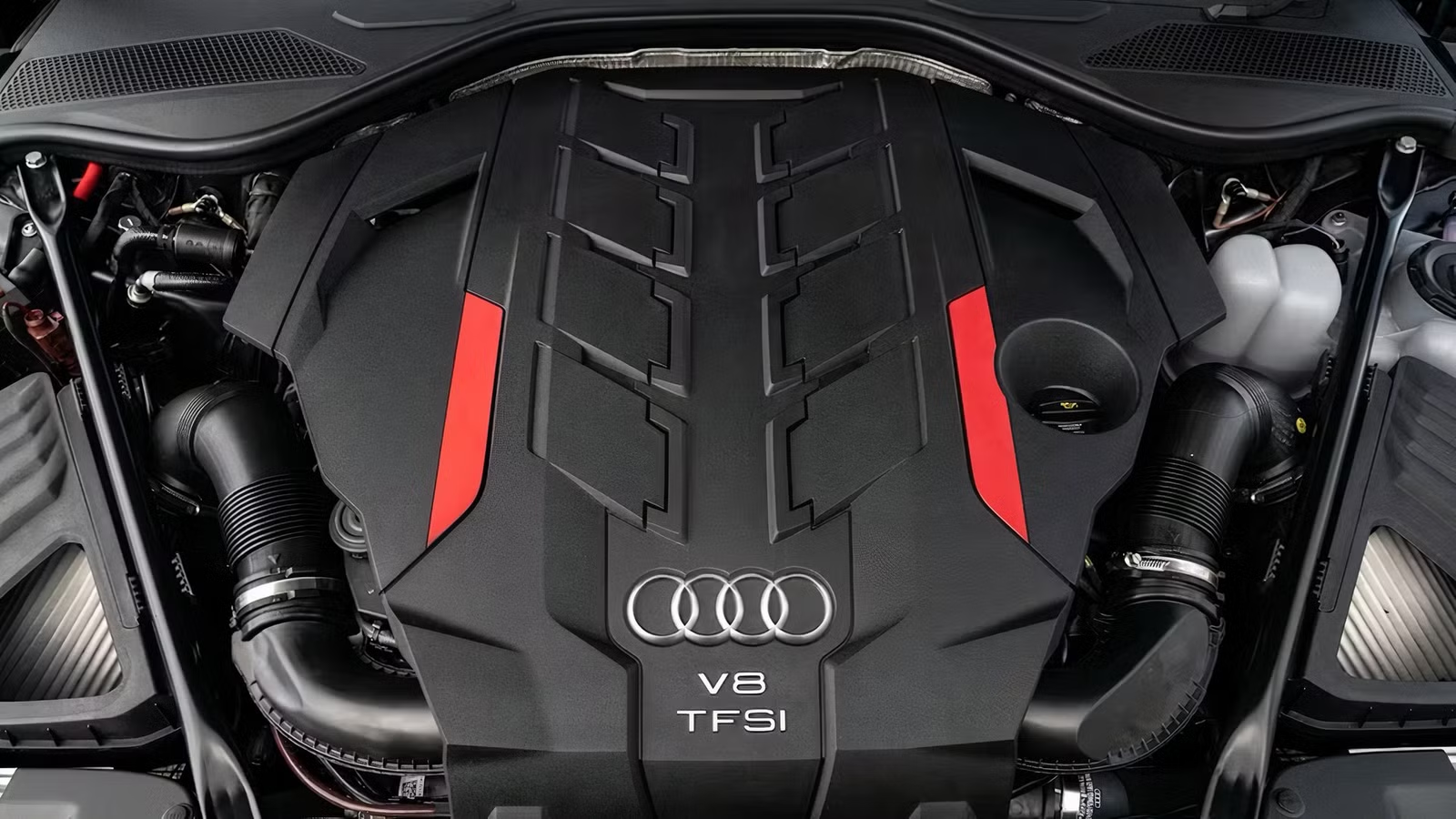
Audi CEO Gernot Döllner just made a lot of V8 fans feel considerably better about the future. Speaking to The Drive ahead of the RS5 launch earlier this month, Döllner was unambiguous: "I'm a big fan of the V8." More importantly, he clarified that package constraints—not corporate emissions' policy—are the only real limit on where that engine can go. "Whenever package-wise possible," he said, "there's no restriction to have an engine like that."
Follow and Like top authors, topics, and trends
Browse with fewer ads across the site
Personalize your profile to showcase your activity
Get a content feed tailored to your interests
By creating an account, you agree to our Terms of Use and Privacy Policy. You also agree to receive our newsletters; you can unsubscribe any time.
*Required: 8 chars, 1 capital letter, 1 number
The Q9, Audi's upcoming three-row flagship SUV, is the clearest fit for V8 power. Its sheer size makes packaging an eight-cylinder engine far less complicated than on a compact or midsize platform, and Döllner specifically called out full-size SUVs as a "perfect fit" for the engine. The Q9 will almost certainly launch with Audi's familiar 3.0-liter turbocharged V6 as the volume powertrain—but that doesn't close the door on something larger.
What's telling is that Audi has already trademarked the name SQ9. That's not confirmation of a performance variant, but trademark filings rarely happen without intent. If an SQ9 does materialize, a V8 — likely with some degree of mild hybrid assistance to manage emissions — would be the logical choice. The Q9 is also stepping into the role Audi's A8 once filled as the brand's flagship luxury statement, which makes a range-topping V8 option commercially sensible as well.
The RS6 Avant is arguably the model where a V8 absence would feel most conspicuous. The current C8-generation RS6 carries a 4.0-liter twin-turbo V8 with mild hybrid assistance — a setup that has defined the car's character and made it one of the most desirable performance estates on the market. Dropping to six cylinders for the next generation would be a significant step backward in perceived prestige, even if the power figures stayed competitive.
Döllner's comments offer some reassurance here. Because the RS6 sits on a larger platform than the RS5, it has more regulatory headroom under EU emissions rules—larger vehicles face less severe per-gram penalties relative to their class. That gives Audi's engineers more room to work with a V8, especially if electrification is layered in. A plug-in hybrid V8 RS6 isn't a stretch; it's the kind of solution that lets the engine survive without running afoul of the regulations that have already pushed smaller RS models toward six-cylinder configurations.
The Q7 is the third name in the conversation, and it has the clearest historical precedent. Both of the model's previous generations were available with V8 power — in the SQ7 trim specifically, which used a 4.0-liter twin-turbo unit to produce 500 horsepower in its most recent form. The Q7 is smaller than the incoming Q9, but it has already demonstrated that it can accommodate a V8 without major packaging compromises.
Whether the next Q7 actually gets one depends on how Audi structures the lineup once the Q9 is established. If the Q9 takes the SQ9 slot at the top of the performance hierarchy, the SQ7 may be positioned slightly below it — which could mean a V8 or could mean a high-output V6 hybrid. Döllner's comments don't guarantee anything, but they do confirm that the decision is open.
The Audi A8 has been in a slow wind-down, and Audi hasn't committed to a direct successor. But Döllner has stopped short of ruling one out entirely—the brand has acknowledged it isn't completely closing the door on a flagship sedan, even if the timeline is uncertain. In the meantime, the Q9 fills that flagship role in the showroom.
Before its gradual discontinuation, the A8 was available with a twin-turbo V8 in both the standard 60 TFSI and the more aggressive S8. Whether a future sedan ever returns to that configuration is speculative territory Döllner hasn't entered publicly. For now, the SUV segment is where V8 ambitions are most likely to be realized.
The broader takeaway from Döllner's comments is that Audi's V8 strategy isn't driven by sentiment—it's driven by physics and regulation. Large vehicles create the packaging space and the regulatory latitude that make eight cylinders viable. As long as the Q9, RS6, and Q7 remain in the lineup, the V8 has a home at Audi. That's not a guarantee of specific models or timelines, but it's a clear signal that the engine isn't being quietly retired. It's being preserved for the vehicles that can carry it properly.
Sources: Autoblog, Carscoops, Car & Driver, Carbuzz
Source: https://www.topspeed.com/audi-ceo-kills-v8-is-dead-narrative/
Cars
Audi CEO Kills The 'V8 Is Dead' Narrative With Three Concrete Candidates
Article Top Ad Zone
Article Middle Ad Zone
Article Bottom Ad Zone
Original Source: www.topspeed.com
Share
Comments
Comment system is currently disabled.