Considering how expensive the average new car is today, a dramatic shift has been occurring in the automotive market in recent years. The price-and-quality gap between luxury cars and mainstream models has never been smaller. The reality is that buying a new car is already a significant luxury, so the line between what is actually a luxury model nowadays is quite blurred.
Japanese automakers have been questioning the automotive status quo for decades, but one mainstream Japanese model in particular is a clear outlier, redefining what luxury means. The problem is, most consumers don't even know it exists or what it offers.
Marketing positioning has always been a key determinant in the automotive industry. Yet what has changed in the last decade is how aggressively mainstream automakers have encroached, both price- and quality-wise, into luxury-tier territory.
Why is the average car so expensive nowadays? Well, automakers are selling fewer cars than before, so the average car needs to be more expensive now to turn a profit. However, consumers are more value-conscious than ever before. Automakers responded not only by encouraging buyers to choose luxury sub-brands (e.g., Acura) but by upgrading top-tier mainstream models. Lexus is, by far, the most successful luxury offshoot (or sub-brand) of any mainstream automaker, but they also experimented with applying their refinements back downstream. The result was that mainstream flagships were competitive, if not better than most entry-level luxury cars, for a lot less money.
Nameplate revival has seen an uptick in popularity among automakers in the last decade. Automakers with decades of history are fond of pulling from their heritage and legacy to establish an existing image for a new product. Often, brands are reviving models that had the most nostalgia or those that were flagship products with a lot of recognition before luxury sub-brands made them irrelevant.
Bringing back a flagship model from the past is a clear signal from an automaker that this model is not a standard product. It carries a heavy expectation because of the reputation of the name alone, and it targets a specific type of consumer. The trend of nameplate revival is not just for the sake of nostalgia, but to establish a market position and product image from the weight of a name alone.
The Honda Prelude's comeback may be controversial, but its return to market has more meaning than you may assume.
Just like in any competitive environment, the benchmark for what is considered acceptable in the luxury segment rises with every passing year. Features like massage seats, which you could only acquire in a six-figure luxury sedan, are now available as standard in the 2026 Nissan Murano Platinum. The result is that luxury brands have been forced to elevate their standards just to maintain meaningful differentiation.
Hybrid powertrains have become the new darling of luxury automakers in the last decade or so as more brands realize the significant quality gains presented by electrification. Hybrids were once dismissed by luxury manufacturers because they believed the technology was only beneficial for efficiency. In truth, hybrid tech provides an ideal blend of efficiency, performance, and refinement. Luxury consumers want smoothness, composure, and a feeling of sophistication, and hybrid technology does all of that and more.
This fact is what made the Lexus ES sedan dominate the luxury hybrid segment. If you wanted a luxury sports sedan, you bought a BMW 3 Series. If you wanted a luxury sedan that drove effortlessly, got great gas mileage, and cost less to maintain than the segment average, you would buy a Lexus ES. That is why when a mainstream automaker utilizes the same type of hybrid system that made the Lexus ES a hit and pairs it with the same type of high-quality cabin found in a Lexus sedan, the justification for paying for that luxury premium becomes harder to justify.
If there is one thing that has been completely overhauled in the automotive industry in the last decade, it is interior quality standards. Before, material quality was the clearest dividing line between luxury cars and economy models. However, nowadays, you can get Nappa leather upholstery in a 2026 Subaru Outback Touring XT. Indeed, most modern mainstream models offer some form of genuine leather or premium leather-trimmed surfaces. The atrocious wood veneers that dominated the trims of many luxury models during the 2000s and early 2010s have been replaced by genuine open-pore wood or quality metal alloy trim, even in mainstream models.
Even acoustic engineering has become mainstream in non-luxury models with active noise cancellation systems and new standards for body sealing and glass lamination. It is safe to say that cabins of modern cars of all kinds have never been more refined and whisper-quiet than they are now. If there is any mainstream car on the market that is a true representation of this increased standard across the board, it is the Toyota Crown, the modern revival of the Japanese brand's most iconic flagship nameplate.
Currently in its sixth generation, the Subaru Outback has become a genuine automotive icon.
Toyota took a big leap of faith to reintroduce the Crown nameplate for the 2023 model year after a 50-year absence from the North American market. It effectively serves as the replacement for the discontinued Toyota Avalon and as a lower-cost alternative to the more EV-focused 2026 Lexus ES.
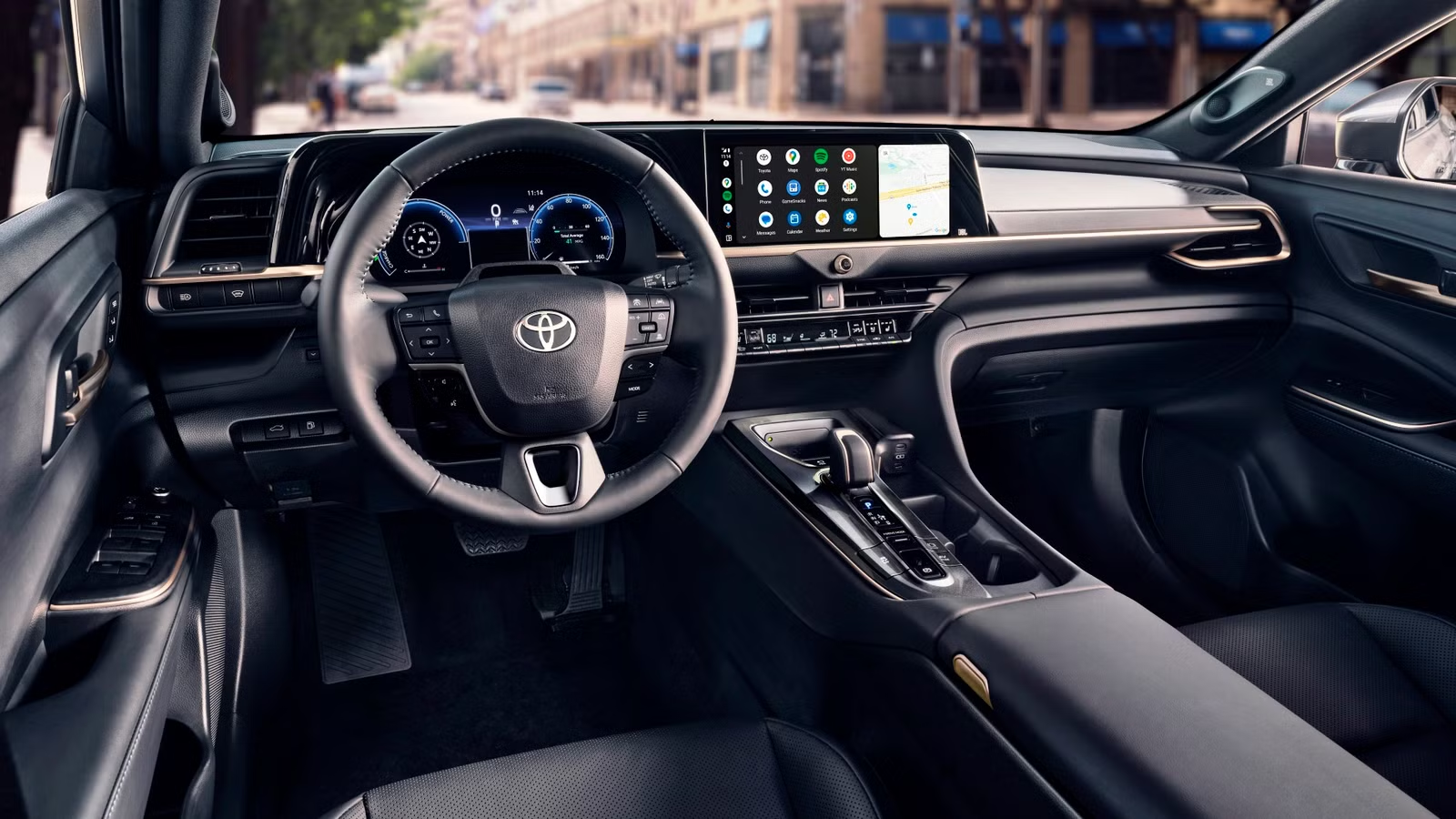
The crossover SUV has become the new standard of what luxury is supposed to be in the current market, but the Toyota Crown presents an alternative argument to that idea. Toyota's priorities for the Crown make it clear that this sedan is a full-blown luxury product with an unassuming Toyota badge. No aspect of the Crown is more important than its cabin quietness, and the extent of acoustic insulation work on this sedan is something other mainstream automakers cannot replicate. Its suspension setup is biased purely for comfort, and its standard interior features are hard to beat.
The Crown’s interior layout is spacious, comfortable, and pleasing to the eye... This is Toyota’s top-of-the-line sedan, so the materials chosen to upholster the interior have a premium look and feel
The base trim on the Crown is the $41,440 XLE, which is usually the top-trim level on a standard Toyota product. Included in the base trim are heated and ventilated leather-trimmed front seats, heated rear seats, wireless Apple CarPlay and Android Auto, and wireless charging. To have those same features in a new Lexus ES, you would have to opt for at least the $57,195 2026 Lexus ES 350e Luxury, and then still add the $3,635 Executive Package. That's roughly a $19,400 difference between the two, just to match the standard features found on the base model Crown.
The top-trim Crown is the $54,990 Platinum. You might think that's a lot of money for a Toyota sedan, and you'd be right. This is not a cheap vehicle by any means; it's actually the best that Toyota has to offer. Once you understand what the Crown Platinum offers, the price doesn't just make sense; it seems like a bargain.
The Crown Platinum is the only trim that offers the hybrid 2.4-liter turbocharged inline-four engine, which produces 340 horsepower. That's more power than any new Lexus ES or Lexus IS available, and it's a Toyota. Also included is standard AWD, adaptive variable suspension, dynamic rear steering, a panoramic view monitor, a hands-free power trunk, and fully configurable drive modes. Not only does the Crown offer more value than any equivalent Lexus sedan, but it is more capable than many of Lexus' offerings in terms of both performance and technology.
A luxury sedan that shuns the spotlight, yet outshines its rivals in the areas that truly matter.
Once we consider the factor of ownership costs, the Toyota Crown has undeniable value for the right buyer. If you are considering an entry-level luxury sedan in the $40,000 to $60,000 range, the Crown may be a perfect fit once you consider the long-term financial picture.
According to CarEdge, the maintenance costs over the first five years of Crown ownership are about $1,662, which is only three percent of the total ownership cost. Over ten years, the maintenance costs are $4,895, which beats the industry average of $851 over ten years. Insurance costs amount to $2,474 per year, which beats the national sedan average by $659 per year. The standard Crown achieves 41 mpg combined, and the performance-focused Platinum model achieves a respectable 30 mpg combined.
The Crown is a niche vehicle, and, as a result, the supply of this flagship sedan is still quite limited. During its debut year, the Crown sold 19,063 units, with 19,648 units the following year, and 12,309 units in the most recent full-year report in 2025. By comparison, the Toyota Camry sold 316,185 units in 2025 alone.
Kelley Blue Book estimates that the average private party value of a 2024 Crown is between $28,800 and $35,300, depending on trim, and $37,000 to $40,000 for Platinum models. If you are willing to look beyond the standard luxury options, you can secure a serious deal on a slightly used Crown right now. As it stands, the Crown is one of the most undervalued used cars on the market, considering the standard of quality it provides even in its base trim.
Found an error? Send it info@www.topspeed.com so it can be corrected.
Sources: Toyota, Lexus, CarEdge, Kelley Blue Book
Source: https://www.topspeed.com/japanese-car-feels-more-upscale/
BMW
The Toyota Crown: A Luxury Sedan That Defies Expectations
Article Top Ad Zone
Article Middle Ad Zone
Article Bottom Ad Zone
Original Source: www.topspeed.com
Share
Comments
Comment system is currently disabled.