Toyota filed plans this week for a $2 billion expansion of its San Antonio manufacturing campus — a project internally called Project Orca — that will add an entirely new assembly line with a targeted production start of 2030. The filing, submitted to Texas authorities on May 15, 2026, is the most concrete signal yet that Toyota is rethinking where it builds trucks for the American market. And for Tacoma buyers, the timing is hard to ignore.
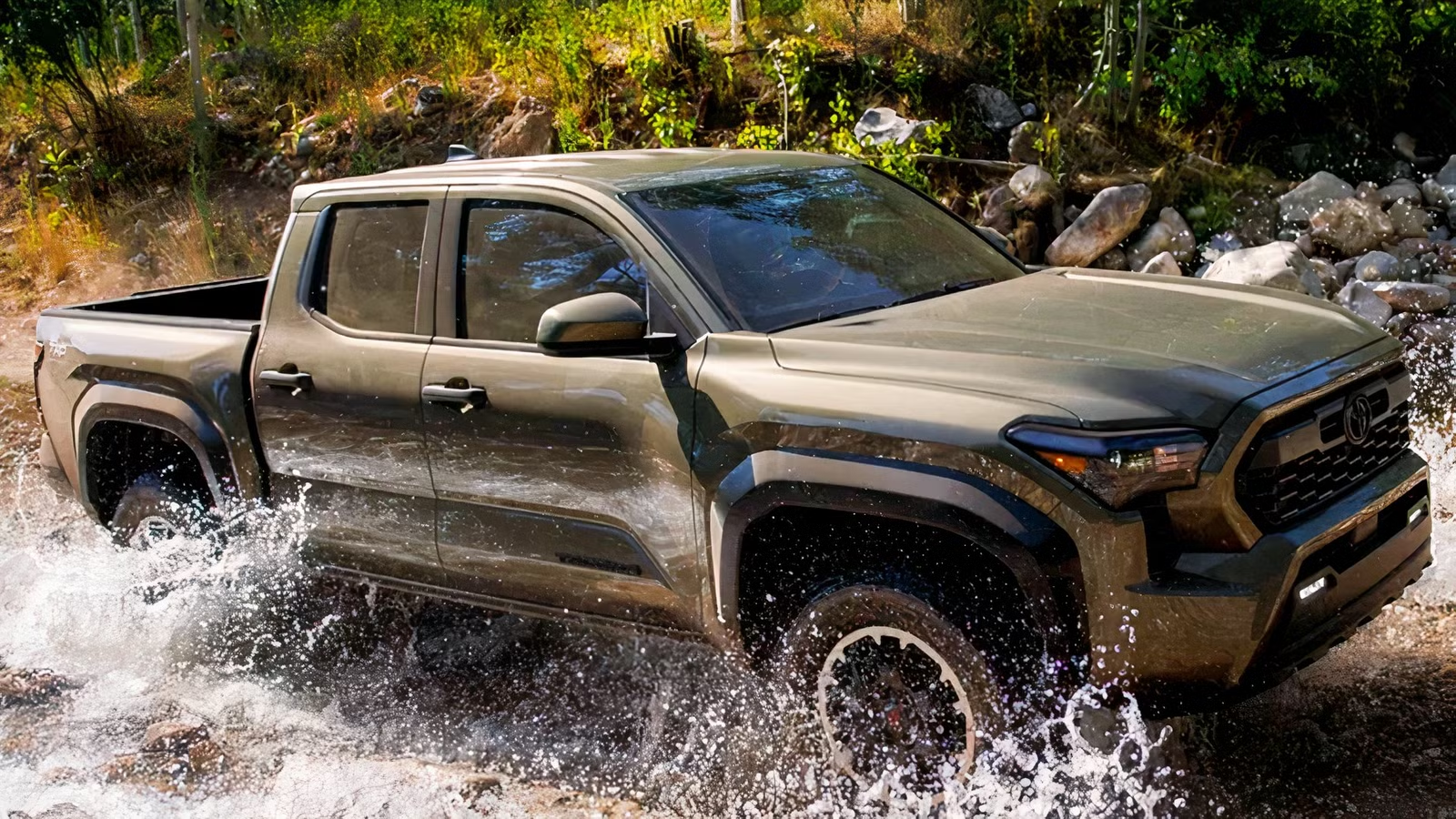
The Tacoma moved from San Antonio to a plant in Baja California, Mexico, in 2021. That made logistical sense at the time. It no longer does. The 25 percent tariff now applied to vehicles imported from Mexico has fundamentally changed the math on cross-border production, and a mid-size truck with the Tacoma's sales volume—consistently the best-selling mid-size pickup in the United States—is exactly the kind of product that absorbs those costs most painfully. A new Texas line would change that equation entirely.
Toyota's regulatory filing describes a major expansion of the San Antonio facility, which already builds the Tundra full-size pickup and the Sequoia SUV. The Project Orca plans call for construction to begin this year, with the new assembly line coming online by 2030. The filing does not name a specific vehicle for the new line—Toyota has not made an official product announcement—but the industrial logic points squarely at the Tacoma.
San Antonio has the existing truck-manufacturing infrastructure, a trained workforce, and a supplier network already oriented around pickup production. Adding a mid-size truck line alongside the Tundra is a natural fit, far more so than launching an entirely new vehicle category at the plant. Toyota has not confirmed the Tacoma assignment publicly, but the combination of the tariff environment and the plant's existing capabilities makes it the most likely candidate by a significant margin.
When Tacoma production shifted to Mexico in 2021, the move offered cost efficiencies that made sense under the trade rules in place at the time. The 25 percent tariff on Mexican-assembled vehicles changes that calculus dramatically. On a Tacoma that retails between roughly $32,000 and $55,000 depending on trim, a 25 percent import duty represents a significant per-unit cost burden—one that either compresses margins or gets passed to buyers at the dealership.
Building domestically eliminates that exposure entirely. For a truck that sells in the volume the Tacoma does, the savings across a full model year's production run would be substantial enough to justify a major capital investment like Project Orca on its own. The $2 billion price tag is large, but spread across years of tariff-free production on one of Toyota's most important nameplates, the arithmetic works.
The most immediate practical benefit of domestic production is supply-chain resilience. Tacoma inventory has been uneven in recent years, partly because cross-border logistics add complexity and vulnerability that a domestic plant doesn't carry. A San Antonio line would be closer to the core of Toyota's North American distribution network and less exposed to border-crossing delays or policy shifts.
There's also a reasonable case that domestic production could unlock trim and powertrain flexibility that's harder to manage from a foreign plant. Toyota has been rolling out hybrid powertrains across its lineup aggressively, and a refreshed or next-generation Tacoma built in Texas would be a logical candidate for an expanded hybrid option — potentially a more performance-oriented variant beyond the current i-FORCE MAX setup. Nothing in the filing confirms new powertrains, but a 2030 production start gives Toyota's engineers several years to develop whatever goes under the hood of a domestically built truck.
For buyers tracking resale value, domestic sourcing has historically been a modest positive signal in the used-truck market, particularly among buyers who prioritize parts availability and service network proximity. A Texas-built Tacoma would carry that advantage from day one.
The 2030 timeline means current Tacoma shoppers won't see a Texas-built truck on dealer lots anytime soon — but the filing itself is meaningful news. It suggests Toyota is committing serious capital to a domestic truck strategy that puts the Tacoma back where it spent the first two decades of its modern life. Construction starts this year. The next chapter of the Tacoma story may well be written in San Antonio.
Source: https://www.topspeed.com/tacoma-left-texas-for-mexico-now-tariffs-are-bringing-it-back/
Cars
The Tacoma Left Texas For Mexico. Now Tariffs Are Bringing It Back.
Article Top Ad Zone
Article Middle Ad Zone
Article Bottom Ad Zone
Original Source: www.topspeed.com
Share
Comments
Comment system is currently disabled.