Gone are the days when a "cruiser bike" tag was reserved only for low-slung machines with a big-twin and classic design cues. Today, the cruiser bike segment is as versatile as it gets, with everyday, entry, and middleweight offerings to flagships that deliver sports bike performance without compromising comfort. More impressive is that most modern cruiser bikes don't skimp on styling, either.
So, style, performance, comfort, and practicality are packaged well on a cruiser bike today. However, one Honda cruiser bike stands out for its well-rounded approach. It packs a 1,000+ cc engine, can be equipped with an automatic gearbox (the only cruiser to do so in its segment), and has a footprint in the ballpark of a middleweight cruiser bike.
Classic cruiser bikes are heavy on styling and chrome. They were built with no size or weight limitations, which is why most old-school cruiser bikes have gigantic V-twins and curb weights that scare riders from riding them in cities. But today, brands have incorporated modern technology and riding assistance to help riders navigate these stretched-out bikes. Trading carburation and heavy, rigid underpinnings for more adaptive and lightweight packages has helped dial up its usability, especially on a daily basis. The acceptance of entry-level and middleweight cruiser bikes without a V-twin, but with other practical engine types, has also unlocked a whole new world of riding experiences for beginner and intermediate riders.
All the new-age additions have helped modern cruiser bikes dial up on many overlooked aspects, especially practicality. The deployment of single-cylinder and parallel-twin mills has helped improve efficiency and repairability. The relatively lighter chassis design allows manufacturers to use more versatile suspension and braking setups. Then there's the plethora of electronics, especially safety and assistive features like ABS, slipper clutches, and traction control.
Weight is always a hindrance when it comes to daily riding a traditional cruiser bike. But with lighter components throughout, the heft has gone down notably. Couple that with its low center of mass and low seat height, and cruiser motorcycles have become much more welcoming to new riders. Despite all these 'practical' aspects, motorcycle makers have not let go of that one defining factor of a cruiser—styling.
We don't give manufacturers enough credit for this. Modern cruiser motorcycles cleverly hide technology features behind classic silhouettes. Examples like the Indian Scout Sixty Bobber and the Harley-Davidson Street Bob are prime examples. Specimens like the Honda Shadow Phantom and Kawasaki Vulcan 900 are so good at looking old-school that bikes packing liquid-cooled engines might come as a surprise.
The likes of the Royal Enfield Super Meteor 650, the Triumph Bonneville Speedmaster, and the BMW R 18, among others, further show us that cruiser motorcycles can be cool even without a V-twin. However, there are only a handful of cruiser bikes that can do it all. And the Honda Rebel 1100 takes the spotlight here.
This brand-new Indian cruiser bike beautifully blends custom styling with weekend-ready practicality.
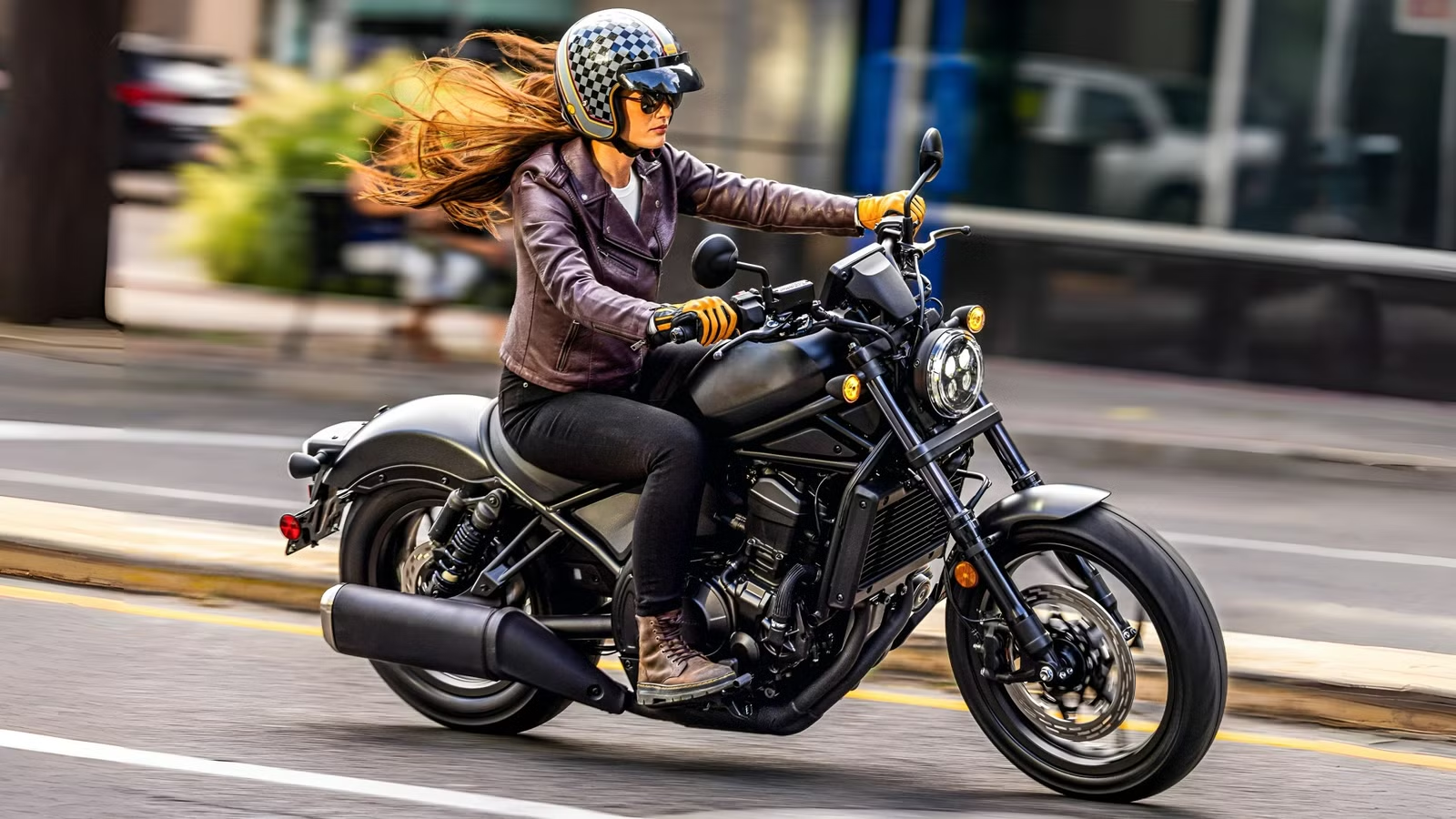
The Rebel 1100 is Honda's flagship cruiser bike. It has an instantly recognizable design language that is shared across the Rebel line-up (from the baby 300 model). Its minimal design language greatly contributes to its compact appeal. In fact, an untrained eye will not be able to easily distinguish between a middleweight Rebel 500 and the Rebel 1100.
Therein also lies its strength, as the tight dimensions help make it a practical urban-ready motorcycle. Furthermore, its modern yet lightweight underpinnings are versatile and help with high-speed stability on the freeway. The combination of all these features makes the Rebel 1100 nail styling, stability, and street-readiness with finesse.
With a starting price of under $10,000, the Rebel 1100 is the most affordable 1,000+ cc cruiser bike. It easily outclasses American options in engine size while having a shorter wheelbase and lower curb weight. For reference, the $9,999 Harley-Davidson Nightster and the $9,999 Indian Scout Sixty both pack sub-1,000 cc engines, have 60+ inches of wheelbase, and weigh over 500 pounds.
These bikes will give the Energizer Bunny a run for its money – and all they need is basic preventive maintenance done on time.
Its trim table shows how Honda takes both breezy riding dynamics and styling equally into account. For an additional $700, Honda offers the only automatic flagship cruiser motorcycle of 2026. The Rebel 1100 DCT simplifies the riding experience by eliminating gear shifts and clutch usage. This does wonders when riding through tight city traffic.
The most stylish of the lot is the Rebel 1100 DCT SE, which is priced at $11,199. This trim is fairly new, introduced in 2025. It comes with DCT as a standard option and is further distinguished by custom-inspired design cues. Notable options include a unique shade (Deep Pearl Gray), bar-end mirrors, a body-colored headlight cowl, bronze alloy wheels, and a custom seat design.
The Rebel 1100 is powered by a 1,084 cc parallel-twin liquid-cooled engine that produces 87 horsepower and 72.3 pound-feet of torque. This is a very versatile engine that is shared with other Honda bikes. This engine, in other states of tune, is used in the Africa Twin ADV, the NT1100 touring bike, and the forbidden Hawk 11 cafe racer.
Honda has tuned it for the Rebel 1100, delivering meatier low and mid-range punch, with torque peaking at 4,750 RPM. About 80% of the torque is available at 3,000 RPM, giving it a peppy character. Furthermore, its power flows linearly and peaks at 7,250 RPM, giving the Rebel enough juice to do triple-digit speeds without overstressing the engine. On the base model, power is sent to the rear wheel via a six-speed manual gearbox.
The Rebel 1100 trim levels equipped with the six-speed dual-clutch automatic transmission elevate the riding experience, offering notable convenience. In the Auto model, the DCT makes this cruiser bike operate like a twist-and-go scooter. Furthermore, riders who want a more engaging ride are treated to a manual model.
This includes a paddle-like shifter on the handlebars that allows the rider to shift gears at their own discretion. Advantages of an automatic gearbox include no stalling, reduced fatigue (in the city and on the highway), better MPG ratings in certain driving conditions, and improved low-speed maneuverability, especially on inclined surfaces. This automatic gearbox notably contributes to the Rebel 1100's breezy street manners, and is not an expensive add-on either.
Underpinning the Honda Rebel 1100 lineup is a semi-double cradle steel main frame. It is coupled to an aluminum sub-frame. This combination upholds rigidity and weight balance. The chassis is suspended on 43 mm forks up front and Showa-tuned dual shocks at the rear. While devoid of extensive adjustability, Honda claims to offer a balanced spring rate for stable highway and nimble urban rides.
Braking duties are taken care of by a single 330 mm disc up front coupled to a radially-mounted four-piston caliper. The rear gets a 256 mm disc coupled to a single-piston caliper. It gets fairly chunky 130-section front and 180-section rear tubeless tires wrapped around lightweight 18-inch front and 16-inch rear alloy wheels. Furthermore, the low-slung design helps keep the center of gravity low.
Despite packing a 1,000+ cc engine, the Rebel 1100 is surprisingly compact for its class. It has a wheelbase of 59.8 inches, a rake angle of 28 degrees, and a trail of 4.3 inches. Hence, this cruiser bike maintains a compact stance without compromising on the stretched-out visual appeal of a cruiser bike.
Furthermore, a low seat height of 27.5 inches helps make this a very accessible motorcycle. Its low curb weight of 487 pounds (for the base non-DCT) model makes new riders feel more comfortable, too. All of these features contribute greatly to making the Rebel 1100 an easy urban runabout. The only compromise here is a tiny 3.6-gallon fuel tank.
We pick 10 cruisers that are affordable and yet offer performance and features at odds with their pricing
Technology is the linking piece that stitches all of its characteristics together for a solid do-it-all package. Honda hides a lot of modern technology under the minimal, neo-retro design of the Rebel 1100. The only visible aspect is its crisp 5-inch TFT screen that runs the Honda RoadSync software for numerous hands-free connectivity features via Bluetooth. This screen allows phone calls, text messaging, playing music, and using the navigation system.
It also gets a wholesome suite of ride-enhancing, safety, and assistive features. These include five ride modes (Standard, Sport, Rain, and two user-defined ones), ride-by-wire, dual-channel ABS, traction control, and cruise control. It gets Engine Braking Control and even Wheelie Control, features mostly found on track-ready sports bikes.
Found an error? Send it info@www.topspeed.com so it can be corrected.
Source: https://www.topspeed.com/modern-cruiser-style-stability-street-manners/
Cars
The Modern Cruiser That Nails Style, Stability, And Street Manners
Article Top Ad Zone
Article Middle Ad Zone
Article Bottom Ad Zone
Original Source: www.topspeed.com
Share
Comments
Comment system is currently disabled.