The adventure motorcycle segment has a pecking order, and the European badges sit at the top of it. Reputation for a brand compounds over decades of delivering great products. And then, when a group of enthusiasts meets up on a Sunday morning ride, that reputation is discussed, spread, and reinforced by more prospective buyers. This dynamic, however, keeps capable bikes overlooked and the inflated prices of alternatives a bit defensible, barring a few exceptions.
Follow and Like top authors, topics, and trends
Browse with fewer ads across the site
Personalize your profile to showcase your activity
Get a content feed tailored to your interests
By creating an account, you agree to our Terms of Use and Privacy Policy. You also agree to receive our newsletters; you can unsubscribe any time.
*Required: 8 chars, 1 capital letter, 1 number
Long production run is in itself proof of reliability. What also makes it the basis of comfort considerations is exactly where the two ideas converge. Lower combustion temperatures mean that less heat reaches the rider. That’s one engineering decision, and two consequences that matter to the same rider on the same long day. The comfort hardware builds upon this theme. Long-travel, fully adjustable suspension at both ends does not usually get specified for a machine whose development stopped at the first viable product.
Independent compression and rebound tuning at each wheel exists because a fixed damping stops tracking the road when pace, load, or surface quality changes. All of these are accumulated answers to the questions that riders have sent back across two decades of ownership that have made the V-Strom so well-balanced as an ADV. That makes it the ideal pick here, offering Honda reliability and GS comfort.
These overlooked adventure bikes offer a lot of value to those looking for a reliable motorcycle
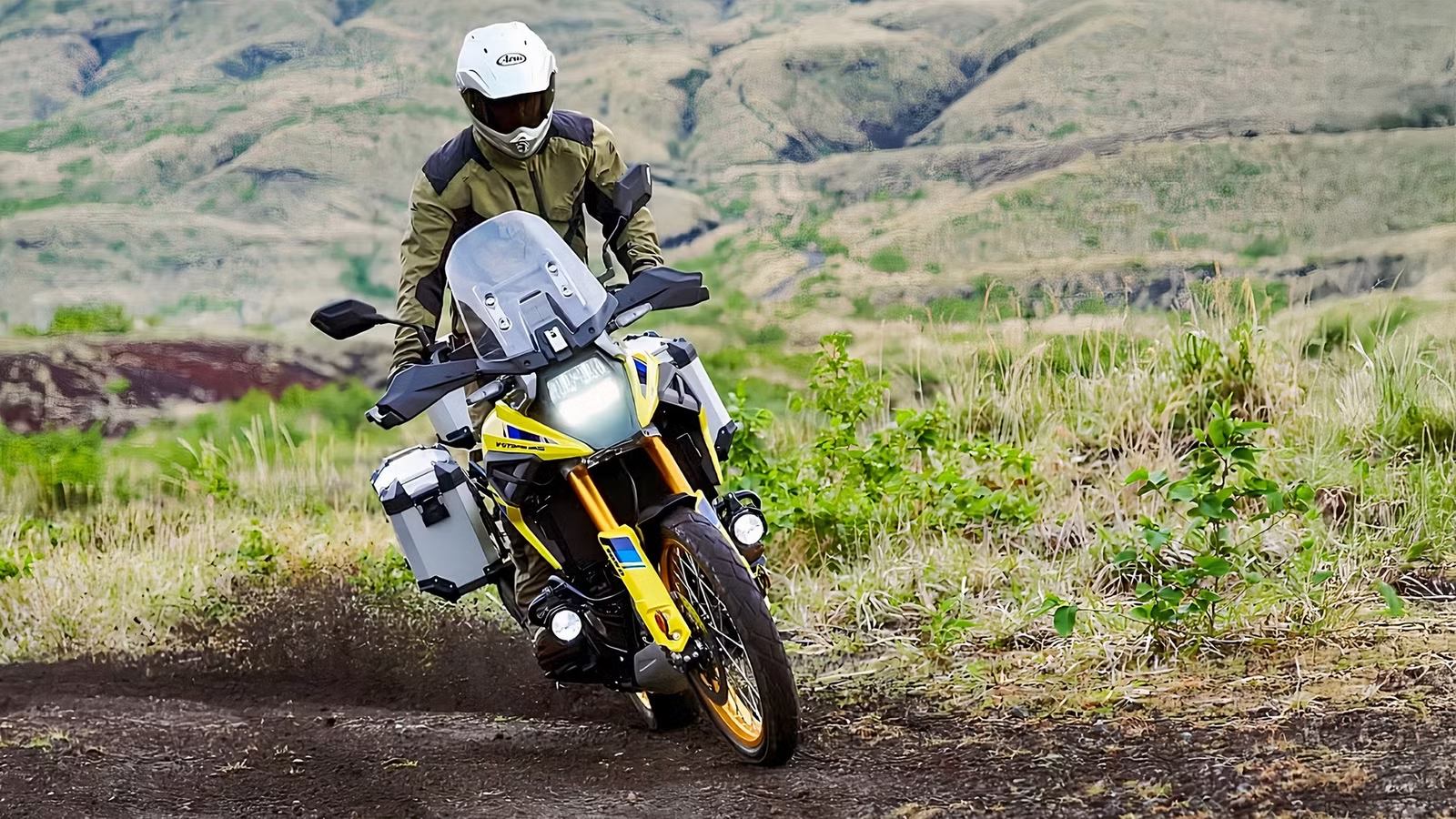
And Suzuki has listened, while silently integrating these changes to build the latest iteration of the V-Strom. This is one of the reasons why the most overlooked adventure bike that will last a lifetime is typically the one without a European badge, and the V-Strom has spent a good part of two decades making that true. The platform launched back in 2002, and the DE variant arrived a whole two decades later in 2023. It brought with it a 21-inch front wheel, more ground clearance, extended suspension travel, and the touring fundamentals that were built solid with the standard 1050. At $16,449 for 2026, this competent ADV package is priced below every European rival at this capability level.
The 1037cc DOHC V-twin with its 90-degree cylinder angle achieves primary balance without a counterbalancer shaft, something that has carried on from the SV650’s V-twin. That’s one fewer rotating assembly part accumulating wear over a high-mileage ownership cycle. Then there is the heat management referred to earlier that also benefits the rider. And finally, the Suzuki Composite Electrochemical Material (SCEM) cylinder bore coating that reduces friction to further improve the engine’s performance and smoothness.
Suzuki bolts the unit directly to the twin-spar frame because the inherent balance makes rubber mounting unnecessary, and the chassis is stiffer for it. Peak output is 107 horsepower and 73.76 lb-ft of torque, with the latter sitting in the mid-range, the ideal place for highway pace for cruising as well as effortless overtakes without downshifts. A 5.3-gallon tank puts the range beyond the distance most riders want to sit for before stopping anyway. Browsing every Suzuki V-Strom model ranked by power across the lineup, the 1050DE sits at the apex, and that position reflects the accumulated refinement as much as displacement.
The most powerful adventure bike on this list is an exotic Italian with 170 horsepower.
A reliable engine is only as good as an equally robust chassis that carries it. And this is a chassis that’s specifically calibrated for adventures that often demand luggage carrying capacity and/or a pillion. The KYB inverted front fork may not be among the most advanced suspension systems in the world, but it offers just what’s needed. Independent compression, preload, and rebound adjustment not only keeps the front-end customizable to be dialed-in for a rider but also accounts for the added load, if and when needed. A pillion and luggage shift the shock inputs beyond what preload alone can address, so proper fine-tuning of the suspension behavior is an added plus.
A KYB link-type rear shock handles full preload and rebound adjustment as well, and Load Dependent Control within the Suzuki Intelligent Ride System (S.I.R.S) manages braking balance automatically when extra weight comes aboard. Suzuki positions the 554-pound heft centrally through the twin-spar frame, and the 1050DE responds to steering inputs more readily than one would expect. The 21-inch front wheel and the DE's extended swingarm hold predictable behavior across surface changes over days and miles on the road.
These adventure motorcycles pack in so much tech, NASA would go green with envy
S.I.R.S. is where the accumulated engineering decisions are managed from a single system. Traction control runs a dedicated Gravel mode calibrated to a different intervention threshold than what dry asphalt warrants, permitting controlled rear wheel slip on loose surfaces rather than cutting power at the wrong moment. Switchable rear ABS disengages independently of the front on unpaved sections, keeping technical surfaces manageable without removing the front braking safety net. Then there is Hill Hold Control that maintains brake pressure on a grade long enough to remove the balance act from a loaded uphill restart.
Back on pavement, the same system shifts without the rider changing anything. Motion Track ABS runs through the six-axis Bosch IMU to extend the ABS function through lean angles. Cruise control holds highway pace without sustained wrist tension. The bidirectional quickshifter handles gear changes in both directions without the clutch, operating as consistently through urban traffic as at open-road speeds. And finally, a 5-inch TFT display puts all of it within a glance, and a USB port at the instrument cluster alongside a 12V outlet under the seat keeps the mobile devices charged.
These adventure bikes offer unrivaled everyday practicality. That's not something many ADVs can claim!
At that price, the DE sits $2,174 above the 2026 BMW F 900 GS's base of $14,275. While the BMW is definitely an upgrade over the smaller V-Strom, the F 900 GS's 895cc parallel twin makes 105 hp and 68.6 lb-ft of torque at 6,750 rpm, pulling 5 lb-ft less than the V-Strom 1050DE at a higher engine speed. The GS fuel tank also holds a lower 3.8 gallons, 1.5 gallons shorter per fill on a loaded touring day. Both are tiny aspects to consider as they build up over distances.
The 2026 Honda Africa Twin CRF1100L at $15,999 makes a closer contest. On paper, this Suzuki delivers Africa Twin-level performance and then some despite the Africa Twin making 101 hp and 83 lb-ft of torque at 5,500 rpm. At approximately 500 pounds, it also runs about 50 pounds lighter. These are real advantages for a rider whose priority is off-road agility over highway miles, but then there’s the case of the parallel-twin, which cannot replicate a 90-degree V-twin’s natural primary balance. At $450 over the Africa Twin and $1,179 over the GS all-in, the V-Strom 1050DE has the character, the slightly better tank range, and decades of platform development to come out on top, albeit being easily overlooked and underappreciated.
Found an error? Send it info@www.topspeed.com so it can be corrected.
Source: https://www.topspeed.com/suzuki-adv-feels-as-reliable-as-honda-as-comfortable-as-gs/
BMW
The Suzuki ADV That Feels As Reliable As A Honda And As Comfortable As A GS
Article Top Ad Zone
Article Middle Ad Zone
Article Bottom Ad Zone
Original Source: www.topspeed.com
Share
Comments
Comment system is currently disabled.