Sports bikes are a motorcycle genre that demands the utmost commitment from riders. The riding dynamics are aggressive, and even the slightest shift in the rider's weight influences how these motorcycles behave. Now, there are a bunch of forgiving sportbikes that can be capable daily motorcycles. But the wilder bunch of superbikes are mostly devoid of these street-friendly features.
Follow and Like top authors, topics, and trends
Browse with fewer ads across the site
Personalize your profile to showcase your activity
Get a content feed tailored to your interests
By creating an account, you agree to our Terms of Use and Privacy Policy. You also agree to receive our newsletters; you can unsubscribe any time.
*Required: 8 chars, 1 capital letter, 1 number
Superbikes are hardcore sportbikes that are designed for the racetrack. They feature highly aggressive ergonomics, razor-sharp steering, and massive amounts of instantly accessible power. The aggressive riding triangle imposes physical demands, as the rider must sit in a forward-leaning posture for extended periods.
There is a knack to riding superbikes, and if not done correctly, it can cause back and wrist pain. However, even when careful, riding a superbike in slow-speed situations makes maneuvering highly uncomfortable, as it limits the rider's leverage when navigating tight corners. The steering of these superbikes is ultra-sensitive, making them very hard to master. Riders must always be vigilant in responding to the bike's "twitchy" feel and executing smooth, precise direction changes.
Its explosive performance is further coupled to a lower curb weight for insane power-to-weight ratios. Therefore, an accidental twist of the very sensitive throttle can instantly launch the bike forward. This is why all those powerful superbikes can easily pop wheelies with no effort. The rider should have high physical and mental endurance to tame these beasts.
Well, if we compare apples to apples, then track-ready superbikes as a whole don't get much more comfortable. But if we explore the gray areas, then examples like the Suzuki Hayabusa, the Kawasaki Ninja 1100SX, and the Kawasaki Ninja ZX-14R stand out for their surprisingly comfortable character. Now, these specimens don't exactly abide by the textbook formula of a nimble, track-ready superbike.
The wheelbases are notably longer, and the performance curve is spread more evenly across the rev band. Also, the rider triangle is not as aggressive as those of quintessential superbikes. Despite these subtle tweaks, they are still categorized as superbikes, even though they are tour-friendly.
Manufacturers can only do so much to make a superbike comfortable without messing up its core formula. Therefore, those niche examples above have limitations. However, if one truly wants to experience the thrills of a superbike without hurting the back and the wrists for long, then sport-tourers are the best bet.
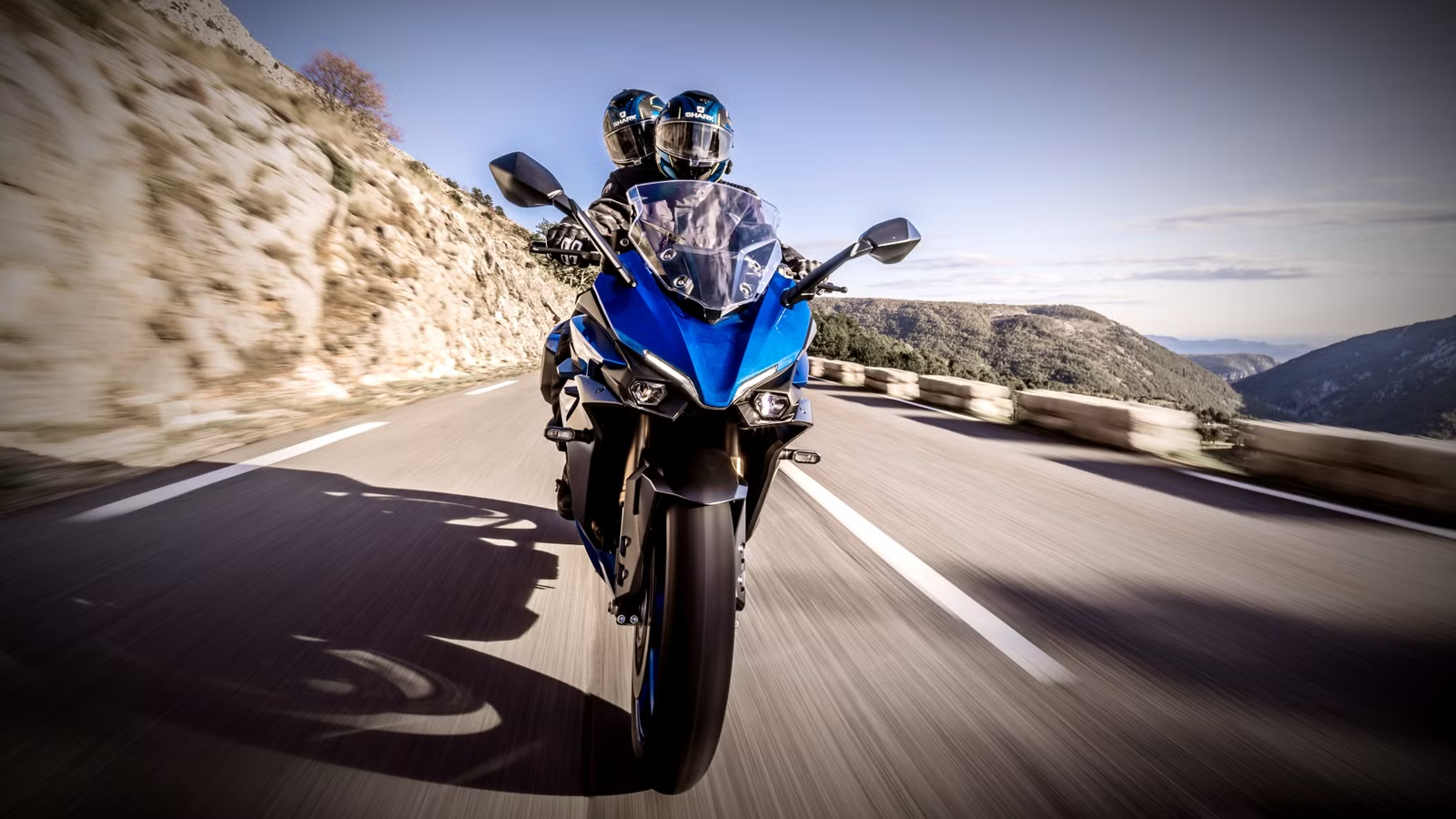
These fast motorcycles pack the heart of a track-going superbike but balance the aggression out with a fairly relaxed rider triangle, comfortable suspension setup, and loads of practical features. Even the electronic and practical features are cleverly blended into the sporty silhouette of these performance tourers without making it look like an afterthought. There are a handful of sport-tourers out there, but the one that truly feels like a superbike without the stress is the bang-for-buck Suzuki GSX-S1000GT+—a Gixxer with side cases and on stilts.
The most powerful inline-4 motorcycle here is a gorgeous-looking Italian naked bike with 208 horsepower.
This Suzuki is a unique sport-tourer with only one direct competitor. The flagship sport-touring segment offers a few exciting motorcycles that lock horns with the GSX-S1000GT+, such as the BMW R 1300 RT, the wild KTM 1290 Super Duke GT, and even the one-of-a-kind Kawasaki Ninja H2 SX with a supercharged engine. But none of these heavy hitters can match the value of the Suzuki tourer, as their prices are significantly higher. The worthy competitor to the Suzuki GSX-S1000GT+'s insane VFM tag is the $13,999 Kawasaki Ninja 1100 SX.
Just like the Suzuki, this Kawa is also powered by a superbike-sourced 1,099 cc four-cylinder engine, but is relatively low on power. It is also heavier and doesn't come with side cases as standard fitment. It does have an edge, with superior technology and features like a six-axis IMU, better suspension, and improved brakes. But looking at the full picture, it is the Suzuki that triumphs with its value-for-money proposition.
At the heart of this sharp-looking Suzuki sport-tourer sits a familiar four-cylinder engine. The 999 cc mill is based on the famed K5 Gixxer sportbike engine but has been de-tuned for a touring-friendly character. The performance curve is spread more evenly across the rev band, and there is meaty torque available earlier to suit the character.
Despite the toned-down nature, the superbike DNA is very much alive thanks to a high compression ratio of 12.2:1 and a fairly high-revving nature beyond 11,000 RPM. The GSX-S1000GT+ produces 150 horsepower at 11,000 RPM and 79.6 pound-feet of torque at 9,250 RPM. Suzuki impresses with this mill's practical side, offering a claimed fuel economy of about 46 MPG. With its sizable 5-gallon fuel tank, this Suzuki sport-tourer can easily do up to 230 miles on a full tank of gas.
Setting the standard for reliability is its seasoned engine-and-main-frame combination, which has been around since 2005. Hence, age has helped Suzuki fine-tune and refine this powertrain-and-chassis combo to be virtually error-free. Furthermore, the toned-down power and torque ratings help make the engine an overengineered machine that won't reach its stress limits even when pushed to the red line for extended durations.
Assisting mechanical components has proven to be low-maintenance. For example, the valve clearances are known to stay in spec for incredibly long intervals, and the routine maintenance is highly straightforward. Finally, the clever combination of proven mechanical hardware (brakes and suspension) and limited electronic intervention makes this sport-tourer an easier package to work on.
The touring bike in context is sportier, more powerful, and way cheaper than the R 1300 RT
The GSX-S1000GT+ sits on a GSX-R sportbike-derived mainframe. It consists of an aluminum twin-spar frame coupled to an aluminum swingarm. The bolt-on subframe is designed to be stronger to take on the weight of a pillion and luggage.
Suzuki claims this chassis offers a balance of weight and rigidity. The frame is suspended on fully adjustable inverted front forks and a rear monoshock, offering 4.7 inches and 5.1 inches of travel, respectively. The lack of electronic adjustability here is a bummer. However, for the aggressive pricing, it does not matter.
Braking duties are handled by Brembo hardware. It gets twin 310 mm discs coupled to radial four-piston fixed monobloc calipers up front. The rear gets a Nissin 240 mm disc coupled to a single-piston caliper. Grip is provided by sticky radial tubeless tires wrapped around lightweight 17-inch alloy wheels. All of these proven hardware features combine to contribute to the Suzuki GSX-S1000GT+'s engaging and predictable dynamics.
The technology suite is shallow by 2026 standards, as Suzuki has made practical sacrifices to achieve its aggressive pricing. Efforts have also been made to avoid robbing the GSX-S1000GT+ of its tech-savvy side by including the necessary features that can be bundled at the price. It has a 6.5-inch TFT display in the cockpit. It is a window to engage with navigation and smartphone features via Bluetooth connectivity.
Other notable assist and ride-enhancing features include switchable ABS, a five-step traction control, a by-wire throttle, ride modes, and cruise control. It also has a USB charging port. Furthermore, Suzuki also offers heated grips as an optional extra for added comfort.
With the rising popularity of crossovers, Honda has jumped aboard the bandwagon with an impeccable new sport-touring machine
The 2026 Suzuki GSX-S1000GT+ is arguably the most well-rounded touring bike of 2026. It is a parts-bin project that has transformed into a well-balanced motorcycle. The high-revving sportbike-derived engine is grin-worthy and reliable. Its underpinnings are versatile yet sturdy.
The design is sharp yet blends practical features like colored side cases well. The seating is spacious and has ample room for an adult pillion. Also, the standard fitment of an assist-and-slipper clutch, a two-way quickshifter, and a low-RPM assist to make this sport-tourer a comfortable urban runabout proves that a concise feature list can be very impactful.
Found an error? Send it info@www.topspeed.com so it can be corrected.
Source: https://www.topspeed.com/superbike-feel-without-stress/
BMW
The Bike That Feels Like A Superbike Without The Stress
Article Top Ad Zone
Article Middle Ad Zone
Article Bottom Ad Zone
Original Source: www.topspeed.com
Share
Comments
Comment system is currently disabled.