In a market obsessed with SUVs, modern luxury sedans aren't always given the airtime they deserve. For those in the know, the premium segment can offer a huge amount of style, luxury, sporty prowess, and class. Among some of the best luxury sedans, European marques have a reputation for turning out some exceptional examples, and while the likes of BMW, Mercedes, Audi, and Porsche tend to get all the attention, Maserati has a few tricks of its own.
Follow and Like top authors, topics, and trends
Browse with fewer ads across the site
Personalize your profile to showcase your activity
Get a content feed tailored to your interests
By creating an account, you agree to our Terms of Use and Privacy Policy. You also agree to receive our newsletters; you can unsubscribe any time.
*Required: 8 chars, 1 capital letter, 1 number
Luxury sedans in America have evolved into something far more aggressive than they used to be. Comfort still matters, but performance, tech, and road presence now dominate the market. Models like the BMW 5 Series and Mercedes-Benz E-Class continue to lead the market because they blend a bit of everything we want in the shape of advanced chassis tech, strong powertrain outputs, a plush interior, and surprisingly athletic feels for large sedans.
BMW's latest mild-hybrid turbo-six gets you massive torque across the rev range; adaptive dampers, rear-wheel steering, and a stiff chassis in the new 5 Series and 7 Series help disguise their massive size. Mercedes pushes harder toward ultra-refined luxury, loading the E-Class with massive digital displays, AI-integrated driver assistance, and air suspension that provides you with the height of refinement.
American luxury sedans still take a much more mechanical approach, with the Cadillac CT5-V Blackwing remaining one of the wildest luxury sedans still available. Instead of downsized hybrid power, Cadillac gives it a hand-built supercharged 6.2-liter LT4 V8 good for 668 horsepower and an optional six-speed manual transmission.
Massive Brembo brakes, magnetic ride dampers, a more muscular build, and rear-wheel drive still combined with the luxury trappings inside, give it a completely different feel from European rivals. Modern luxury sedans are faster, heavier, and more advanced than ever, but some of the best still feel genuinely engaging behind the wheel.
Italian luxury sedans have a reputation for prioritizing emotion over perfection, and that is exactly why they stand out today. While German rivals focus heavily on precision engineering and refinement, Italian cars still emphasize steering feel, engine character, and styling that looks dramatic from every angle.
The Alfa Romeo Giulia Quadrifoglio remains one of the best modern Italian sedans in this sense. Its Ferrari-derived 2.9-liter bi-turbo V6 kicks out more than 500 horsepower, while its lightweight chassis, near-perfect weight distribution, and quick steering ratio give it a level of responsiveness most modern luxury sedans struggle to match. Carbon-fiber components, like the driveshaft and hood, help keep weight down and give you a properly connected drive.
Maserati's flagship sedan, the Quattroporte, was discontinued in 2023, but as a nearly new sedan, the 3.0-liter twin-turbo V6 under the hood offers smooth power with a soundtrack that feels far more mechanical and emotional than most luxury sedans today.
While electrification and hybrid powertrains have pushed a lot of V engines out of the market, the more organic feel mixed with an exceptionally classy cabin of some of the more recent Italian sedans makes them stand out.
As one of the most famous Maserati models, the Ghibli nameplate holds a prestige that few European brands can match. Long before it became associated with modern executive sedans, the Ghibli name presented one of the most exotic GTs/coupes of the late '60s. Introduced in 1967 at the Turin Motor Show, the original Ghibli was designed by Giorgetto Giugiaro during his time at Ghia, and it became one of the most beautiful Italian cars from their golden age.
The low-slung body, razor-sharp styling, long hood, and front-mounted quad-cam V8 helped it compete with the heavy hitters of the '60s, like the Ferrari Daytona. However, it did so by focusing more heavily on high-speed luxury and long-distance comfort rather than outright race-inspired aggression.
The Ghibli name disappeared for years before Maserati revived it in the 1990s with a completely different mindset. Instead of a large V8 GT, the second-gen Ghibli arrived in 1992 as a compact twin-turbo coupe. It was smaller, sharper, and far more aggressive than the original. You could get it with twin-turbo V6 engines ranging from 2.0 liters to 2.8 liters, while some of the Cup models were equipped with a nearly 330-horsepower mill, which was huge horsepower for a lightweight rear-wheel-drive coupe of the early '90s.
Then the biggest change came in 2013 when the Ghibli transformed from a niche Italian coupe into a full-size luxury sports sedan designed to compete directly with the 5 Series and E-Class. This third-gen Ghibli marked a major turn for the brand and represented a shift toward higher production appeal, and the Ghibli became Maserati's entry point into the luxury market below the Quattroporte.
These 10 luxury sedans blend performance, comfort, and cutting-edge tech, making them top contenders for your shortlist.
Between 2014 and 2024, the third-gen Ghibli was available as the posh Italian alternative to BMW, Mercedes, and Porsche sedans. It didn't always get the same attention as some of the longer-lasting German sedans of the time, but it did things differently with a still connected experience, luscious design, and an Italian feel that is hard to replicate.
When the Ghibli was reintroduced in 2014, prices were relatively high, at just shy of $70,000. By the time the final model year was released in 2024, the starting price was around $110,995, so an expensive luxury sedan any way you look at it. The question that some asked, though, was whether it was worth the money at the time.
Throughout its ten-year run, the third-gen Ghibli was originally available with three main engine options. They are Ferrari-derived, so as far as Italian engineering and prestige go, it is a good place to start. They have the following specifications:
The engine that defines most of the third-gen Ghibli is the Ferrari-assembled F160-series bi-turbo V6. Maserati used several versions, including the F160 AO and the high-spec F160 AN. Although the aluminum block shares basic Pentastar architecture, Ferrari re-engineered it with its own cylinder heads, combustion chambers, valve timing systems, intake design, and final assembly in Maranello.
Unlike a lot of turbocharged German luxury sedans, which are tuned for total smoothness, the engines used in the Ghibli were designed to feel truly alive underfoot. The 60° V6 has short intake runners, low-mounted turbos, and a relatively free-revving character that gives it very sharp throttle response.
Then there is the F154-derived bi-turbo V8 in the Trofeo and the exceptionally rare 334 Ultima models. It gets a cross-plane crankshaft, a wet sump, a hot-V turbo layout, electronically controlled exhaust valves that open progressively under load, and twin-scroll turbos. It is the most powerful engine option, the most visceral, and it can get you to 60 mph in between 3.7 and 4 seconds.
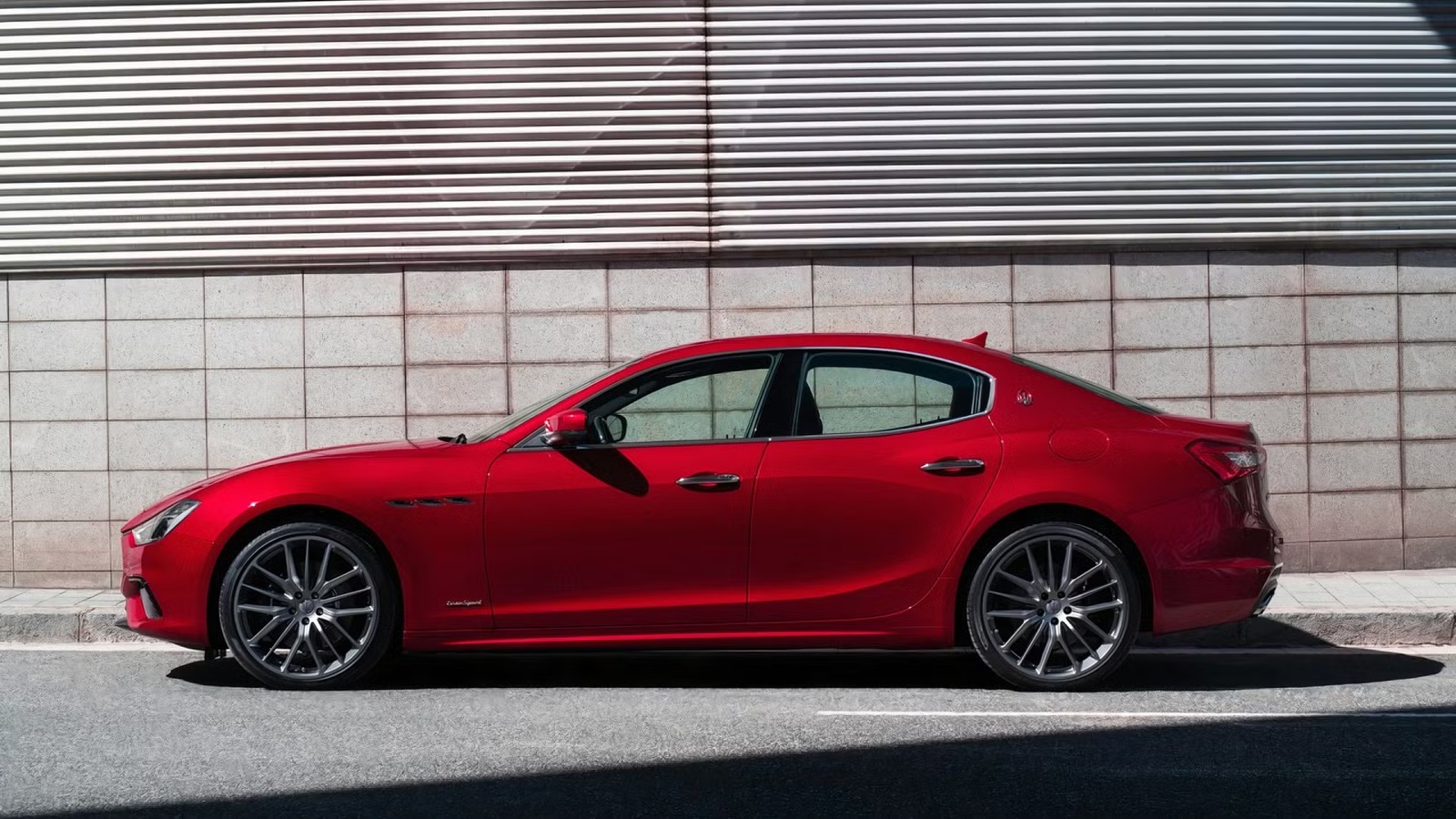
The third-gen Ghibli stands out because it doesn't follow the typical luxury sedan formula. The proportions are more luxury grand tourer than an executive sedan, with a long hood, short rear deck, and a low, cab-rearward stance that gives it a stretched, athletic look.
You get the trident grille, triple side fender vents, frameless windows, and tightly shaped rear lights, while higher trims get larger wheels and darker finishes to make it all look far more aggressive and less polished than some of its German rivals. In typical Italian design fashion, the Ghibli is built around emotion.
The real personality of the Ghibli comes from its sound, though. The F160 V6 doesn't produce noise; it builds a rising, almost-mechanical sound that you can feel in the cabin. It has a hard-edged metallic note under load, like compressed air being forced through a tuned chamber, and it doesn't try to smooth itself. Instead, it sharpens as revs climb, giving off a raspy note, while on lift-off, you get a brief but natural-sounding burble.
The V8 under the hood of the Ghibli Trofeo and 334 Ultima pushes that Italian emotion even further. Its crank delivers a deep, rolling pulse at low revs, but the sound doesn't stay calm for long. The hot-V turbos help it build pressure quickly, and as the exhaust valves open, the tone shifts from a heavy rumble to a sharp, bubbling wail. It isn't clean, but dramatic, and that's what helps to make the Ghibli one of those sedans that sounds like it is in a league of its own.
This overlooked option may not get the same recognition as a 5 Series, but it offers much more quality than meets the eye.
With beautiful design cues, a hint of aggression, powerful engine choices, and exhaust notes that immediately turn heads, you'd think the third-generation Ghibli would be a go-to choice in the used luxury sedan market despite some of the original pricing.
However, the Ghibli caused some confusion when it was released, and we can see why. Many thought that the intent of the Ghibli wasn't clear: was it an engaging driver's car or a comfortable GT? The engine power is good, the sprint times are impressive, and there are a lot of impressive design cues. However, the only transmission option was an eight-speed auto, and while it was a responsive ZF unit, the Ghibli was built perhaps too soft to be the track weapon expected from an Italian exotic and too sporty to be a full-blown long-distance GT, despite its high comfort levels.
Then there are the shared parts in some model years that betrayed the price tag. Early model years borrowed heavily from FCA's parts bin, with switchgear, infotainment hardware, column stalks, and interior control modules being visibly shared with more mainstream models. This makes the cabin arguably feel less bespoke than you'd expect from the price point.
Even though the chassis, powertrains, and tuning are uniquely engineered for Maserati, those everyday touchpoints cause a mismatch, especially compared to German rivals that lean heavily on fully in-house luxury systems.
Then there is the biggest issue for the Ghibli: its reliability reputation. Like some high-end German vehicles that don't have the best relationship with dependability, the Ghibli is presumed to have a difficult time with garage visits. In the past, we have seen and heard of tricky electronics, finicky engines, and high maintenance costs for Italian performance cars. However, this reputation isn't entirely fair in the Ghibli's case.
According to owner reviews on Kelley Blue Book, the final model year is rated 4.4 out of 5 overall, with a 4.4 out of 5 reliability rating. 90% of owners who have left a review would recommend one, and according to CarEdge, the average five-year maintenance costs are approximately $3,304. To put that into perspective, CarEdge says that the BMW 5 Series has average five-year maintenance costs of $4,535.
Value depreciation was not always in the Ghibli's favor. According to CarEdge, a Ghibli will lose 45.6% of its value after the first year, 71% of its original value in the first five years, 79.3% after 10 years, and rate it "F" for value rating. That isn't great news if you were to buy a new Ghibli when it was originally available, but for used buyers, this is fantastic.
While these luxury sedans offer cutting-edge technology and performance, their rapid depreciation means buyers should think twice before buying one.
Low current used prices aside, the third-generation Maserati Ghibli is still worth a serious look in 2026. If you can find a Maserati Ghibli for sale, you should check it out for its "old-school character" and true Italian flair. The interior isn't a techy showroom but is set up to feel like a driver's car, with a low seating position, physical switchgear, and a center console that is tall with mechanical layout.
Higher trims get leather upholstery on the seats and dashboard, while contrast stitching, open-pore wood, and thick bolstered seats give the cabin an air of being sporty and luxurious. Then there is the hardware that gives it a decent sporty edge.
Some trims, like the Trofeo, are available with a very tight chassis, hard spring rates, stiff anti-roll bars, and a far more aggressive damper mapping that gives the ride real bite. The optional Skyhook adaptive damping system also constantly adjusts each corner individually, giving you firm control when you want it and softness on the highway when that is needed.
Ghibli S and Modena models are equipped with rear-wheel drive paired with a torque transfer rig for a sporty feel in the corners, while the Q4 models are equipped with AWD with a 50:50 torque split system that shores up traction. The V8-equipped Trofeo also gets rear-wheel drive for the most driver-centric feel.
There are a lot of options for a relatively short run, and if you want a limited-edition model, the rare 334 Ultima, built to say a sad farewell to Maserati's V8, saw only 103 models made; they have a current average price of around $95,000. Today, they are hard to come by, but they are the last run of what should be a more loved used luxury European sedan.
If you can deal with a slower pace than a Quattroporte and a less-techy than a BMW build, a used Maserati Ghibli represents one of the last-chance buys of a luxury Italian sedan that prioritizes a hands-on experience, hydraulic-feeling steering, surprisingly low maintenance costs for its pedigree, a sumptuous design that is always going to turn heads, and engine options that are becoming a lot harder to find in the modern market.
Found an error? Send it info@www.topspeed.com so it can be corrected.
Sources: Maserati, Kelley Blue Book, and CarEdge.
Source: https://www.topspeed.com/maserati-ghibli-used-luxury-sedan-everyone-misunderstands/
BMW
The Maserati Ghibli Is The Used Luxury Sedan Everyone Gets Wrong
Article Top Ad Zone
Article Middle Ad Zone
Article Bottom Ad Zone
Original Source: www.topspeed.com
Share
Comments
Comment system is currently disabled.