Hybrid car technology in the U.S. has undergone a remarkable transformation, evolving from a niche, experimental segment at the turn of the millennium into a cornerstone of the modern automotive market by 2026. Initially defined by specialized, efficiency-focused vehicles like the early Honda Insight and Toyota Prius, the technology was once viewed with skepticism and largely relegated to early adopters seeking maximum fuel economy.
Follow and Like top authors, topics, and trends
Browse with fewer ads across the site
Personalize your profile to showcase your activity
Get a content feed tailored to your interests
By creating an account, you agree to our Terms of Use and Privacy Policy. You also agree to receive our newsletters; you can unsubscribe any time.
*Required: 8 chars, 1 capital letter, 1 number
As of 2026, the demand for hybrid cars in the U.S. has reached a historic peak. The market is estimated at approximately $312.8 billion and captures a 42 percent share of the global hybrid sector. This surge is primarily driven by a pivot among American consumers who seek significant fuel efficiency and lower emissions without having to deal with the hurdles currently associated with fully electric vehicle ownership.
Over the last decade, hybrids have evolved from niche, economy-focused commuter cars into sophisticated and high-performance vehicles. Modern systems now benefit from advanced power electronics and lightweight materials to provide better acceleration and towing capabilities than their gasoline-only predecessors, effectively positioning hybrids as the new mainstream standard for the American road.
Honda’s journey into hybrid technology began in 1999 with the original Insight, a groundbreaking two-seater that served as the first mass-production hybrid available in North America, earning acclaim for its ultra-lightweight aluminum construction and record-setting fuel efficiency. Over the subsequent quarter-century, the brand evolved its approach from the early Integrated Motor Assist system to its sophisticated, current-generation two-motor hybrid powertrain.
Today, this technology is a cornerstone of Honda’s U.S. lineup, powering popular models across its compact and midsize catalog. The commercial success of these models has been significant. Honda's electrified variants now represent over 25 percent of its total brand sales in the U.S., with the CR-V and Accord frequently topping sales charts as the best-selling hybrid SUV and car in the nation, respectively. This widespread adoption marks a successful transition from niche innovation to a core volume driver for the company, helping Honda achieve record electrified sales volumes in recent years.
The 2026 Honda Civic Si is a modestly exciting sedan that blends practicality and performance with a balanced platform to perfect driving skills.
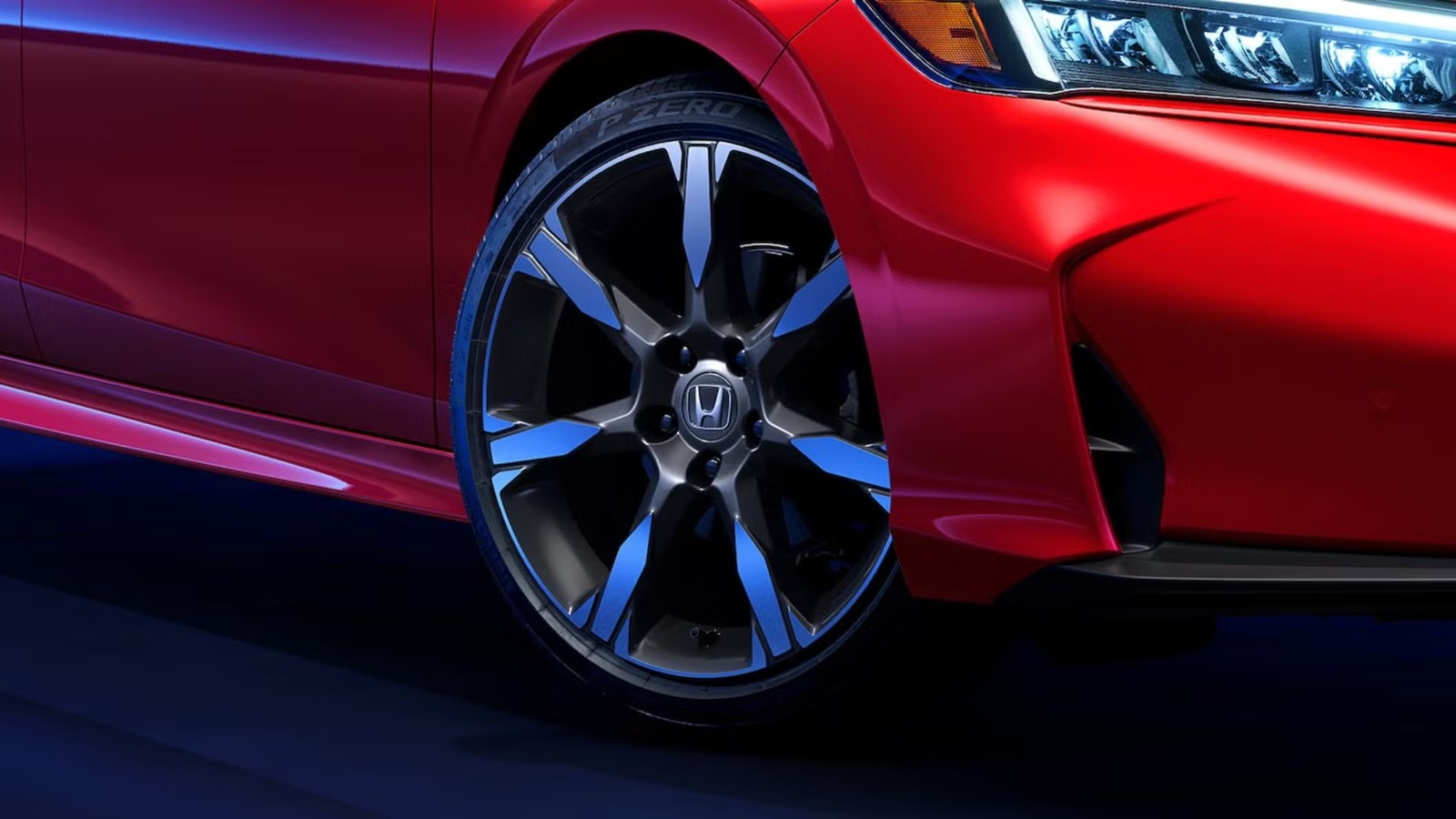
The 2026 Honda Civic Hybrid serves as a critical gateway to the brand's American HEV passenger car lineup. The Japanese brand introduces it to occupy the premium space within the compact family. As a result, it sits just below the larger Accord Hybrid, which is adjacent to the CR-V Hybrid. The compact sedan is positioned to capture a diverse and dynamic key demographic. It strongly resonates with younger buyers, first-time car owners, and consumers who prioritize fuel economy without wanting to compromise on a more engaging driving experience.
This strategic placement has yielded immense commercial success. American Honda reports that the Civic Hybrid achieves a record-breaking sales performance in Q1 2026. This momentum anchor helps elevate overall Civic sales to 57,600 examples for the first quarter. This means that it secures its spot among the top fifteen best-selling vehicles in the U.S., underlining the market's aggressive pivot toward accessible, electrified powertrains.
The 2026 Honda Civic Hybrid is available in both sedan and hatchback body styles. The Japanese brand divides these into two distinct, well-equipped trims. For the sedan variant, the lineup starts with the Sport Hybrid at $29,395, while the top-tier Sport Touring Hybrid is priced at $32,395.
Buyers who prefer the versatility of the five-door hatchback configuration will find the Sport Hybrid starting at an MSRP of $30,595, with the premium Sport Touring Hybrid capping the range at $33,595. Every iteration of the 2026 Civic Hybrid lineup is subject to an additional mandatory destination and handling fee of $1,150.
The Honda Civic Hybrid has always been a safe option for many American consumers, thanks to its straightforward approach to personal mobility. This design strategy works very well for the brand, especially with the current-generation model. iSeeCars awards the 2026 model year with a 7.9/10 overall score, including 7.0/10 for reliability, 8.6/10 for retained value, and 8.0/10 for safety.
On the reliability front, it indicates that the model will cover an average lifespan of 9.4 years or 142,807 miles, with a 12.8-percent probability of covering 200,000 miles. Regarding value retention, you can expect the entire Civic sedan range to lose $8,909 or 30.3 percent of its value, which is a marginally better result than most of the compact car segment.
According to J.D. Power, the same Civic model year benefits from an 85/100 consumer-verified overall score, which includes 84/100 for quality and reliability, 84/100 for the driving experience, 90/100 for resale, and 83/100 for the dealership experience.
Edmunds Consumer Reviews currently rates the Civic Hybrid range at a 4.4/5 average score from 39 unique submissions. Key strengths include its driving experience, fuel economy, and acceleration abilities. Some owners have criticized it for having uncomfortable seats and loud road noise.
The 2026 Honda Civic Hybrid utilizes a highly advanced, front-wheel-drive propulsion system. This is based on a 2.0-liter dual-overhead-cam Atkinson-cycle four-cylinder gasoline engine. Supporting this is a powerful two-motor electric drive unit. Unlike standard internal combustion setups, this arrangement foregoes a traditional mechanical transmission. Instead, the brand applies an electronic continuously variable transmission. It uses the traction motor to drive the front wheels while electronically managing engine-generated power.
This sophisticated layout generates a combined total system output of 200 horsepower and 232 pound-feet of torque from the ICE and electric motor. The HEV system enables the Civic Hybrid to sprint from 0 to 60 MPH in 6.6 seconds, depending on the testing environment and body style. For the sake of preserving mechanical components and optimizing fuel efficiency across its varied drive modes, the vehicle features an electronically limited top speed of 112 MPH.
The 2026 Honda Civic Hybrid delivers impressive efficiency results that vary slightly depending on the body style. The sedan variants achieve an EPA-estimated fuel economy rating of 50/47/49 MPG on the city/highway/combined cycle. The hatchback versions return a marginally lower but still impressive 48 MPG combined rating. Equipped with a 10.6-gallon fuel tank capacity, the sedan achieves a 520-mile range on a full tank.
According to standard EPA metrics calculated against the average internal combustion compact car, you can expect to save up to $4,500 in fuel over five years. Factoring in a typical annual driving distance of 15,000 miles and current average regular unleaded fuel prices, the annual fuel cost sits at $1,050. This means you'll get to enjoy a low cost to drive 25 miles of just $1.75. Filling the tank from empty to full requires an approximate cost to fill of just $34.50 for both sedan and hatch variants.
The 2025 Honda Civic Hybrid delivers 200 horsepower, up to 49 MPG combined, and premium features for under $34,000.
The 2026 Honda Civic Hybrid comes standard with an impressive collection of comfort, convenience, and entertainment features on the entry-level Sport Hybrid trim. This strategy makes the Civic more expensive than its key rivals, but it ensures a more upscale baseline experience. Within the cabin, occupants are greeted by dual-zone automatic climate control, three-level heated front cloth seats, a leather-wrapped steering wheel, red ambient lighting, and a one-touch power sunroof.
Uplifting convenience is push-button start, remote engine start, a 7.0-inch digital driver information interface, and Honda's Smart Entry with Walk Away Auto Lock system. On the entertainment front, the Sport Hybrid features a 7.0-inch color touchscreen infotainment system, featuring wired Apple CarPlay and Android Auto, and a standard eight-speaker sound system.
Stepping up to the top-tier Sport Touring Hybrid trim significantly elevates the technological and luxury equipment. This grade introduces leather-trimmed upholstery, an eight-way power-adjustable driver's seat, and a larger, fully customizable 10.2-inch digital instrument cluster. Entertainment consists of a larger 9.0-inch touchscreen featuring Google Built-In integration. This grants direct access to Google Assistant, Google Maps, and Google Play apps. Honda also includes wireless functionality for both Apple CarPlay and Android Auto.
Furthermore, the Sport Touring Hybrid adds high-tier convenience upgrades, including a wireless smartphone charging pad, additional USB-C charging ports throughout the cabin, and front and rear parking sensors. You also get an auto-dimming rearview mirror and a 12-speaker Bose Premium Sound System utilizing Centerpoint surround-sound technology.
Found an error? Send it info@www.topspeed.com so it can be corrected.
Sources: Honda, The EPA, iSeeCars, Edmunds, and J.D. Power.
Source: https://www.topspeed.com/affordable-hybrid-feels-anything-but-cheap/
Cars
The Affordable Hybrid That Feels Anything But Cheap
Article Top Ad Zone
Article Middle Ad Zone
Article Bottom Ad Zone
Original Source: www.topspeed.com
Share
Comments
Comment system is currently disabled.