Few sports cars command as much respect in the U.S. as the Chevrolet Corvette. Since letting loose in the early 1950s, it has been the go-to choice for bang-for-your-buck performance, aggressive style, and noise. We are now in the C8 generation of the Corvette, and that winning formula hasn't changed. Today, you can pick up a 2026 Corvette Stingray with a 490-horsepower V8 for $70,000.
Follow and Like top authors, topics, and trends
Browse with fewer ads across the site
Personalize your profile to showcase your activity
Get a content feed tailored to your interests
By creating an account, you agree to our Terms of Use and Privacy Policy. You also agree to receive our newsletters; you can unsubscribe any time.
*Required: 8 chars, 1 capital letter, 1 number
American supercars do things a little differently from the European models that once ruled the roads, and that is why we love them. While the likes of Ferrari obsess over razor-sharp steering response and Porsche chase technical perfection through obsessive engineering, some of our homegrown supercars are built around giant-displacement engines, massive torque, and exceptional noise.
The Saleen S7 was America's first true mid-engine exotic, and is equipped with a naturally aspirated 7.0-liter V8 good for 500 horsepower before later bi-turbo models pushed the number to 750 horsepower. With a carbon fiber body, track-worthy aerodynamics, and a claimed 220-mph top speed, it proved America could build a genuine world-class supercar without copying Europe.
Then there are the progressively outrageous Dodge Viper generations. The third-gen Viper SRT-10 gets an 8.3-liter naturally aspirated V10 that pumps out 500 horsepower and 525 pound-feet of torque, all sent to the rear wheels through a six-speed Tremec manual.
By the fourth generation, engine displacement had grown to 8.4 liters and output to 600 ponies. Hardcore Viper ACR models come equipped with massive adjustable aero features capable of generating 1,000 pounds of downforce at speed, and transformed the Viper into a supercar-cum-muscle car.
Hennessey has always taken things that extra step further, and the Venom GT is the embodiment of this. This lightweight hypercar is one of the most outrageous cars an American brand has ever made.
Equipped with a 7.0-liter twin-turbo LS-based V8 good for up to 1,244 horsepower, and built with no AWD system, no hybrid assist, and no traction wizardry, except for the turbos, this is a pure American muscle hypercar. It can hit 60 mph in 2.7 seconds and get to 186 mph (200 kph) in just under 13 seconds.
The 2000s reset expectations for American supercars. After a relatively conservative 1990s, Detroit entered the decade with very deliberate escalation: more displacement, more boost, and headline-grabbing horsepower that could stand next to Europe's best. However, unlike earlier muscle car eras, the targets weren't just other American marques; this time, they were Ferrari, Porsche, and Lamborghini.
Ferrari was refining the F430; Porsche was evolving the 911 Turbo at the time, and Lamborghini was leaning harder into V10 drama. Ford led the American charge with the 2005–2006 Ford GT revival, and unlike earlier American performance cars, this wasn't just a straight-line hero; it was a Le Mans-inspired statement piece.
Under the hood is a supercharged 5.4-liter V8 good for 550 horsepower and 500 pound-feet of torque, mounted in a mid-engine position with a Ricardo six-speed manual transmission. Short overhangs, low roofline, and a chassis designed to sustain high-speed stability rather than short bursts helped to rewrite what an American performance car could be capable of.
Then there were Dodge and Chevrolet. Dodge was continuing their work with the long-hooded, front-engine, RWD and massive V10 philosophy with the SR II and ZB I-generation Viper models, while Chevrolet had the C6 Corvette. Built between 2005 and 2013, this generation of Corvette wasn't exotic in layout or design, but thanks to its lightweight build, front-engine, rear-drive setup, and beefy engines, it was increasingly behaving like one.
It may not carry the same weight, but it can embarrass the oldest and most pedigreed of the old boys.
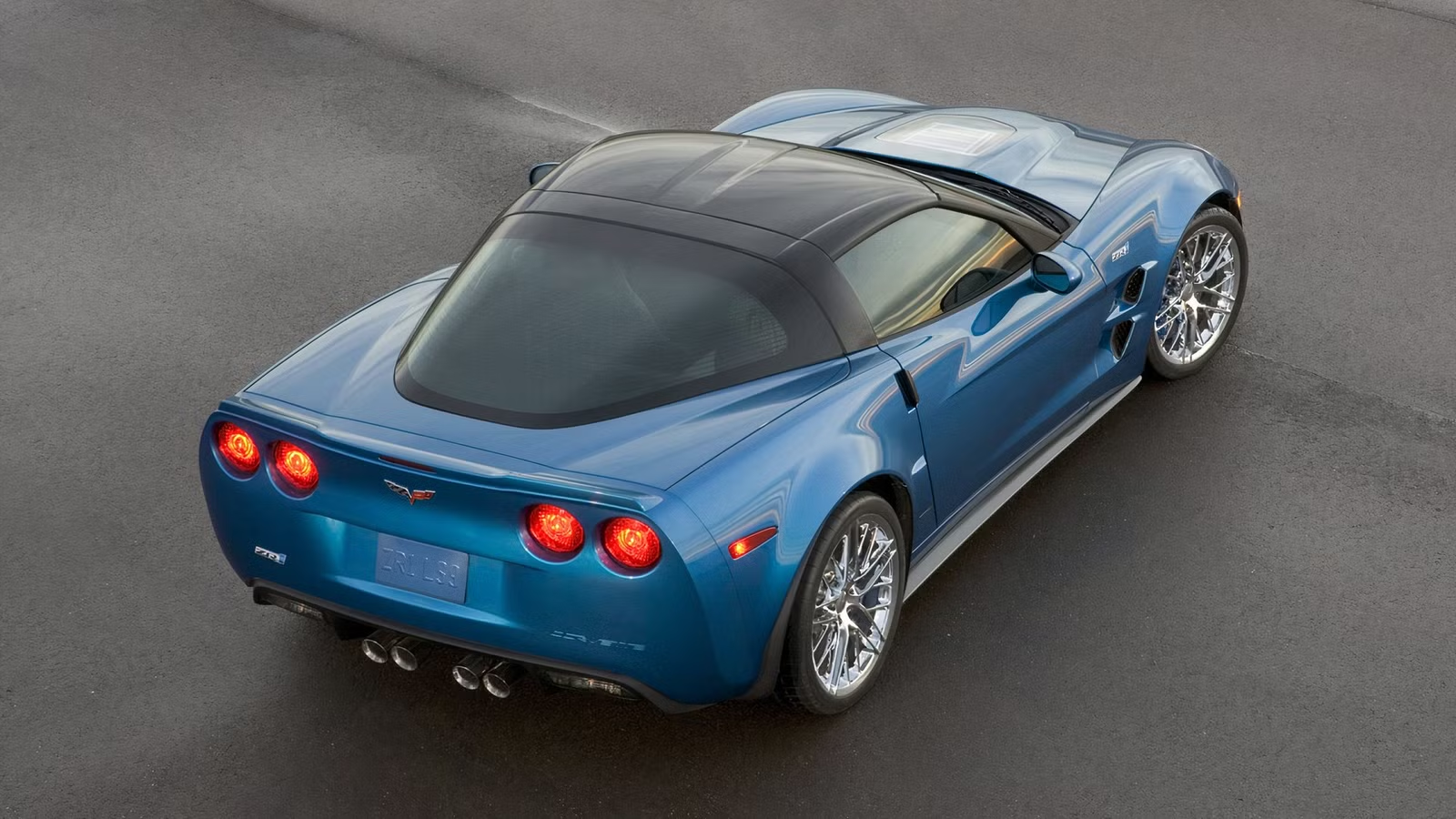
The defining model for the C6-generation Corvette is the ZR1. As the highest grade of the generation, it was a beast when it was originally released between 2009 and 2013, and it is still today. Even today, driving a C6 ZR1 doesn't feel dated; it's an older performance car that still takes the competition to more expensive, newer models.
The C6 Corvette ZR1 was not a cheap American performance car when it was released. In 2009, it had a starting price of $105,000; in 2010, $109,130; in 2011, $112,050; in 2012, $113,500; and in 2013, it had a starting price of $113,575.
To put that into perspective, a 2009 Porsche 911 Carrera 4S originally cost $110,600; a 911 Turbo from the same year cost $132,000, and a 2010 Lamborghini Gallardo had a starting price of $198,000.
At the center of what makes the C6 Corvette ZR1 such a contender to modern supercars is the front-mounted V8 under the hood. It has the following specifications.
The LS9 isn't just a V8 with a blower bolted to it; it is a deeply reworked, hand-assembled evolution of GM's small-block. It follows traditional pushrod architecture, but nearly every internal component was upgraded to withstand forced induction.
The LS9 is equipped with a forged steel crankshaft, forged aluminum pistons, and titanium connecting rods, giving it real strength to take the strain of boost. The supercharger is a 2.3-liter Eaton TVS Roots-type unit running around 10–11 psi in factory state, which has been integrated tightly with a liquid-to-air intercooler sitting in the intake path.
While European rivals were increasingly using DOHC engines at the time, the C6 ZR1 still gets an OHV layout, which helps reduce complexity, while dry-sump lubrication allows for oil scavenging from a separate reservoir to help prevent starvation under lateral G forces. That means the engine can sit lower in the chassis while still maintaining stable oil pressure in high-speed cornering.
The output is healthy, and while modern supercars like the new Ferrari F80 can spit out over 1,000 horsepower, for a 13-year-old model, the C6 ZR1 certainly puts up a good fight in terms of speed. A 2026 F80 can hit 60 mph in 2.1 seconds and has a top speed of 217 mph; a new Lamborghini Temerario can hit 60 mph in as little as 2.1 seconds, and a 2026 Porsche 911 Turbo S can do it in 2 seconds.
A C6 ZR1 can sprint to 60 in 3.4 seconds and has a top speed of 205 mph. So, while it isn't as quick up to speed, its top speed today is intense, while against other cars of the same ilk of a similar age, it does exceptionally well. Some 0–60 mph times and top speeds of 2000s supercars and sports cars are as follows for perspective.
This underrated 2000s American supercar was built as a weapon of mass-power but it is sorely overlooked by so many - here is why it shouldn't be.
On top of the visceral speed, massive V8 under the hood, sultry looks, and raucous noise from the tail, what makes the C6 ZR1 a true driver's car, especially up against more modern examples, is that it's built to be driven by you, not by an electronics system.
You do get a supercharger and some systems, but there is nothing in it that has been added to make it feel suitable for mass production. Inputs go in, mechanical reactions come out, and there's very little in between.
Underneath all the loudness, the C6 ZR1 is still a very mechanical package wrapped in high-output hardware. Power from the LS9 is sent through a Tremec six-speed manual with heavy, deliberate shift action and long clutch travel that forces you to lock in to drive it. There's no dual-clutch lightning speed—just a traditional box that makes everything feel physical.
The chassis is built around a hydroformed steel frame with bonded aluminum elements, giving it serious rigidity without adding weight; the ZR1 weighs just 3,350 pounds. Suspension is handled by a double-wishbone setup at both ends, which is tuned for high-load stability rather than isolation, and while Magnetic Ride Control is included, it works more like a fine-tuning layer that sharpens things up rather than masking what the chassis was designed for.
You get a carbon-fiber hood with a raised center section and heat extractors to clear the supercharger's thermal load; wide front and rear fenders house a staggered tire setup, and huge carbon-ceramic Brembo brakes sit behind the lightweight wheels, with fixed calipers and oversized rotors built to resist fade after all day of caning it.
It has been reported that the 60–0 mph distance for a C6 ZR1 is 97 feet. So, not only is it a supercar killer on the way up, but also on the way down.
It can be argued that modern supercars are built with fast-driving ease in mind; the C6 ZR1 doesn't let you take your eye off the ball. It is set up to be driven fast by those of us who know what we are doing behind the wheel. The rear transaxle layout helps balance weight distribution, but the front-engine, RWD configuration still means the rear axle is constantly managing torque from the supercharged V8 ahead of you.
This is most apparent when the road gets bumpy. The limited-slip diff works hard, but it can't completely disguise how much load is being transferred through the rear wheels under acceleration. Combine that with relatively direct steering and a chassis that lets you know everything rather than filtering it, and you get an American supercar that always feels awake, even when you're cruising.
The brakes are powerful enough to demand proper weight transfer discipline; the suspension reacts quickly enough that mid-corner adjustments are felt immediately, and the drivetrain never feels detached from what the engine is doing. In short, nothing is softened or filtered into the background. It's this kind of intense setup that makes some modern supercars feel not so super.
Big displacement engines are all but a thing of the past; we miss them. This is the biggest engine ever used in an American sports car.
If you are looking for a real driver's car with real bite and looks to match it, the C6 ZR1 has to be a top contender. Unlike a lot of modern supercars and performance cars, the ZR1 is the best of both worlds; it makes you drive it with skill (or learn how to drive with skill) and it delivers power via a hardy, supercharged V8.
It isn't the "purest" supercar on the market, but it's a model that bridges the gap between old and new without losing sight of actually driving something.
The interior isn't as plush as a Ferrari's or Porsche's, but it gets you everything you could ask for in a car meant to be driven. The seating position is low, the gear shifter is within easy reach, the sports buckets are nicely bolstered, and the later C6 ZR1 models started to get suede and leather inserts for better grip on the steering wheel, shift knob, and seat centers. However, the real attention to detail has been put into how it drives over what it looks like inside.
Instruments are "crude" compared to what we get today, and most of it is analog, with a large central tachometer taking up the cluster and a secondary digital information display handling speed, temperatures, and performance readouts. The graphics and resolution got better as the years progressed, but the core philosophy remained: make engine data instantly readable without having to hunt through a load of menus.
What makes the ZR1 even better is that it's not priced a million miles beyond reach for what you get; in typical Corvette fashion, it's maximum bang-for-your-buck still.
A new Porsche 911 Turbo S does get you a 701-horsepower rig and 2.4-second 0–60 mph times (with Sport Chrono Package), but it costs $270,000 upwards. The new Ferrari F80 gets a twin-turbo 3.0-liter V6 mated to a hybrid rig good for 1,184 horsepower and 2.2-second 0–60 mph times, but you are looking at spending at least $3.75 million.
According to Classic.com, the C6 ZR1 has an average auction price of $103,713. The lowest recent auction price was $61,000, while the highest Corvette C6 ZR1 for sale recently fetched $151,200. Yes, we know this is still a lot of money, but you get a huge amount for it.
The secret-sauce blend of bona-fide supercar sprint times, intense stopping distances, 200+ mph top speeds, a proper V8 under the hood, a model line that made the Europeans finally admit that American supercars did exist, and a real hands-on feel makes finding a Corvette C6 ZR1 for sale far more appealing than lusting over some newer European supercars that are likely to always be out of reach.
Found an error? Send it info@www.topspeed.com so it can be corrected.
Sources: Chevrolet, J.D. Power, Classic.com, and Kelley Blue Book.
Source: https://www.topspeed.com/corvette-c6-zr1-still-shames-modern-supercars/
Cars
The Corvette C6 ZR1 Secret That Still Embarrasses Modern Supercars
Article Top Ad Zone
Article Middle Ad Zone
Article Bottom Ad Zone
Original Source: www.topspeed.com
Share
Comments
Comment system is currently disabled.