There are certain vehicles in the industry where each improvement has pushed the boundaries of design, technology, or sometimes, even luxury. Brands that were once known for value rather than heritage or design are now making names for themselves in these aspects.
Take, for example, Hyundai—a brand primarily known for affordable vehicles to go from A to B and not much else—has been reinvented numerous times over the past decade. At one point, Hyundai showed the world that it could enter the luxury and performance segments with the Genesis sedan and Genesis Coupe. It also showed the world that a stylish vehicle didn't need to come from the luxury segment when it debuted its Fluidic Sculpture design language in the mid-2000s.
Now, in 2026, Hyundai has witnessed numerous reinventions, whether in the electric vehicle (EV) space or its core mainstream vehicles. Cars like the Hyundai Santa Fe and its boxy silhouette have become bold design statements, while the Ioniq 5 became one of the front-runners of today's retrofuturistic design theme. The Hyundai SUV in today's topic also shares these qualities, and to a point that it arguably feels even more luxurious than a Mercedes-Benz GLC.
In a world cluttered by emission regulations and the advent of electric vehicles, these 10 SUVs still rock a six-cylinder engine.
Everyone loves an underdog story because it is these kinds of stories where competitors in the same field are forced to step up their game. Since Hyundai started becoming a desirable brand in the mid-2010s, competitors have adapted, so let's take a look at those moments when South Korea's largest automaker was churning out sensational hits that led it to where it stands today.
Hyundai wasn't a brand you'd go to for exciting cars, but that all changed in 2009 with the debut of the Hyundai Genesis Coupe. Even to this day, the Genesis Coupe is a great two-door grand tourer (GT) with proper German car-like rear-wheel drive (RWD) driving finesse at an affordable price. On a related note, the Genesis Coupe also came with the Genesis sedan, which was a midsize luxury offering that brought Lexus levels of luxury at a more competitive price. This led Hyundai to finally make the Genesis nameplate a brand of its own.
Likewise, the Genesis Coupe set the tone for fun and sporty Hyundais when the brand became confident enough to launch its own motorsports sub-brand. Called Hyundai N, the South Korean automaker's performance division has churned out sensational models like the Elantra N. For EV fans, the Ioniq 5 N proved to the world that high-performance and EVs can certainly mix, particularly as to this day, it's one of the only few EVs, in my opinion, that have an attitude.
Finally, the story of Hyundai wouldn't be complete without its bold take on vehicle design. The mid-2000s Fluidic Sculpture era reached its peak with the debut of the YF-generation Sonata in 2009, and I think many will agree that this generation of the Sonata still looks good in 2026. Fluidic Sculpture 2.0 was less successful, as some of the models it produced didn't push the boundaries of design enough. Hyundai will once again find its design footing with Sensuous Sportiness, which made its debut in the 2020 Sonata.
Fast-forward to 2026, and you've once again got several models with distinct designs—some of which even proved to be controversial. Case in point, the Hyundai Santa Fe, whose boxy look was the result of its "Refined and Robust" design theme. The Ioniq 5's retrofuturistic looks were a blend of Sensuous Sportiness with its Parametric Pixel motif for its EVs, which resulted in the Ioniq 5 being crowned as the 2022 World Car Design of the Year, World Electric Vehicle of the Year, and World Car of the Year. The model in today's article isn't exactly part of a design language, as Hyundai decided to give this SUV a unique identity. And yet, with its striking looks and posh interior, this model, in my opinion, brings into question why you should still spend a fortune on a German luxury car.
These are the hottest models soon to debut from every major manufacturer stateside.
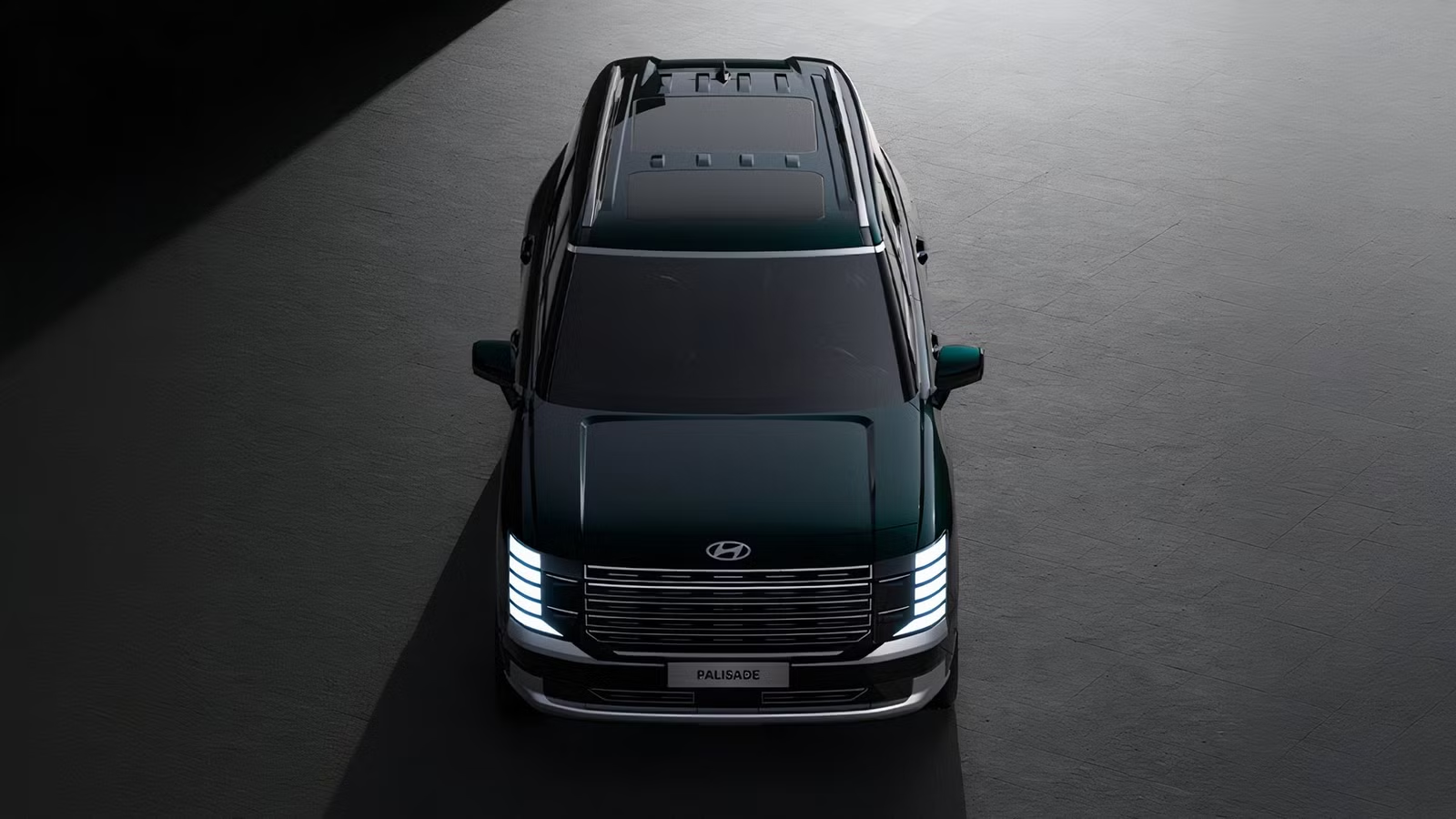
The Hyundai SUV that's pushing the boundaries of what to expect in a three-row mainstream family SUV is the 2026 Hyundai Palisade Calligraphy—a truly posh large crossover SUV whose design and quality make us question whether a proper luxury SUV is even worth it.
Remember a time when German luxury cars had sophisticated and authentic designs? Yes, I do miss that era, too, and so the 2026 Hyundai Palisade Calligraphy is therefore a refreshing model to see. Rather than taking a page out of the typical modern design playbook, the Palisade innovates with its distinct and bold front end. Frosted glass for the horizontally stacked LED daytime running lights lets these elements blend with the grille when the vehicle is turned off. Once the vehicle is in motion, these become the LED daytime running lights. The main headlight beams are tucked at the sides of the grille, once again concealing these design elements to create a very thoughtful front end.
At the sides, the Palisade Calligraphy's silhouette is accented by a host of satin silver elements running down the vehicle and also the windows. 21-inch multi-spoke, two-tone wheels add a touch of class to the overall design of the vehicle. Finally, the rear end features LED taillights that mirror the stacked layout of the daytime running lights. Of course, going for lower trims will result in a Palisade that looks less premium, but fundamentally speaking, all the innovative design flourishes of this vehicle are fitted on all variants.
Equally impressive is the interior of the Palisade Calligraphy, because this is where Hyundai's best foot forward in terms of premium feel shines. The overall design puts airiness at the forefront, with its deeply sculpted dash adding a sense of space. Neatly integrated into the dash design is the brand's signature twin-screen layout consisting of dual 12.3-inch displays running the connected car Navigation Cockpit (ccNC) operating system.
Surrounding the interior of the Calligraphy variant are tons of Nappa Leather upholstery that is mixed with genuine wood trims. Its interior has barely an ounce of gloss black, too, which is always a good thing. The GLC, unfortunately, has fallen for that trap. But what the Palisade has that a GLC doesn't even have is a plethora of physical controls at the front of the cabin. This makes its interior so user-friendly, and that's before we even begin with the expansive center storage area that also contains a wireless charging pad. Finally, those at the back are treated to ventilation for the power-adjustable captain's chairs, while third-row occupants get a power-folding third row that, for now, is subject to a recall due to its mechanism, unfortunately killing a child.
This is one of the best three-row SUVs you can buy today, due to qualities that are pretty much luxury grade without luxury-grade pricing.
If you're ready to begin your crafted journey with the Palisade Calligraphy, you'll first need to determine which type of vehicle is perfect for you. That's because you have the choice between the 3.5-liter V-6 and the potent yet highly efficient 2.5-liter turbo hybrid.
The first engine choice is a 3.5-liter V-6 that produces 287 horsepower and 260 pound-feet of torque, mated to a smooth-shifting eight-speed automatic. This powertrain combination is smooth, but as you'll see with its power output, the engine is just right for its size and weight. Our team has reviewed the Palisade Calligraphy V-6, and based on their experience, the eight-speed transmission is smooth but can feel confused and hesitant during downshifts. And yes, you'll be commanding a lot from this engine when you load this vehicle up with people, because its peak torque doesn't come until 5,000 rpm.
On the upside, if luxury-grade handling and refinement are what you're after, then the 2026 Hyundai Palisade Calligraphy is perfect for you. Its suspension and handling tuning help this large three-row SUV feel smaller than it actually is, thanks to perfectly weighted steering, along with body control that balances ride and handling. Credit the self-leveling hydraulic rear dampers, which keep the body leveled even when loaded. Ride quality is equally impressive, quelling bumps even before its vibrations are transmitted into the cabin.
If you could afford the Calligraphy variant already, then why not splurge altogether for the hybrid? Not only is it our pick based on its excellent fuel economy and our seat time with this version, but it's also the more potent and more capable powertrain out of the two. With a parallel arrangement due to the electric motors being positioned between the engine and the six-speed automatic transmission, the Palisade Hybrid avoids the droning throttle feel of Japanese hybridsthat make use of an e-CVT.
The Palisade Hybrid also has a few clever features that take advantage of its electrified drivetrain, including vehicle-to-load (V2L) and even Stay Mode, where the vehicle uses the hybrid system's battery to power the vehicle when idling.
2.5-liter turbocharged inline four hybrid
31 MPG (FWD Limited, FWD Calligraphy)
But more importantly, this engine is even more potent than the V-6. Power is delivered linearly and in a very responsive manner, especially thanks to the electric motors filling in the gaps of the engine's power band and the torque interruptions during gear changes. With so much power on tap, you'll also rarely hear this engine working hard, while the ability to cruise in pure electric during coasting and light throttle applications simply adds to the indulgent refinement of the Palisade Calligraphy.
Found an error? Send it info@www.topspeed.com so it can be corrected.
Source: https://www.topspeed.com/hyundai-suv-feels-more-luxurious-than-mercedes-glc/
Cars
The Hyundai SUV That Feels More Luxurious Than A Mercedes GLC
Article Top Ad Zone
Article Middle Ad Zone
Article Bottom Ad Zone
Original Source: www.topspeed.com
Share
Comments
Comment system is currently disabled.