Imagine this: you get to pick one car for life. It’ll be the only car in your garage, regardless of how many cars your garage can swallow. In that case, a driving enthusiast is better off picking something that’s equal parts high-performance, with a manual transmission, and as practical as a crossover SUV. Essentially, a performance car that can do everything.
Follow and Like top authors, topics, and trends
Browse with fewer ads across the site
Personalize your profile to showcase your activity
Get a content feed tailored to your interests
By creating an account, you agree to our Terms of Use and Privacy Policy. You also agree to receive our newsletters; you can unsubscribe any time.
*Required: 8 chars, 1 capital letter, 1 number
Today, the automotive world is ruled by compact SUVs or crossovers. Everyone wants one for their higher seating position and the option of all-wheel drive. Though the average driver typically thinks they need those features more than they do. What actually matters in the real world is the practicality of a compact SUV body style: large interior space and plenty of cargo space to haul everything from a week’s worth of groceries to road trip luggage.
Such a practical format existed long before compact SUVs became the trend; we’re talking about station wagons. Sure, many of you will think of old American station wagons with wood panels on the side, but wagons come in a lot of variety. These range from practical family wagons to performance wagons that can keep up with sports sedans. For driving enthusiasts, it’s the latter that matters more. It’s why modern performance wagons, like the Mercedes-AMG E 53 Hybrid Wagon or Audi RS 6 Avant, are so popular.
But what if you want an American flavor with a powerful V8 engine and manual transmission? You can’t buy a single brand-new American station wagon with a manual transmission today, but just 12 years ago, Cadillac had one. This Cadillac wagon went against the market trends, featuring a supercharged V8 engine, three pedals, and all the luxury you’d expect from this American moniker. It may be forgotten by the masses, but it will remain one of the best executions of a performance wagon ever.
The fast wagon niche promises excellent practicality with the kind of power and fun that you'd normally expect from a sports sedan or sports car.
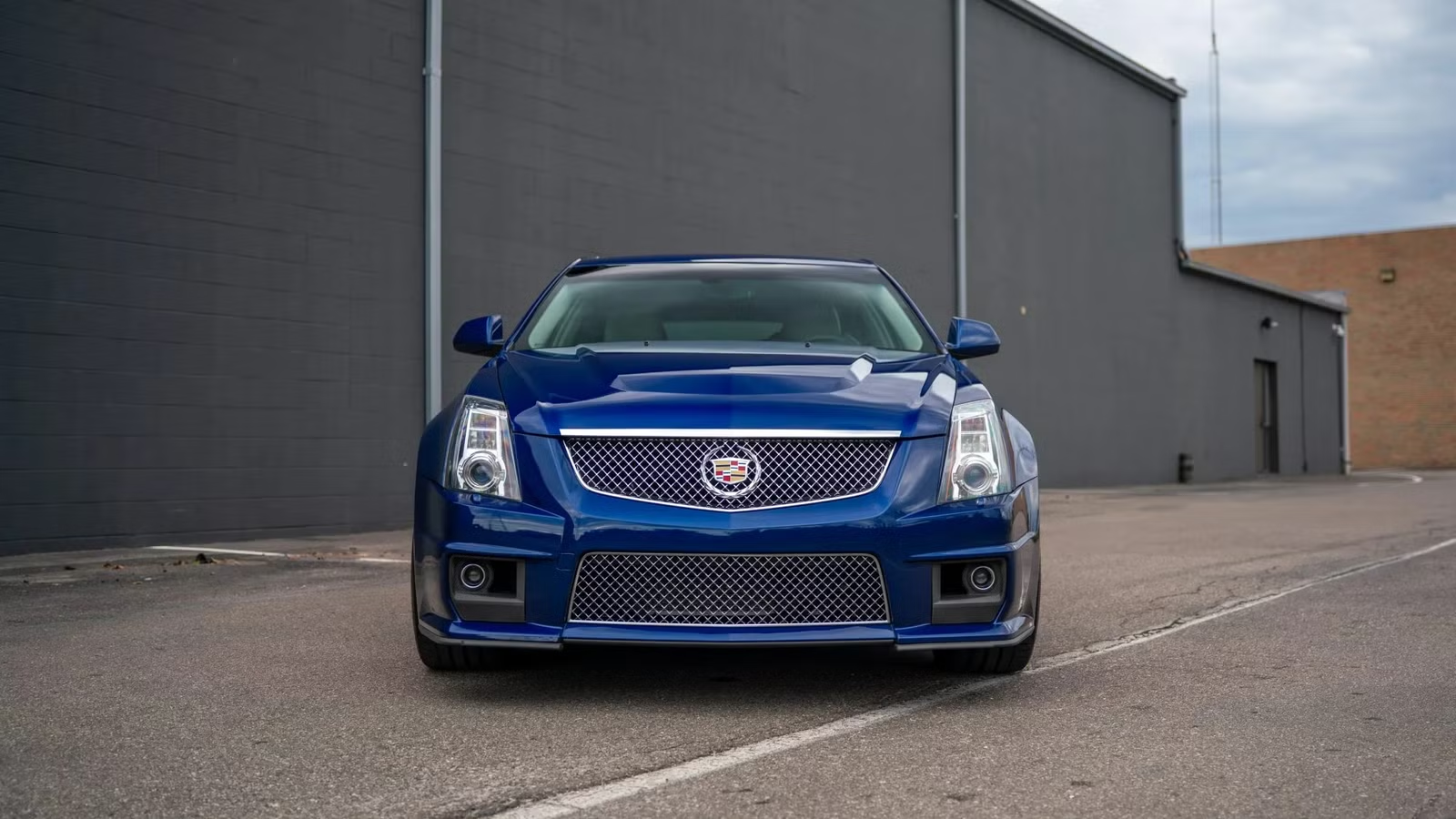
Back in 2011, Cadillac went against the grain; instead of building a snappy roadster or a fast sedan, the American company focused on creating something that would be known as the CTS-V Wagon. It combined the utility and practicality of the big CTS wagon with the ever-powerful V-Series treatment, resulting in a spacious family hauler that could keep up with proper sports cars. The CTS-V Wagon thus became an instant automotive icon that still commands respect today.
The CTS-V Wagon is everything an enthusiast will ever need. It features a detuned version of the Corvette ZR1 supercharged V8 engine, crammed under the hood of a full-size wagon body. With 560 horsepower on tap, what made matters better was the option of a six-speed manual transmission, along with Magnetic Ride Control (MRC), which gave it M3-like agility in the corners.
As good as wagons are, they are still a niche product, including the standard CTS wagon. So, it’s no surprise that the CTS-V was nearly invisible in terms of mass-market sales for General Motors. But it was never meant to be. It was a halo project designed to showcase Cadillac’s performance credentials, nothing else. This is why the CTS-V Wagon, over its brief production from 2011 to 2014, sold only under 2,000 units. The official number cited is roughly 1,767 units, making it among the rarest modern American cars.
The CTS-V Wagon with the manual transmission is even rarer. Unconfirmed numbers stand at just 514 units. Because so few CTS-V Wagons were ever made, the three-pedaled versions are even rarer today, which helped it achieve instant classic status. As mentioned, the CTS-V Wagon may not be a popular pick today, but those in the know are willing to pay a premium to experience the American performance wagon format in all its glory.
What was once a staple on the market has all but disappeared. Here is what happened to the American station wagon and what it needs for a comeback.
Under the creased aluminum hood of the CTS-V Wagon sits its crown jewel, the LSA engine. This 6.2-liter supercharged V8 is essentially a detuned version of the LS9 V8 found in the Corvette ZR1, and despite being less powerful than the LS9, it still produces a whopping 556 horsepower and 551 pound-feet of torque. Back when it was launched, reviewers noted that the V8 delivered incredible power, with a thunderous wave of torque that was enough to keep up with many sports cars.
The engine features an intercooled 1.9-liter Eaton TVS supercharger with a unique design. It employs twin four-lobe rotors, twisted at 160 degrees instead of the typical three-lobe setup twisted at 60 degrees. This unique setup, paired with the air inlet and outlet port, is said to create smoother, more efficient airflow into the engine. The same supercharger also served in the Camaro ZL1 and Corvette ZR1. Thanks to this, you don't have to wait for power to arrive — it's simply there, along with the signature metallic whine that complements the deep V8 thrum.
So, what does this setup perform like in the real world? The CTS-V Wagon is not a light car; tipping the scales at 4,300 pounds, it’s heavy. Still, the supercharged V8 manages a 0-to-60-mph time of 3.9 to 4.0 seconds, which is impressive even by today's standards. It’s not too shabby for a rear-wheel drive car, but the wagon wasn’t just about straight-line performance. Early reviewers also noted that the engine had a dual personality, turning into a civilized cruiser at low engine speeds and violent when you give it the beans.
Move aside luxury SUVs; this 2025 Audi luxury performance wagon proves you can have practicality and performance grit in one package.
The CTS-V Wagon came with a pair of six-speed transmissions, starting with the Hydra-Matic 6L90 six-speed automatic with steering wheel-mounted shift controls. Most owners naturally went for this for the easy driving experience it offered. As good as automatic transmissions were in the early 2010s, they still couldn’t match the visceral feel of a manual. So, the few enthusiasts who wanted to keep things analog and interesting went for the available Tremec TR6060 six-speed manual transmission.
The six-speed manual transmission was chosen for a reason. Before making its way into the CTS-V Wagon, the transmission served in the Shelby GT500 and Dodge Viper — it was sturdy enough to handle the LSA's massive torque without eating itself up. According to those who have driven the manual model, the manual CTS-V Wagon is an experience. It lacked the over-boost protection sometimes felt in the automatic model, while giving the driver unfiltered access to the engine’s capability.
Moreover, the manual transmission made the driving experience better and made you feel more in control of the car beyond just power delivery. The CTS-V Wagon has a long roof, which makes it less precise than a similarly sized sedan. The manual transmission allows you to control the weight transfer of the long-roof body with precision, and at the same time, engine braking can help improve the car's behavior in fast corners. What’s there not to like about the manual transmission on this V8 performance wagon, then?
They might be the forgotten children of decades past, but station wagons are still better than big, bulky, SUVs.
The performance of the LSA didn’t take away from the CTS-V Wagon’s practicality. On the outside, this wagon features a handsome design that doesn’t look as dorky as older wagons. The mesh grille, functional power dome hood, and flared fenders that barely contain the 19-inch forged aluminum wheels are clues that this wagon means business. At the back, Cadillac's hallmark vertical taillights frame the tailgate, which hides a surprisingly generous 25 cubic feet of cargo space behind the rear seats.
Step inside, and you’re met with typical Cadillac luxury appointments with unmistakable V-Series touches everywhere. Standard features include leather upholstery, a heated steering wheel, a Bose surround sound system, and a deployable infotainment screen. These upscale touches share space with performance bits, including Recaro performance seats with pneumatic bolster controls, suede microfiber accents on the steering wheel and shift knob, and clearly legible gauges delivering real-time data.
Adding to its practicality and comfort is the Magnetic Ride Control (MRC). This includes shocks that use magneto-rheological fluid to adjust damping rates every millisecond. As a result, the wagon feels like a true Cadillac on the highway and, when things start getting fast, it turns into a capable performance car that can handle fast corners with ease.
Before the popularity boom of the SUV, classic station wagons used to define the American road trip. With these modern versions, wagons could again.
Who wouldn’t want a performance wagon with a V8 engine and manual transmission? But if you’re looking for a bargain, you’d have to look elsewhere. The CTS-V Wagon is a rare modern classic that has appreciated significantly in value over the last decade. The manual examples are even more so; they often sell more than their original MSRP of $62,990 in 2011. Classic.com puts the CTS-V Wagon manual’s average asking price at $63,241, which is over $10k more than that of the automatic model ($50,957).
Given how rare this car is, many will still see this as a bargain. If you’re one of those, don’t hesitate; the CTS-V Wagon is actually a solid choice even in 2026. The LSA V8 engine is generally dependable and easy to modify. However, you will have to keep the enthusiast tax in mind for things like the MRC shocks and Brembo brake rotors, which can be expensive to replace. Earlier models also suffered from supercharger isolator rattle, which should’ve been fixed under warranty.
With the concerns aside, it’d be foolish to pass up this amazing piece of American automotive history. The CTS-V Wagon was nothing short of an anomaly; in a world that was moving toward crossovers, for a brief moment, GM took the risk to prove its engineering prowess. The CTS-V Wagon remains the last of its kind. It’s an all-American V8 station wagon with a manual transmission. Not to forget, it is appreciating in value, so it’s essentially an investment today.
Found an error? Send it info@www.topspeed.com so it can be corrected.
Source: Cadillac, Car and Driver, Classic.com
Source: https://www.topspeed.com/forgotten-luxury-station-wagon-manual-and-v8/
Cars
The Forgotten Luxury Station Wagon With A Manual Transmission And V8 Power
Article Top Ad Zone
Article Middle Ad Zone
Article Bottom Ad Zone
Original Source: www.topspeed.com
Share
Comments
Comment system is currently disabled.