The compact SUV segment in the United States has solidified its position as a powerhouse of the domestic automotive industry over the last five years. During this time, it has grown to capture nearly 42 percent of all new passenger vehicle registrations. This massive volume expansion reflects a long-term structural shift away from traditional sedans, driven by buyers seeking a blend of elevated ride height, cargo flexibility, and improved fuel economy.
Follow and Like top authors, topics, and trends
Browse with fewer ads across the site
Personalize your profile to showcase your activity
Get a content feed tailored to your interests
By creating an account, you agree to our Terms of Use and Privacy Policy. You also agree to receive our newsletters; you can unsubscribe any time.
*Required: 8 chars, 1 capital letter, 1 number
Chevrolet has shifted its U.S. business model to anchor heavily around its entry-level subcompact and compact SUV portfolio. The American brand has successfully transitioned out of traditional passenger sedans to capture budget-conscious buyers and has effectively redefined what consumers expect from an entry-level vehicle. It has done so by restructuring these smaller utility vehicles with aggressive modern styling, enhanced digital cockpits, and highly competitive pricing structures starting well under $30,000.
This product pivot has delivered massive rewards in terms of sales volume. GM confirms that its leading subcompact and compact crossovers have surged over the last five years to push annual deliveries for these specific segments combined well past the 300,000-unit mark in 2025. These vehicles operate on tighter individual profit margins than Chevrolet’s full-size pickups and traditional large SUVs. However, this high volume returns favorable profitability. This high-volume strategy keeps production facilities running at optimum capacity, heavily offsets corporate average fuel economy penalties, and establishes a massive, loyal base of first-time and urban buyers that fuels overall brand profitability.
If you’ve been skimming over the 2025 Chevy Trax in favor of flashier names, it’s time to give it a closer look.
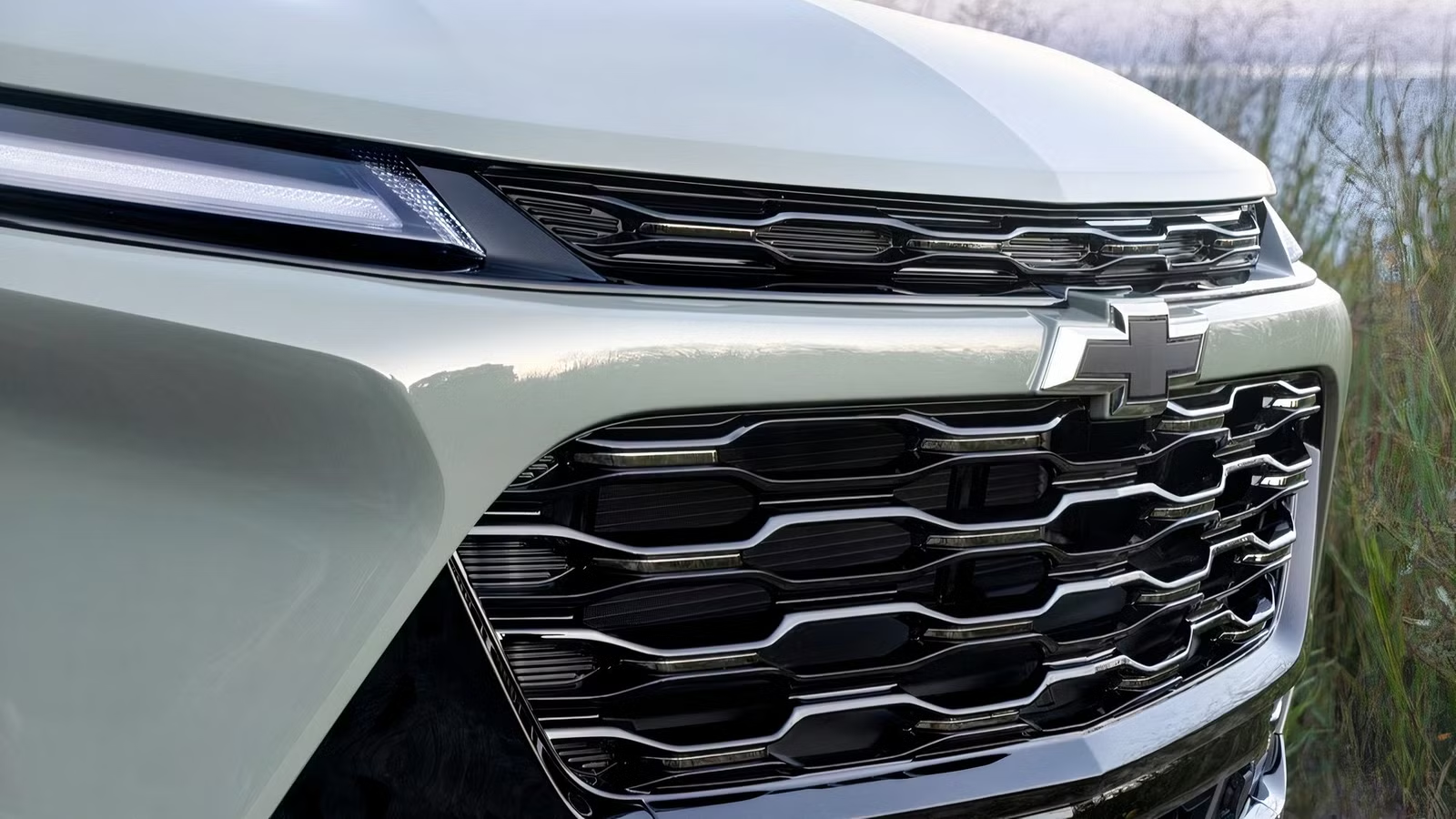
The 2026 Chevrolet Trax is GM's critical, high-volume gateway to the brand's entire crossover lineup. This subcompact crossover acts as the brand's entry-level foundation in the portfolio beneath the slightly larger Trailblazer. Chevrolet has purpose-built the Trax to capture budget-conscious first-time new-car buyers, young urban professionals, and downsizing older consumers. The model targets a demographic that prioritizes a sub-$25,000 starting price without sacrificing modern styling or advanced digital cabin tech.
This positioning has proven to be a massive success, according to General Motors' Q1 2026 earnings and retail reports. It reveals that the Trax achieved its best-ever first-quarter retail market share, solidifying its status alongside the larger Equinox as one of the primary drivers of GM's core profitability and crossover volume. Even amid broader first-quarter automotive industry headwinds, the Trax's blend of sharp aesthetics, essential driver-assistance safety suites, and accessible pricing has made it a standout performer, keeping Chevrolet firmly entrenched at the top of the competitive subcompact sales charts.
The 2026 Chevrolet Trax catalog splits across five distinct trims. This starts with the LS base model at $21,700. For an entry-level trim, the LS is surprisingly well-equipped with standard entertainment and comfort features. It includes an 8.0-inch infotainment touchscreen with wireless Apple CarPlay and Android Auto, a built-in Wi-Fi hotspot, and Active Noise Cancellation to keep the cabin quiet.
Stepping up to the 1RS at $23,200 shifts the focus toward a sportier aesthetic, adding 18-inch wheels, black bowtie emblems, and distinct red interior accents. While it carries the same 8.0-inch screen, the 1RS introduces standard comfort upgrades like heated front seats, a heated steering wheel, and a remote starter system to enhance cold-weather convenience.
The technology core of the lineup centers around the LT trim, which matches the 1RS with a starting price of $23,200. Its specification prioritizes modern digital convenience over sporty looks. This trim expands the cabin entertainment layout with a larger 11-inch HD infotainment touchscreen paired with an 8.0-inch digital driver information center, automatic climate control, and a six-speaker audio system.
The sporty 2RS or the outdoor-themed ACTIV act as the flagship trims for the range, costing $25,400. The 2RS pairs the LT’s upgraded 11-inch screens with aggressive 19-inch wheels, Evotex premium faux-leather upholstery, and a flat-bottom heated steering wheel. Meanwhile, the ACTIV swaps out the urban sport accents for unique titanium-chrome exterior trim. It also features 18-inch black-painted wheels, exclusive interior color details, and an eight-way power-adjustable driver's seat with two-way lumbar support.
Across all five models, Chevrolet keeps standalone options and package selections straightforward. For the lower-tier LS and LT variants, you can opt for dedicated Convenience Packages to add missing premium elements like heated seats, a wrapped heated steering wheel, and body-color heated power mirrors. A standalone Sunroof Package is also widely available from the 1RS up through the ACTIV trims. This bundles a power sunroof alongside a wireless smartphone charging pad on the LT, 2RS, and ACTIV. All trim levels are subject to an additional mandatory $1,795 destination freight charge to transport the vehicle to dealership lots.
Taking aim at the subcompact & compact SUV markets, the 2024 Chevy Trax 2RS is a model that stands out for lots reasons - find out how the 2RS does it
The 2026 Chevrolet Trax is powered by a compact turbocharged EcoTec 1.2-liter inline three-cylinder engine. This generates 137 horsepower at 5,000 RPM and 162 pound-feet of low-end torque peaking at 2,500 RPM. Chevrolet routes this power exclusively to the front wheels via a conventional six-speed automatic transmission.
Because its engineering prioritizes urban packaging and high fuel efficiency rather than utility hauling, the Trax is not rated for towing, and Chevrolet officially discourages trailer pulling of any kind. From a standstill, the subcompact crossover completes the sprint from 0 to 60 MPH in 8.8 seconds, eventually climbing to an electronically limited top speed of roughly 115 MPH.
The 2026 Chevrolet Trax delivers highly competitive efficiency metrics for a non-hybrid crossover, earning official EPA estimates of 28/23/30 MPG on the city/highway/combined cycle. A 13.2-gallon fuel tank offers an estimated range of 370 miles in pure city environments and up to 422 miles on open highways under ideal conditions.
According to standardized EPA criteria based on current national averages for regular unleaded gasoline, you can expect an annual fuel cost of approximately $1,650. This translates to a cost of $1.38 to drive 25 miles. Over a standard five-year ownership cycle, the Trax’s thrifty three-cylinder powertrain is projected to save consumers roughly $750 in fuel costs compared to the average new vehicle in the U.S. car market. You can expect a total cost to fill the empty tank to average between $40 and $45, depending on localized gas station pricing fluctuations.
Is there an upscale alternative to the Chevrolet Trax? Buick has a subcompact crossover that could easily be worth the premium and right for you.
The Trax may not be GM's most exciting creation, but it earns a lot of praise from reviewers and owners. J.D. Power gives the model an 83/100 consumer-verified overall score, including 84/100 for quality and reliability, 83/100 for the driving experience, 82/100 for resale, and 84/100 for the dealership experience.
The 2026 model year currently holds a 4.4/5 average score on the Edmunds consumer review portal, based on 75 reviews. Key strengths include its value proposition, visual presence, and fuel efficiency. Some owners have criticized its reliability and manufacturing quality, road noise, and unsatisfactory infotainment system experience.
iSeeCars gives the 2026 Trax a 7.5/10 overall score, including 7.1/10 for reliability, 7.8/10 for retained value, and 7.5/10 for safety. On the reliability front, the publication indicates that the subcompact crossover will experience an average lifespan of 10.1 years or 132,138 miles, with a 1.6 percent probability of reaching 200,000 miles.
Every 2026 Chevrolet vehicle comes packaged with a standard factory warranty designed to provide foundational peace of mind during the initial years of ownership. The coverage begins with a three-year or 36,000-mile bumper-to-bumper limited warranty. This covers parts and labor to correct any manufacturing defects in materials or assembly. The coverage uniquely includes factory-installed tires against the same defects. Beyond this initial window, the core mechanical components receive extended protection under a five-year or 60,000-mile powertrain limited warranty.
These include internally lubricated parts within the engine, transmission, and front-wheel-drive systems. Sheet metal panels are shielded by a dual-tier corrosion policy, featuring standard three-year or 36,000-mile surface rust protection alongside a long-term six-year or 100,000-mile rust-through warranty that guards against actual structural perforation. Furthermore, Chevrolet bundles five years or 60,000 miles of 24/7 roadside assistance. The brand also fully covers the Trax's first maintenance visit within the initial year of ownership for a complimentary oil change, multipoint inspection, and tire rotation.
Found an error? Send it info@www.topspeed.com so it can be corrected.
Sources: Chevrolet, EPA, J.D. Power, iSeeCars, and Edmunds.
Source: https://www.topspeed.com/compact-suv-budget-superstar/
Cars
The Compact SUV That Quietly Became A Budget Superstar
Article Top Ad Zone
Article Middle Ad Zone
Article Bottom Ad Zone
Original Source: www.topspeed.com
Share
Comments
Comment system is currently disabled.