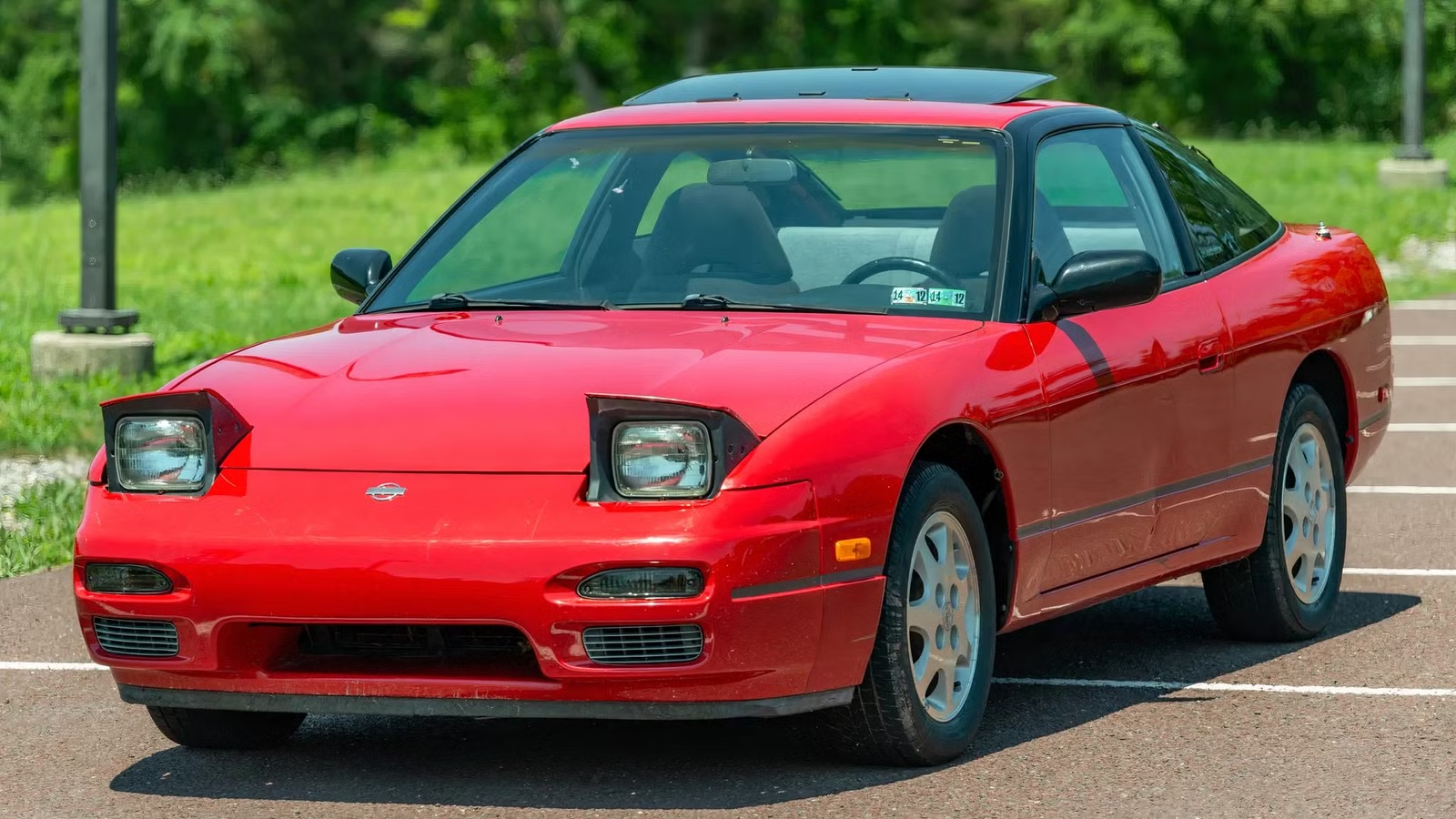
The 1990s created some of the most beloved Japanese performance cars in automotive history, but few have aged quite like the Nissan 240SX. What started life as an affordable compact sports coupe eventually evolved into one of the most sought-after tuner platforms on the planet. Long before social media transformed car culture into a global phenomenon, the 240SX had already built a cult following through underground street racing, drifting, and grassroots modification communities.
Follow and Like top authors, topics, and trends
Browse with fewer ads across the site
Personalize your profile to showcase your activity
Get a content feed tailored to your interests
By creating an account, you agree to our Terms of Use and Privacy Policy. You also agree to receive our newsletters; you can unsubscribe any time.
*Required: 8 chars, 1 capital letter, 1 number
Today, clean examples are becoming increasingly rare, and values continue to climb as nostalgia surrounding 1990s Japanese performance cars grows stronger. The 240SX has become a symbol of an era where lightweight handling, mechanical purity, and tuner creativity mattered more than outright horsepower numbers.
During the late 1980s and throughout the 1990s, Japanese automakers mastered the formula for affordable sports coupes. Cars like the Honda Prelude, Toyota Celica, Mitsubishi Eclipse, and Mazda MX-6 targeted younger buyers looking for style and excitement without exotic-car pricing. Yet the 240SX carved out its own identity because it offered something many rivals did not: rear-wheel drive.
Introduced to the American market for the 1989 model year, the 240SX rode on Nissan's now-famous S13 platform. Under the hood sat the KA24E 2.4-liter naturally aspirated inline-four engine producing 140 horsepower and 152 pound-feet of torque. While those numbers did not sound particularly impressive even by early-1990s standards, the car’s personality came from its chassis rather than straight-line speed.
The S13 coupe weighed approximately 2,700 pounds depending on trim, giving it an excellent power-to-weight ratio for the era. Nissan also equipped the car with independent suspension at all four corners using MacPherson struts up front and a multi-link rear setup. That rear suspension design would later become one of the biggest reasons the platform excelled at drifting.
The styling also helped cement its reputation. Pop-up headlights on early S13 models gave the car a distinctly Japanese sports-car identity, while the low-slung profile and long hood proportions made it appear more expensive than it actually was. Younger enthusiasts immediately gravitated toward the 240SX because it looked sporty, handled exceptionally well, and remained attainable on modest budgets.
By the mid-1990s, street culture had embraced the car fully. It became a regular feature in import magazines, VHS street-racing tapes, and eventually early internet forums dedicated to Japanese tuning culture. Unlike expensive halo cars such as the Toyota Supra Turbo or Acura NSX, the 240SX was something ordinary enthusiasts could realistically own and modify. That accessibility became one of the most important ingredients behind its lasting popularity.
A lightweight, rear-wheel-drive coupe with a naturally aspirated engine proves that bulletproof engineering and everyday usability can still coexist.
Although American-market Nissan 240SX models never received a factory turbocharger, enthusiasts quickly realized the chassis was capable of handling far more power than Nissan originally intended. That discovery transformed the car from an affordable coupe into a drifting and tuning legend. The most important technical ingredient was the S-chassis layout itself. The front-engine, rear-wheel-drive configuration created excellent balance, while the relatively long wheelbase made transitions predictable during oversteer situations. Weight distribution hovered close to 55:45 front-to-rear depending on trim and modifications, helping the car maintain stability while sliding.
In Japan, the closely related Silvia and 180SX models received the turbocharged SR20DET engine, a 2.0-liter dual-overhead-cam turbocharged inline-four that produced between 202 and 247 horsepower depending on generation and trim. Enthusiasts quickly discovered these engines could be swapped into American 240SX models with relative ease.
Once turbocharged SR20DET swaps became popular, the 240SX suddenly gained the power it always deserved. A lightly modified SR20DET could easily produce 250 to 300 horsepower reliably, while upgraded turbo setups pushed some builds well beyond 400 horsepower. Combined with the lightweight chassis, those power figures created a perfect recipe for drifting. The car could break traction progressively and maintain long, controlled slides without feeling unpredictable or difficult to recover. Hydraulic steering also provided excellent feedback compared to modern electrically assisted systems.
The S14 generation introduced in 1995 refined the formula further. Nissan widened the chassis, improved rigidity, and slightly softened the styling for a more mature appearance. The KA24DE engine featured dual overhead cams and produced 155 horsepower and 160 pound-feet of torque. While still naturally aspirated in America, the improved torque delivery made the car more responsive during aggressive driving.
Professional drifting also played a major role in elevating the 240SX’s reputation. Drivers around the world adopted Nissan’s S-chassis platforms because they were inexpensive, durable, and exceptionally tunable. As drifting exploded globally during the late 1990s and early 2000s, the 240SX became the definitive entry-level drift machine. Even today, many enthusiasts still consider the S13 and S14 among the best-balanced drift platforms ever created.
The used-car market is full of hidden performance car gems from the 2000s that deliver excitement without breaking the bank.
The Nissan 240SX arrived at exactly the right time in automotive culture. During the 1990s, aftermarket tuning exploded in popularity thanks to Japanese performance imports, growing motorsport influence, and increasing availability of modification parts. The Nissan platform became one of the biggest beneficiaries of that movement. One major reason was mechanical simplicity. The KA24 engines were robust iron-block powerplants capable of handling forced induction surprisingly well. Even stock internals could tolerate moderate turbocharger setups when tuned correctly. That durability made the 240SX extremely attractive to younger enthusiasts working with limited budgets.
The engine bay itself also provided generous space for modifications. Turbo kits, intercoolers, upgraded radiators, and custom intake systems could be installed relatively easily compared to more tightly packaged sports cars. Nissan’s modular engineering philosophy further simplified upgrades because many components from other Nissan models could be adapted onto the chassis. Suspension tuning became another enormous part of the 240SX scene. Coilover kits, adjustable control arms, sway bars, limited-slip differentials, and steering-angle modifications transformed the car into a highly customizable performance machine. Enthusiasts could tailor the platform for drifting, grip driving, drag racing, or daily use.
Aftermarket support exploded accordingly. Companies such as HKS, Greddy, Apexi, Tein, Cusco, and Bride built extensive catalogs around the S-chassis platform. Wheels from Volk Racing, Work, SSR, and Enkei became closely associated with modified 240SX builds. The tuning community surrounding the car also helped spread its popularity. Owners exchanged swap guides, turbo setups, suspension geometry recommendations, and fabrication tips through forums and local meetups. The 240SX became more than transportation; it evolved into a creative platform where enthusiasts could build highly personalized machines.
Pop culture amplified that reputation even further. Japanese drifting videos, import magazines, and eventually films like The Fast and the Furious exposed wider audiences to modified Nissan S-chassis cars. Suddenly, the 240SX represented an entire lifestyle centered around tuning, drifting, and Japanese automotive culture.
Its affordability made the platform even more influential. During the early 2000s, used 240SX models could often be purchased for just a few thousand dollars. That low barrier to entry allowed younger enthusiasts to experiment with modifications without the financial risks associated with more expensive performance cars. Ironically, that same affordability also contributed to the car’s eventual scarcity.
These ten forgotten JDM icons represent some of the most innovative and exciting cars to come out of Japan.
One of the most impressive aspects of the 240SX is how well it still drives decades later. While many 1990s sports cars now feel outdated or disconnected compared to modern machinery, the Nissan’s core driving dynamics remain remarkably engaging. A major reason is weight. Modern performance cars have become significantly heavier due to safety regulations, luxury features, and electrification. Even relatively compact sports coupes today often exceed 3,500 pounds. By comparison, the S13 and S14 remain featherweights.
That low curb weight gives the 240SX an agility modern cars sometimes struggle to replicate. Turn-in feels immediate, body motions remain predictable, and the chassis communicates constantly with the driver. Rather than relying on electronic systems to create excitement, the car delivers genuine mechanical feedback. The steering is another standout characteristic. Hydraulic power steering provides natural resistance and detailed road feel that many enthusiasts believe has disappeared in modern electric systems. Drivers can sense front-end grip levels intuitively, making the car especially confidence-inspiring during aggressive cornering.
The suspension geometry also deserves enormous credit. Nissan’s multi-link rear setup allowed excellent traction while maintaining stable oversteer characteristics. Unlike some older rear-wheel-drive platforms that could snap unpredictably, the 240SX transitions progressively and controllably. Even naturally aspirated examples remain entertaining because the momentum driving suits the chassis perfectly. The KA24DE engine’s strong low-end torque complements the lightweight platform, allowing drivers to carry speed through corners rather than relying purely on horsepower.
The aftermarket community continues to modernize the platform as well. Modern coilovers, chassis bracing, brake upgrades, and tire technology dramatically improve performance while preserving the original analog driving experience. As newer performance cars become increasingly digital, many enthusiasts now appreciate the 240SX precisely because it feels so mechanical and raw. There are no complicated drive modes, synthetic engine sounds, or intrusive electronic systems diluting the experience.
For years, the 240SX remained an inexpensive used sports coupe. Owners drifted them, modified them heavily, crashed them, and often neglected them entirely. Few people predicted the car would eventually become a highly collectible Japanese classic. Unfortunately, that widespread abuse dramatically reduced the number of surviving clean examples. Many cars were stripped for parts, damaged during drifting events, or subjected to poorly executed modifications. Rust also claimed large numbers of S13 and S14 models, particularly in colder climates. As the broader collector market began embracing Japanese performance cars during the 2010s, enthusiasts suddenly realized how difficult it had become to find unmodified 240SX examples. Prices began climbing rapidly.
Today, clean S13 hatchbacks and coupes command substantial premiums, while pristine S14 Kouki models have become especially valuable due to their aggressive styling and lower production numbers. Original paint, factory interiors, and unmodified drivetrains now significantly impact collector value. The nostalgia factor has also become impossible to ignore. Enthusiasts who grew up idolizing 240SX builds in magazines and drifting videos are now reaching peak earning years. Many are willing to pay significant money to own the cars they dreamed about during their youth. The broader appreciation for analog sports cars further strengthens demand. Modern vehicles may be faster and more technologically advanced, but few deliver the same lightweight simplicity and tuner-friendly personality that defined the 240SX.
What makes the car especially fascinating is that it was never intended to become an icon. Nissan simply built an affordable rear-wheel-drive coupe for everyday enthusiasts. Yet through drifting culture, tuning communities, motorsport influence, and decades of grassroots passion, the 240SX evolved into something much bigger. Today, the Nissan 240SX stands as one of the defining Japanese sports coupes of the 1990s. Its combination of balance, affordability, tunability, and timeless driving dynamics created a legacy few cars ever achieve. And as surviving examples continue disappearing, the legend surrounding Nissan’s beloved S-chassis only grows stronger.
Found an error? Send it info@www.topspeed.com so it can be corrected.
Source: https://www.topspeed.com/nissan-240sx-became-90s-sports-coupe-everyone-wants/
Cars
Why The Nissan 240SX Became The '90s Sports Coupe Everyone Wants
Article Top Ad Zone
Article Middle Ad Zone
Article Bottom Ad Zone
Original Source: www.topspeed.com
Share
Comments
Comment system is currently disabled.