Adventure bikes are supposed to be ready for everything. But in the real world, a lot of them arrive as compromise machines. They are fine on pavement, decent on gravel, and then somehow still leave owners shopping for crash protection, suspension work, better wheels, rally screens, firmer seats, and electronics add-ons before the first serious trip.
Follow and Like top authors, topics, and trends
Browse with fewer ads across the site
Personalize your profile to showcase your activity
Get a content feed tailored to your interests
By creating an account, you agree to our Terms of Use and Privacy Policy. You also agree to receive our newsletters; you can unsubscribe any time.
*Required: 8 chars, 1 capital letter, 1 number
A truly stock-ready adventure bike does not just look rugged. Stock-readiness isn't about stripping features down. It's about getting the fundamentals so right that the rider's first instinct is to ride, not to upgrade. That means suspension that genuinely handles technical terrain without immediate revalving. It means ergonomics that fit a range of riders without a custom seat arriving in the mail. And it means rider aids sophisticated enough to feel like factory-engineered safety nets, not budget afterthoughts.
The whole idea behind such a motorcycle is that you should be spending money on fuel, tires, and actual miles, not on a long list of corrections to make the bike usable. But here's the frustrating reality of the mid-displacement adventure segment: most bikes compromise somewhere obvious. The Yamaha Ténéré 700 is a brilliant off-road chassis let down by a thin electronics suite. The BMW F 900 GS leans balances everything well, but the optional packages are necessary to unlock its full potential. Luckily, there is one bike that doesn't need this type of upgrade.
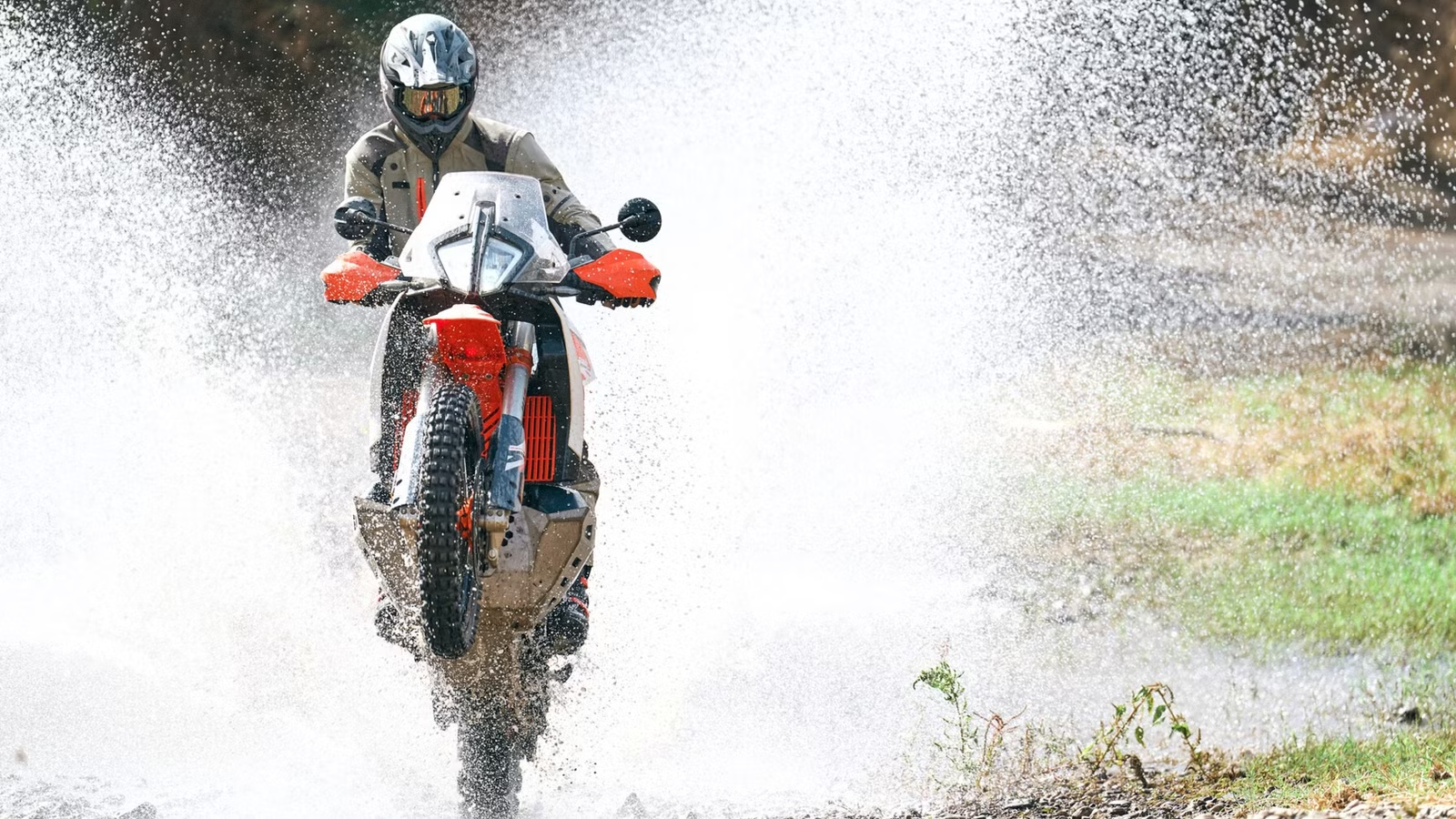
KTM has spent decades building its reputation around dirt-first machinery, and the company’s Dakar heritage is part of the reason the Adventure line carries so much credibility with riders who actually leave the pavement. The 890 Adventure R fits neatly into that story. KTM describes the bike as inspired by the Dakar-winning KTM 450 RALLY, and the visual link is obvious the moment you look at the front end, the high fender, and the stance. This is KTM’s premium middleweight adventure option for riders who want factory-engineered off-road intent from day one.
This is not trying to be the universal answer for every rider. It is built for the one who wants a bike that can attack rough terrain first and still be civilized enough to commute, tour, or slab across state lines. KTM’s own assessment is blunt about that versatility, describing the bike as capable of handling highways, rocky gravel switchbacks, and even single-track-style paths while still offering all-day comfort. That is a strong claim, but the hardware underneath it gives the claim some real weight.
This is also the most affordable flagship ADV with an automatic transmission.
The 890 Adventure R’s 889cc LC8c parallel twin is one of the bike’s biggest strengths, mostly because it manages to feel purposeful rather than oversized. KTM lists the engine as a twin-cylinder, 4-stroke parallel twin with 105 hp and 74 lb-ft of torque, paired to a 6-speed gearbox and Bosch ride-by-wire management. The LC8c uses KTM’s distinctive 285-degree crank offset, which gives it a cadence and feel closer to a V-twin than an evenly firing twin.
This shows up in the dirt, where tractable delivery and rear-wheel feel are worth more than spec-sheet bragging rights. All this while, the six-speed gearbox and PASC anti-hopping slipper clutch round out a powertrain package that feels mature, confidence-inspiring, and completely uninterested in being anything other than fast and controllable.
This is where the KTM starts separating itself from the average middleweight ADV bike. The 890 Adventure R gets a WP XPLOR setup featuring upside-down 48 mm front forks and a mono-shock at the rear, with 240 mm of travel at each end. Although the suspension is easily adjustable, the company says the bike’s suspension is tuned for improved comfort and strong overall performance.
The wheel setup comprises 21-inch front and 18-inch rear spoked wheels with aluminum tubeless rims. That is the correct hardware for a bike with this mission, because it favors control and durability off-road while still being practical enough for real-world travel. The trellis frame geometry, 63.7-degree steering head angle, 60.1-inch wheelbase, and 10.3-inch mm ground clearance all reinforce the same point.
The riding position is the sort of thing that matters more after three hours than after three minutes. KTM says the tank spoilers and rear side panels are shaped to improve movement on the bike, especially when riding aggressively off-road, and the slim tank design is intended to help when standing on the pegs. Its one-piece seat is also described by KTM as being built for freedom of movement off-road while still offering comfort on long road-going stretches.
The dimensions are approachable in the way serious adventure bikes often are not. The seat height is listed at 34.4 inches, which is tall in the way a proper off-road ADV should be tall, but it is paired with a narrow waist and a chassis that helps the bike feel manageable once you are actually on it. At 474 pounds fully fueled, it is not a featherweight, yet KTM’s layout keeps the mass from feeling bulky or top-heavy in the way some larger adventure bikes do. For riders who want a machine that can still be hustled through slow technical terrain without feeling like an appliance, that balance is a big part of the charm.
Big adventure bikes are cool, but this approachable Honda adventure-tourer proves simpler, lighter motorcycles make more sense for real life.
KTM has not stripped the 890 Adventure R of electronics in the name of purity, which is the right move. The bike gets a 5-inch TFT display with KTMconnect Bluetooth integration for turn-by-turn navigation, music, and calls, plus the sort of rider aids that make a hard-edged motorcycle far easier to live with. The equipment highlights ABS, traction control, ride modes, and smartphone connectivity, along with four modes: Street, Rain, Off-road, and the optional Rally setting. Each mode adjusts power delivery, traction control sensitivity, and ABS intervention thresholds independently.
The Rally mode is particularly worth noting — it dials back both ABS and traction control intervention to a minimum, giving experienced off-road riders the unfiltered feel they prefer on loose terrain without requiring a dealer visit to unlock it. The bike also ships in Demo mode for the first 1,500 km, which lets riders test the full suite of optional electronics — including the quickshifter, heated grips, and cruise control — before committing to a purchase. That's a clever way to let the product sell itself.
Diving deeper, KTM’s Motorcycle Traction Control uses a 6D inertial measurement unit and lean-angle data to manage rear-wheel slip and limit unintended front-wheel lift, while Cornering ABS uses the same sensor suite to keep braking stable even when the bike is leaned over. KTM also says Off-road ABS automatically activates in Off-road or Rally mode, reducing intervention up front and disabling ABS at the rear, so the rider can steer with the back end when the terrain calls for it.
Found an error? Send it info@www.topspeed.com so it can be corrected.
Source: https://www.topspeed.com/adventure-bike-makes-expensive-mods-feel-unnecessary/
BMW
The Adventure Bike That Makes Expensive Mods Feel Unnecessary
Article Top Ad Zone
Article Middle Ad Zone
Article Bottom Ad Zone
Original Source: www.topspeed.com
Share
Comments
Comment system is currently disabled.