Pickup trucks are the lifeblood of the U.S. automotive market. In 2025 alone, Ford sold over 800,000 F-Series trucks, the Chevy Silverado still paves the way as one of the most staple trucks to buy; heavy-duty trucks still rule the worksite, and we are constantly getting new electric trucks, compact trucks for city life, and everyday-versatile models.
Follow and Like top authors, topics, and trends
Browse with fewer ads across the site
Personalize your profile to showcase your activity
Get a content feed tailored to your interests
By creating an account, you agree to our Terms of Use and Privacy Policy. You also agree to receive our newsletters; you can unsubscribe any time.
*Required: 8 chars, 1 capital letter, 1 number
The American truck market has never had more variety, but one thing is still noticeably absent: affordable, fuel-efficient diesel mid-sized pickups. Drivers in Australia, New Zealand, Europe, and Southeast Asia can walk into a dealership and buy a diesel-powered truck built around long-distance efficiency and everyday usability, while we are more limited to gas engines, hybrids, or expensive heavy-duty diesels that are best for towing.
That hasn't always been the case, though. Models like the Chevrolet Colorado Duramax briefly showed us there was genuine interest in smaller diesel pickups in the U.S.A. The 2.8-liter Duramax inline-four has an output of 181 horsepower and 369 pound-feet of torque, and can help the Colorado tow up to 7,700 pounds while still returning 30 mpg.
Despite how good that sounds, the diesel Colorado was discontinued in 2022 as GM streamlined its engine choices. Today, diesel power in American trucks is mostly reserved for heavy-duty models like the Ford Super Duty Power Stroke, Ram Heavy Duty Cummins, and Chevy Silverado HD Duramax.
These trucks are still very impressive, with exceptional towing capabilities, but they are meant for something completely different compared to the lighter, more efficient diesel trucks sold abroad. Globally, diesel engines still dominate foreign pickup truck markets because they offer exactly what truck buyers need: strong low-end torque, long driving ranges, durability, ease of maintenance, and good fuel economy under load.
In much of the world, diesel trucks are viewed less as a lifestyle choice and more as a practical choice. Trucks like the Toyota Hilux, Isuzu D-Max, and Ford Ranger are expected to handle everything from commercial hauling to remote overlanding while remaining relatively economical for everyday life. Smaller turbo-diesel engines fit that role perfectly because they deliver strong pulling power without the high consumption of large gas engines.
The American truck market has evolved differently over the last two decades. Full-sized trucks have gotten bigger, more luxurious, and a lot more powerful as we started using them as family vehicles alongside work duties. At the same time, relatively cheap gas prices helped to reduce the need for ultra-efficient diesel models, while strict emissions controls made smaller diesel engines a lot more expensive to engineer and certify compared to other countries' markets.
This has pushed automakers toward smaller turbocharged gas engines, hybrids, and now electric trucks instead of heavily investing in diesel mid-sized trucks. Ford expanded the F-150 lineup with hybrid powertrains, Toyota introduced the Tacoma i-FORCE MAX, and Ram is making more electric options. The efficient diesel trucks that dominate foreign markets remain largely absent here, and this has created a major contrast between what we prioritize in a truck in the U.S. and what much of the world still depends on every day.
The turbo diesel that redefined durability, performance, and fuel economy for trucks.
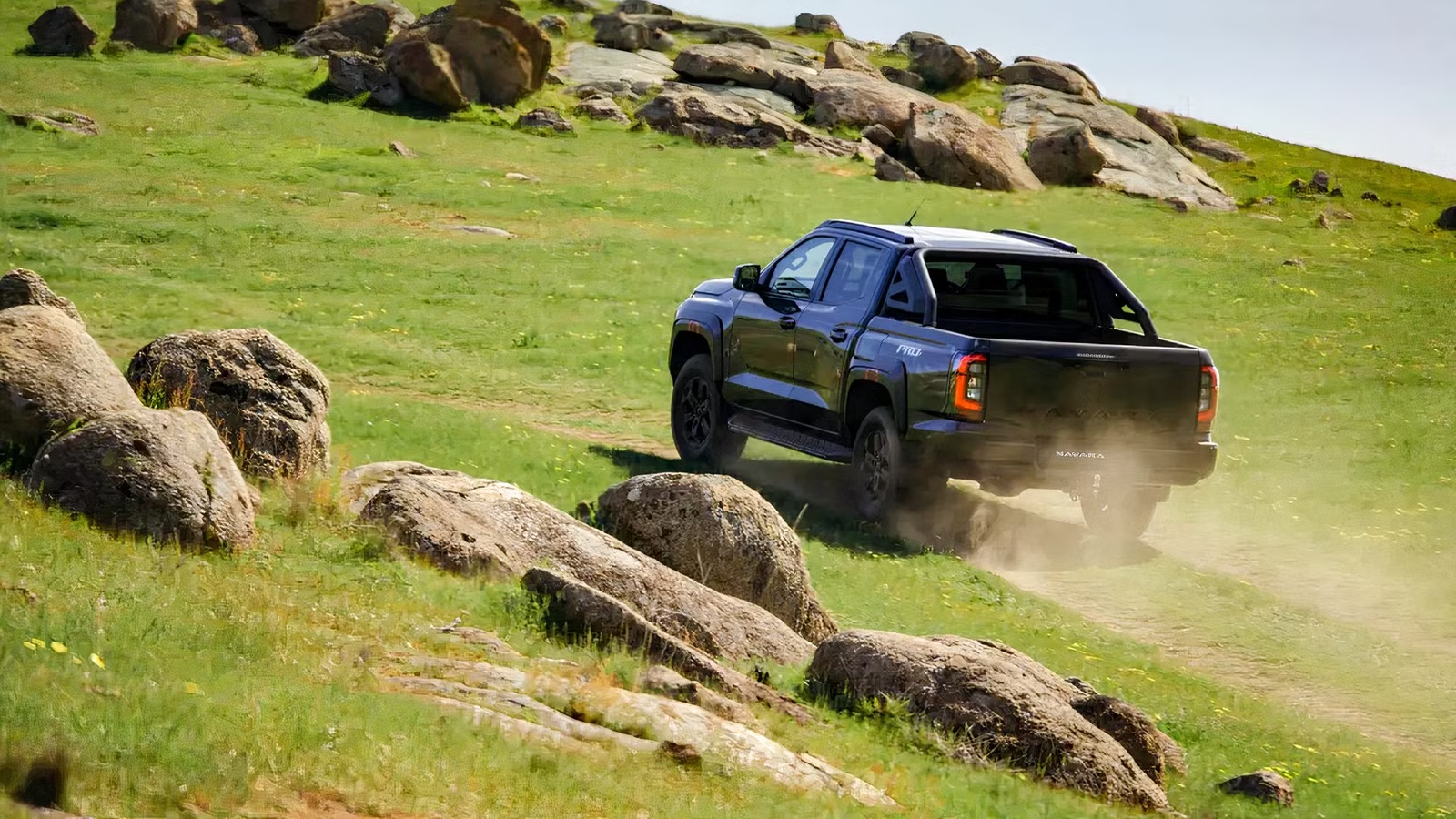
With that in mind, we aren't surprised that we don't get the diesel-powered 2026 Nissan Navara; we just wish we did. Redesigned for the Australian market, the 2026 Navara has a starting price of $57,990 AUD (around $41,400 USD), and is available in four grades: the SL Dual Cab, the ST Dual Cab, the ST-X Dual Cab, and the PRO-4X Dual Cab. The MSRPs are as follows.
The new Nissan Navara rides on the same ladder-frame platform and has the same powertrain as the Mitsubishi Triton, another useful pickup truck not for sale in the U.S.A., and we think it would fill a good space in our mid-sized pickup truck market.
There is just one engine option for the 2026 Navara for the Australian market: a twin-turbocharged diesel engine. It has the following specifications.
2.4-Liter Turbocharged Inline-Four Diesel
All models come equipped with four-wheel drive with electronic selection, and according to Nissan Australia, alongside the healthy amount of torque wound out low in the rev range, you use just 7.7 liters of diesel per 100 km.
This equates to roughly 30.5 combined mpg. To put that into perspective, FuelEconomy.gov says that the 2026 Ford Maverick can achieve up to 38 mpg when you opt for front-wheel drive and the 2.5-liter hybrid powertrain. Crucially, though, it is a lot smaller than the Navara and can only tow up to 4,000 pounds when equipped with the 4K Tow Package.
The standout figure for the Navara mid-sized diesel truck is that it can tow up to 7,716 pounds braked and 1,653 pounds unbraked. Nissan also says that all models of the 2026 Navara have a payload capacity of 1,047 kg (metric), which is roughly 2,308 pounds.
That puts it in serious work-truck territory despite its impressive fuel economy. The 2026 Tacoma is one of the go-to trucks in the U.S., but this year, it can only tow up to 6,500 pounds, while the 7,500-pound tow limit for the Ford Ranger is overshadowed by its mediocre-in-comparison combined mpg rating of 23. Where the diesel Navara also hits differently is that it achieves its impressive capability thanks to the low-end torque output, which becomes very handy when towing trailers and boats across the country.
The entry-level SL and mid-range ST trims come equipped with dual-range four-wheel drive, rear diffs, hill descent control, and a suspension tuned with the harsh Australian landscape in mind. Both these trims are equipped with Nissan's Easy 4WD system, which gives you proper low-range capability in the mud, on loose terrain, and on steep climbs.
The ST-X and top-tier PRO-4X take things much further. Both get Nissan's Super 4WD system with a Torsen limited-slip center diff that allows full-time four-wheel drive on the pavement, something that a lot of traditional part-time systems can't do. They also come equipped with seven terrain modes, including Mud, Sand, Snow, and Rock, alongside a better suspension rig for more articulation and stability under load and over rough ground.
Then there's the PRO-4X itself, which is designed much closer to overland-focused trucks than the increasingly lifestyle-oriented trucks we are getting here in the U.S. Nissan has fitted it with 265/65R17 Toyo A/T tires, skid plates, upgraded dampers, and nine inches of ground clearance. You also get impressive approach, breakover, and departure angles, which are as follows.
Combined with the low-end grunt of the turbo-diesel mill, the off-road goodies, the new diesel Navara would make for an exceptional overlanding and off-roading truck for the boonies of the U.S.
Which pickup trucks have the best diesel engines? These oil burners are made to deliver excellent power for towing and payload.
We didn't suddenly stop liking diesel trucks overnight; economics and regulations simply stopped making sense for smaller pickups. Back in the early 2010s, automakers started rolling out some impressive compact and mid-sized diesel models because we needed towing efficiency and longer highway range.
Models like the Colorado Duramax and Ram 1500 EcoDiesel could tow between 7,700 and 12,560 pounds while achieving between 22 and 30 mpg, with the Colorado sitting at the higher mpg end of the scale but at the lower end of the towing one. Both were dropped in 2022 and 2023, respectively.
Diesel tech in the U.S. has become a lot more complicated. Modern U.S.-spec diesel engines have to have diesel particulate filters (DPFs), exhaust gas recirculation systems (EGRs), selective catalytic reduction (SCR), and diesel exhaust fluid (DEF) injection systems to meet federal emissions rules.
These systems are good, but they add huge engineering complexity and costs to vehicles that already sit very high in a very overcrowded market. It has become very hard to justify all of this on a $40,000 mid-sized truck compared to an $80,000 heavy-duty truck.
The biggest challenge comes straight from the EPA and California Air Resources Board emissions standards that govern light-duty trucks. Under current EPA Tier 3 light-duty emissions regulations, which are enforced alongside CARB rules, automakers have to meet very strict limits for nitrogen oxides (NOx), particulate matter, and fleet-average greenhouse gas emissions across their lineups.
The EPA says modern light-duty trucks must meet very low targets for NOx and non-methane gas outputs combined. This is a huge challenge for small diesel engines because diesel combustion can naturally create more NOx and soot than gas engines.
It is not like Australia doesn't have diesel engine regulations; they do, in the form of the Australian Design Rules, which are based quite heavily on Euro emissions standards. While they are still strict, their framework is more closely aligned with global diesel rules, which also helps explain why there are so many more smaller, diesel-powered options around the world compared to here in the U.S.
For a truck like the diesel Navara to be sold here in the U.S., Nissan would effectively need to engineer a separate U.S.-specific emissions package. That means recalibrated engine mapping, extra after-treatment hardware, EPA durability testing, federal certs, and CARB compliance testing. For a mid-sized truck that would likely see far fewer than gas-engine Tacomas, F-150s, and Rangers, it wouldn't make a huge amount of sense.
At the same time that diesel engines became more expensive to engineer, American gas trucks got a lot better. Turbocharged engines like the 3.5-liter Ford EcoBoost V6 can push out diesel-like numbers without needing expensive after-treatment. The 2026 Ford F-150 equipped with it can wind out 500 pound-feet and tow up to 13,500 pounds. That is territory diesel half-ton trucks used to dominate almost unchallenged.
Then there are hybrid systems; the Toyota Tacoma i-FORCE MAX and Ford F-150 PowerBoost both get electric motivation to fill in low-end torque instantly, and mimic the pulling power that is linked to diesel engines. Mechanically, the instant electric torque delivery solves a lot of the same drivability advantages that diesel engines offer for towing.
We also have a very extensive EV truck market. The Ford F-150 Lightning only had a short run between 2022 and 2025, but in that time, it proved that electric tech can be used in the real world, with a maximum torque output of 775 pound-feet and a maximum towing capacity of 10,000 pounds when properly equipped.
The Tesla Cybertruck may not be the first electric truck you think about when you think about work, but it is also very useful. The 2026 tri-motor model (the Cyberbeast) can wind out 864 pound-feet, tow up to 11,000 pounds, and get from zero to 60 in as little as 2.6 seconds. A diesel engine can't match that combined prowess, so we are unfortunately not likely to turn back to mid-sized diesel trucks in the U.S.
Despite the rise of EVs, Chevy remains committed to fuel-efficient diesel trucks, keeping the market alive amid slimming options.
Converted AUD to USD prices are reasonable; the diesel-powered 2026 Navara tows a very impressive amount; it is fully kitted out for the hard life, and it can achieve high mpg ratings. It all sounds good, but we do see why diesel trucks aren't as popular as they once were. Alongside the evolution of gas, turbo, and EV powertrains, the EIA says the average price for a gallon of diesel in the U.S. is currently approximately $5.64 (at the time of writing), while the average price for a gallon of gas is $4.50.
Diesel engines don't generally do as well in terms of consumption in the cities compared to long slogs on the highway, and as trucks are becoming more lifestyle models and are being used more for urban driving, gas engines and hybrids do look more appealing. However, it is still a shame that we don't have a mid-sized diesel truck like the Navara in the U.S.; it gets a huge amount right for those of us looking for a sensibly-sized diesel work truck.
On top of everything the Navara can do, you also get a usable and comfortable cabin, especially in the higher trims. Across the lineup, it comes equipped with a 12.3-inch touchscreen paired with a digital driver cluster, while higher trims get soft-touch materials, contrast stitching, and nicely bolstered seats. The interior is very much still a working one, with physical controls, an upright driving position, deep door bins, and a wide central console. In short, there is no fuss.
The new Navara defines balance in a segment that, unfortunately, doesn't exist here in the U.S. anymore. It isn't designed to chase luxury-truck drama or extreme off-road prowess, but instead, it is designed to focus on being durable, efficient, and as a diesel-powered tool that can handle work duties and weekend trips in a manageable package.
Found an error? Send it info@www.topspeed.com so it can be corrected.
Sources: Nissan, FuelEconomy.gov, EIA, and EPA.
Source: https://www.topspeed.com/30-mpg-diesel-truck-american-doesnt-get/
Cars
The 30 MPG Nissan Truck That America Doesn't Get
Article Top Ad Zone
Article Middle Ad Zone
Article Bottom Ad Zone
Original Source: www.topspeed.com
Share
Comments
Comment system is currently disabled.