Porsche has publicly praised Hyundai's simulated gear-shift system for electric vehicles, calling it "really good"—and coming from the brand that gave the world the PDK and still builds the last great manual sports car, that endorsement carries weight. It also raises an uncomfortable question: If Porsche is benchmarking artificial engagement, what does that mean for the future of driving feel?
Follow and Like top authors, topics, and trends
Browse with fewer ads across the site
Personalize your profile to showcase your activity
Get a content feed tailored to your interests
By creating an account, you agree to our Terms of Use and Privacy Policy. You also agree to receive our newsletters; you can unsubscribe any time.
*Required: 8 chars, 1 capital letter, 1 number
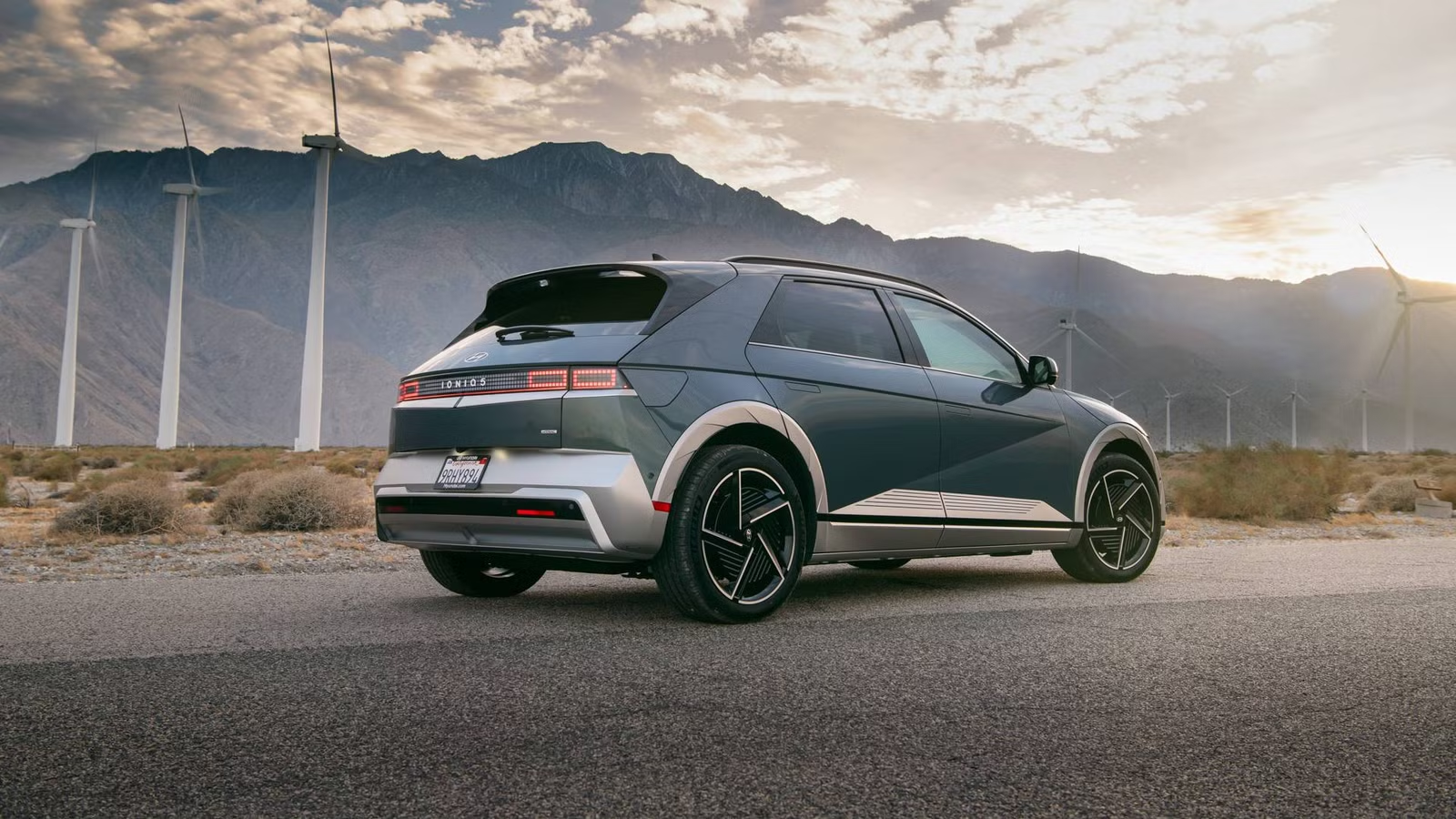
Hyundai's system, developed through its N performance division, replicates the sensation of gear changes in an electric vehicle that has no mechanical transmission whatsoever. The hardware generates physical feedback through the shifter, mimicking clutch engagement and the jolt of an upshift, while the software momentarily interrupts torque delivery to simulate the brief power pause you'd feel rowing through a real gearbox. The result is a car that behaves, in feel if not in physics, like it's changing gears.
Hyundai has signaled it wants to expand the technology across more of its EV lineup, not keep it confined to halo performance models. A recently filed patent also hints at a more advanced version capable of behaving like either an automatic or a manual, depending on driver preference. Honda has moved in a similar direction with simulated shifting on at least one of its EV models, which suggests the industry is converging on artificial engagement as a genuine product category, not a party trick.
Porsche's praise matters precisely because of what the brand represents. This is the company that fought hard to keep a manual gearbox in the 992 GT3 when the market had largely moved on, that treats the PDK as a performance instrument rather than a convenience feature, and that has been more vocal than almost any other manufacturer about preserving driving engagement through the EV transition. When Porsche calls a competitor's artificial shift system "really good," it is not being polite; it is setting a benchmark.
The Drive noted the implicit weight of the moment plainly: Porsche has set Hyundai as the bar for fun EVs. That framing is worth sitting with. Legacy manufacturers grafting simulated engagement onto their EVs now have a credibility anchor they didn't have before. Startups like Rivian and Lucid, which have largely declined to pursue artificial feedback in favor of a clean-slate EV experience, may find themselves on the wrong side of an emerging enthusiast consensus.
Carscoops noted the obvious candidate for Porsche's own simulated-transmission debut: the all-electric 718 Cayman and Boxster, which are expected to replace their combustion predecessors. Those cars carry the heaviest expectations of any Porsche EV; the 718 platform is where driving purists live, and any loss of engagement will be scrutinized hard. If Porsche's engineers are studying Hyundai's approach closely enough to praise it publicly, it is reasonable to infer that some version of the technology is being evaluated for that platform.
That is not confirmation. But the logic is tight. Porsche cannot credibly call a competitor's simulated-shift system "really good" and then deliver an electric 718 with no engagement simulation at all, not without answering for the contradiction. The endorsement may be the earliest public signal that artificial gear changes are coming to Stuttgart, dressed in Porsche's own engineering language.
Here is where the skepticism is warranted. Simulated shifting is, by definition, a manufactured sensation: software and actuators conspiring to make a driver feel something that isn't mechanically happening. The counterargument is that driving feel has always involved some degree of engineering artifice: exhaust notes are tuned, steering weights are calibrated, and throttle maps are shaped. A simulated gear change is further along that spectrum, but it is not categorically different.
What changes when Porsche validates it is the social permission structure. Enthusiasts who dismissed fake shifts as a cynical concession to nostalgia now have to contend with the fact that one of the most credibility-rich brands in performance cars thinks the execution is genuinely impressive. That does not make the technology authentic. It makes the debate harder to win on principle alone.
The broader trend is clear: simulated engagement is becoming a real engineering discipline, and Hyundai's N division is currently leading it. Porsche's approval does not settle the philosophical argument about whether fake shifts belong in a performance car. But it does mean that argument is no longer between purists and marketers; it's between two camps of serious engineers. For anyone who cares about what driving an EV actually feels like, that shift in the conversation is the most important development here.
Porsche praising Hyundai’s simulated shifting says a lot about where performance EVs are headed. Purists may never fully accept fake gear changes, and that skepticism is fair, but the bigger issue is whether the system makes an electric car more fun to drive. If Hyundai has found a way to give EV drivers some of the rhythm, anticipation, and involvement that disappeared with combustion engines, Porsche would be foolish not to pay attention. The future of driver engagement may not be purely mechanical, but it still has to feel deliberate, convincing, and worth seeking out.
Sources: Autoblog, Carscoops, Edmunds, Motor1, The Drive, InsideEVs
Source: https://www.topspeed.com/porsche-approves-hyundais-fake-ev-gear-shifts/
Cars
Porsche Praises Hyundai's Fake EV Gear Shifts Technology
Article Top Ad Zone
Article Middle Ad Zone
Article Bottom Ad Zone
Original Source: www.topspeed.com
Share
Comments
Comment system is currently disabled.