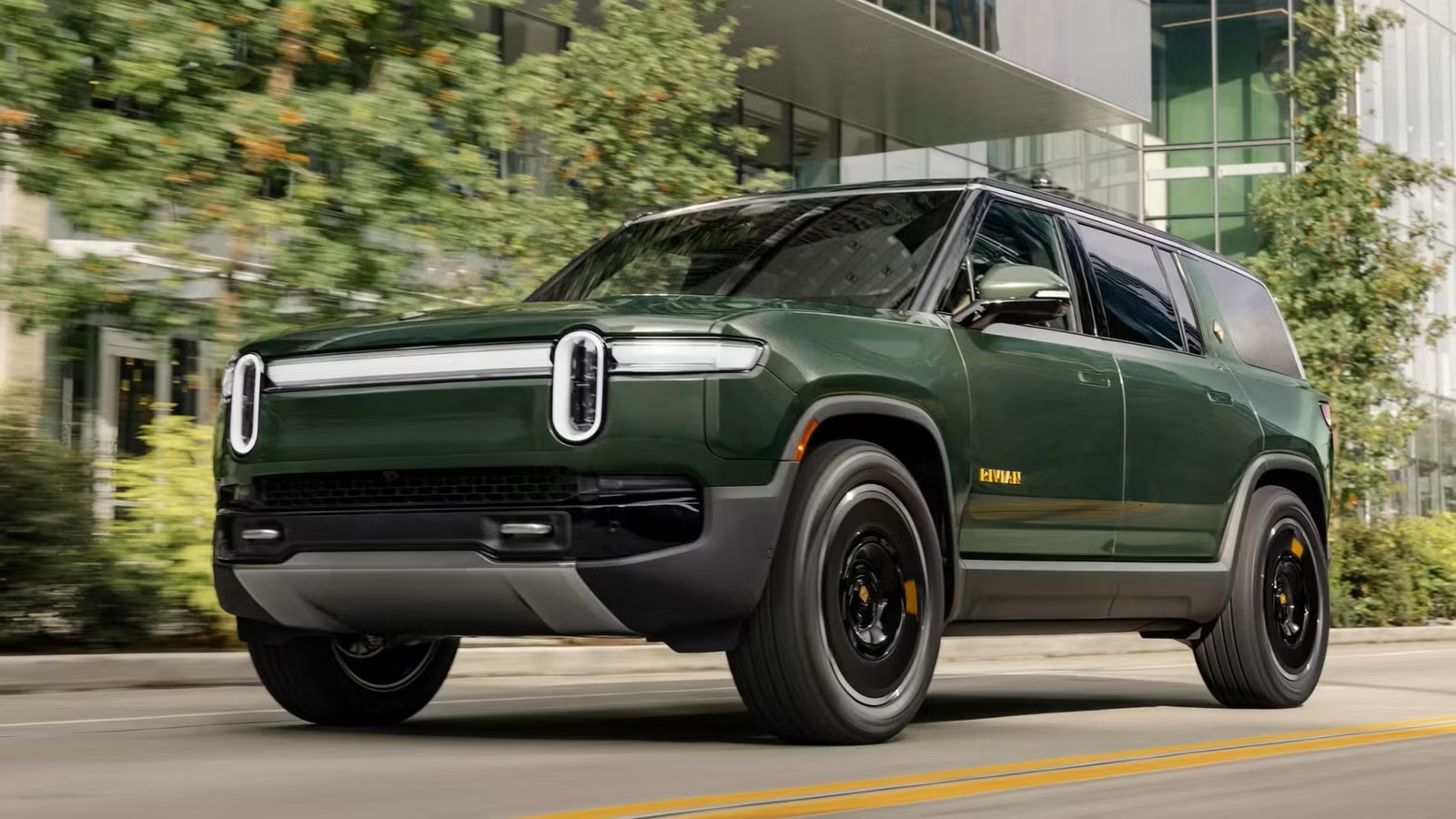
Federal safety regulators have formally opened an investigation into nearly 115,000 Rivian R1T and R1S vehicles from the 2023 and 2024 model years after complaints that the left rear toe link can separate while driving. The National Highway Traffic Safety Administration confirmed the probe this week, citing reports of the suspension component failing in a way that directly affects vehicle control and steering response.
Follow and Like top authors, topics, and trends
Browse with fewer ads across the site
Personalize your profile to showcase your activity
Get a content feed tailored to your interests
By creating an account, you agree to our Terms of Use and Privacy Policy. You also agree to receive our newsletters; you can unsubscribe any time.
*Required: 8 chars, 1 capital letter, 1 number
The toe link is a suspension component that controls the angle of the rear wheel relative to the vehicle's centerline—what engineers call toe alignment. When it's intact and properly set, the rear wheels track predictably, and the vehicle handles as intended. When a toe link separates, that rear wheel can shift to an unintended angle, causing the vehicle to pull, dart, or swerve unexpectedly. At speed, that kind of sudden handling change gives the driver very little time to react.
In at least two reported incidents involving the Rivian R1S, a broken bolt caused the toe link to fail, sending the SUV swerving across lanes. NHTSA's investigation language describes the failure as potentially leading to "unintended vehicle movement"—a phrase that covers everything from a subtle handling change to a loss of directional control. For a vehicle that owners regularly take off-pavement, the stakes are compounded: uneven terrain, reduced traction, and higher suspension loads are exactly the conditions where a compromised component is most likely to fail completely.
The investigation covers approximately 114,000 to 115,000 R1T and R1S units built for the 2023 and 2024 model years. NHTSA's preliminary evaluation—the first formal stage of an investigation—will determine whether the complaint volume and failure mode justify escalating to an engineering analysis and, ultimately, a recall demand.
This isn't the first time Rivian's rear toe links have drawn regulatory attention. Earlier in 2026, Rivian recalled just under 20,000 vehicles for toe links that had been improperly reassembled during service. The current NHTSA probe appears to be a separate and broader concern—focused on toe links separating in vehicles that may not have undergone service work, which would suggest a potential design or manufacturing issue rather than a service error. Rivian has stated that its own internal investigation leads the company to a different conclusion than NHTSA's concern about safety risk, though the federal agency is proceeding with its probe regardless.
NHTSA has not issued a recall order at this stage—an investigation must run its course before regulators can compel one. The typical timeline from a preliminary evaluation to a recall decision can range from several months to over a year, depending on how quickly engineers can replicate the failure and establish a root cause.
In the meantime, owners of 2023 and 2024 R1T and R1S vehicles should pay attention to any changes in rear-end handling, including unexpected pulling to one side, a loose or vague steering feel, or any unusual noise from the rear suspension. If any of those symptoms appear, the safest step is to stop driving the vehicle and contact Rivian directly or schedule an inspection at a service center. Owners can also file a complaint directly with NHTSA at safercar.gov—complaint volume is one of the factors regulators use to assess the urgency of an investigation. Rivian has not announced a stop-sale or any customer communication campaign tied to this specific investigation as of this writing.
NHTSA's investigation will determine whether the left rear toe link issue is widespread enough to require a formal recall across the full 115,000-vehicle population. Given that a prior service-related recall already touched this same component, and that the R1T and R1S are built around off-road use cases that stress suspension systems harder than typical road driving, owners have good reason to monitor this one closely.
This is the kind of issue Rivian cannot afford to let linger. The R1T and R1S are sold as tough, adventure-ready EVs, so any concern involving a rear suspension component tied directly to vehicle control naturally feels bigger than a routine defect investigation. To be clear, this is not a recall yet, and NHTSA has not concluded that the full vehicle population is unsafe. But a toe link is not a minor comfort feature; if it fails, it can affect how the vehicle tracks, steers, and reacts at speed.
For owners, the practical advice is simple: watch for unusual rear-end noises, sudden pulling, vague steering, or any change in how the vehicle feels, and get it inspected if something seems off. For Rivian, the priority should be just as clear: identify the root cause quickly, communicate plainly, and act decisively if a wider fix is needed. Adventure vehicles are built on trust, and Rivian needs to make sure this suspension concern does not undermine the rugged image it has worked so hard to build.
Sources: TTAC, Carscoops, Road & Track, The Drive
Source: https://www.topspeed.com/nhtsa-opens-investigation-into-115k-rivian-r1t-and-r1s-over-rear-toe-link-separation/
Cars
NHTSA Opens Investigation Into 115K Rivian R1T And R1S Over Rear Toe Link Separation
Article Top Ad Zone
Article Middle Ad Zone
Article Bottom Ad Zone
Original Source: www.topspeed.com
Share
Comments
Comment system is currently disabled.