The Kia Seltos is now in its second generation, and ever since this car debuted just before the COVID-19 pandemic, Kia’s subcompact crossover has become the brand’s global second-best-selling vehicle, just behind the even more popular Sportage. No pressure, then, right?
Follow and Like top authors, topics, and trends
Browse with fewer ads across the site
Personalize your profile to showcase your activity
Get a content feed tailored to your interests
By creating an account, you agree to our Terms of Use and Privacy Policy. You also agree to receive our newsletters; you can unsubscribe any time.
*Required: 8 chars, 1 capital letter, 1 number
Though the changes don't necessarily rewrite the subcompact crossover SUV rulebook, they are enough to put the Seltos near the top of the food chain.
This full hybrid is the fuel-economy champion among cars that require no special charging routine from the driver to attain maximum efficiency.
To understand how much the Seltos has improved, we have to take a look at how the previous generation model performed in terms of driving feel as well as its tech and features.
Kia wasn't big on hybrids in prior years, and so the first-generation Seltos was never offered with such a powertrain. What I was able to drive was the base 2.0-liter four-cylinder that produces 147 horsepower, and this is mated to a CVT, branded as IVT or Intelligent Variable Transmission. This engine is just right for its size, though for some, it may be too tepid. For me, personally, I found the engine linear and smooth, if not a bit buzzy due to the need to rev it hard when merging on a highway. On the upside, the IVT never had the rubber-band feel associated with CVTs, since its main highlight was its simulated gears.
On the other hand, there was also a 1.6-liter turbo four-cylinder that was initially offered with a seven-speed dual-clutch. In the other Kia vehicles I experienced this powertrain combination, I wasn't a fan of the roughness of the dual-clutch automatic at low speeds. On the move, however, the responses are snappy. Thankfully, the 2024 facelift remedied this issue by fitting the 1.6-liter turbo with an eight-speed automatic. By then, this was undoubtedly the engine choice you should go for.
Just like the powertrain, its driving dynamics were good, but it didn't really stand out. That's perfectly fine since this segment isn't necessarily known for passionate driving, but as rival crossovers either got a hybrid powertrain or driving dynamics that emulated bigger crossover offerings, the Seltos started to feel like it'd be left behind. Still, the Seltos got meaningful upgrades over the years, such as the addition of acoustic front glass during its mid-cycle facelift, along with other refinement improvements. Overall, the Seltos has always been a comfortable crossover SUV, and it's in this aspect that the new generation model aims to improve upon, and then some.
The 2027 Kia EV3 promises to shake up the entry-level EV segment with a 320-mile range and premium features.
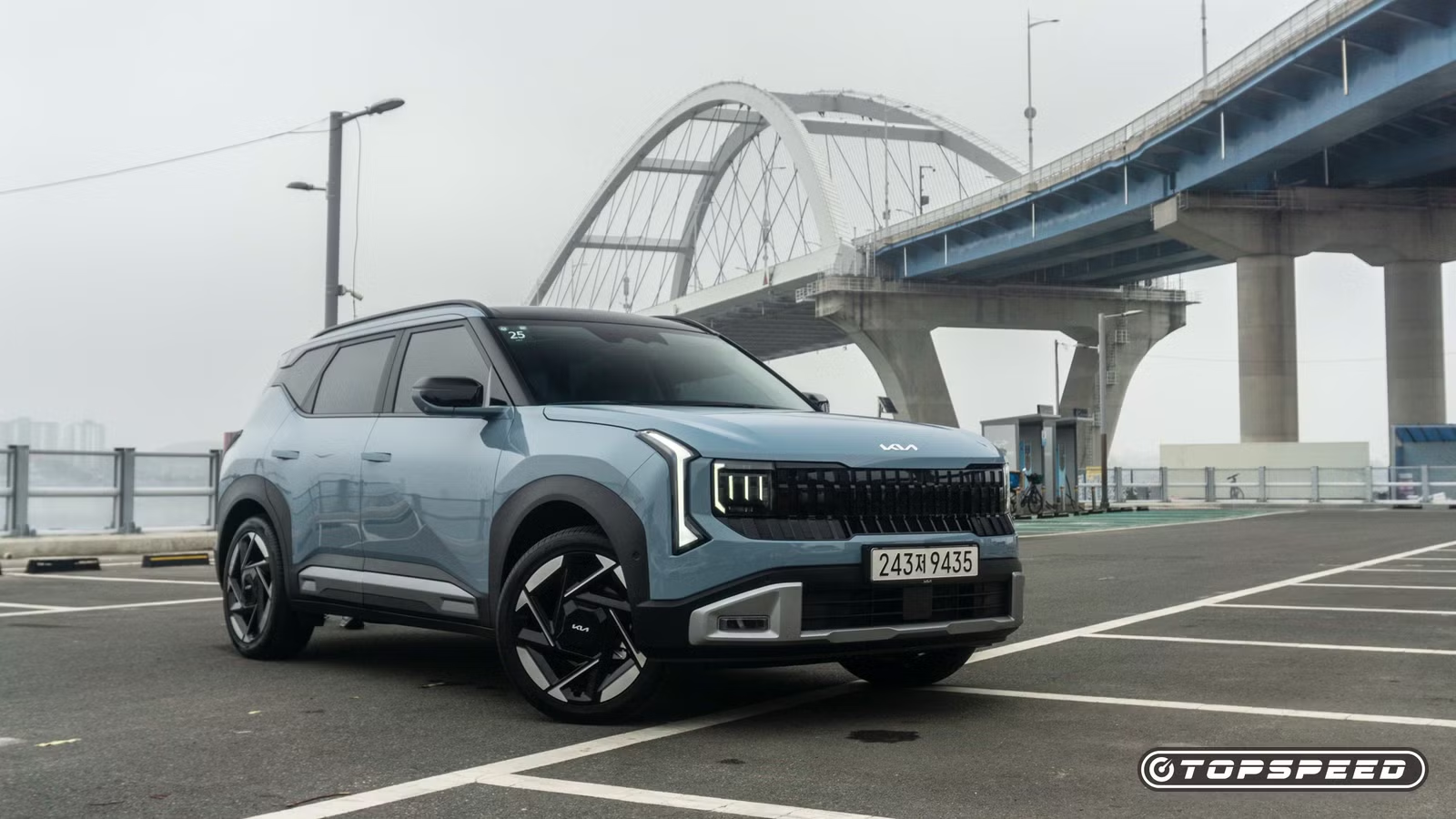
As we now look into the second-generation model, the 2027 Kia Seltos has already made a bold impression with its stylish design inside and out. Kia's Opposites United design language has already produced a couple of award-winning models, and we're confident that it'll apply to the new Seltos, too.
The cleverness of the 2027 Kia Seltos begins with its front end, because it's already here where you'll see plenty of clever design touches. For instance, the wide and bold grille cleverly integrates the main LED headlights and a portion of the LED daytime running lights. Kia achieved this by making the main LED projectors as thin as the lines for the daytime running lights, so whether they're turned on or off, the main headlights simply blend with the grille design. Admittedly, though, the effect looks slicker with the white LED daytime running lights, but the amber LED lights of the U.S.-spec model still look cool nonetheless.
At the sides, the Seltos retains the previous model's design flourishes, such as the rising beltline towards the D-pillars. This has been enhanced for this generation through a character line that starts at the front wheel arches. Lastly, the rear end also receives quite a glow-up with its cleaner tailgate design that contains taillights that are just shy of becoming full-width LED units. At least the Seltos resists conforming to the continued trend towards full-width lights, right?
Kia continues its design A-game inside the Seltos, thanks to its stylish lines that are mixed with adventurous material and color choices, though it is still unknown if the bold interior colors will make their way to the North American market. As expected in this segment, there's still a noticeable amount of hard plastic, but this has been cleverly textured to feel premium to the touch. On the upside, soft-touch materials are also present on the dash and doors. Plus, most of these soft finishes are actually recycled and sustainably sourced. No animals were harmed in the creation of this vehicle's vegan-friendly leather upholstery.
A standard 12.3-inch screen with the connected car Navigation Cockpit (ccNC) operating system is fitted, while upper trims come with posh appointments such as a panoramic sunroof. It is unknown if the Seltos for North America will receive premium features fitted to this Korean-spec model, such as a Harman Kardon sound system, a head-up display, ventilated front seats, and a powered tailgate. An electronic shifter mounted at the steering column also comes as standard in the hybrid. Whichever variant you choose, though, the Seltos has much more interior space thanks to its larger dimensions.
The Toyota RAV4 Hybrid sets the standard for compact hybrid SUVs, but these often overlooked models beat the RAV4 in some key areas.
The Seltos has always been related to entry-level duty in Kia's lineup, but this generation is set to become a more forward-thinking offering. That's because a hybrid is being offered for the first time, and it's quite a good one at that.
The hybrid is indeed the highlight of the range, because while its 1.6-liter four-cylinder and six-speed dual-clutch combo is a familiar recipe from cars like the Niro Hybrid and Elantra Hybrid, this powertrain has one trick up its sleeve—the optional electronic all-wheel drive (e-AWD). Yes, it takes a page out of the Toyota hybrid book, and by opting for e-AWD, the hybrid system's output is bumped from the front-wheel drive's (FWD) 155 to 179 horsepower. The FWD Seltos Hybrid makes 139 horsepower in other markets, which feels modest but responsive and smooth. Ditto the six-speed dual-clutch, whose quick and snappy responses make the hybrid system feel linear versus the Japanese and their preference for an e-CVT.
The Seltos Hybrid has another clever trick up its sleeve, and that's its ability to use the hybrid battery for vehicle-to-load (V2L) capabilities. With a 1.49 kWh battery, don't expect the Seltos Hybrid to power your appliances or camping gear for a very long time, but at least you have the option to do so. And then, as for fuel economy, the Seltos Hybrid has yet to be rated by the EPA, but our time in Korea gave us a figure of 15 to 18 km/l (35 to 42 MPG) on mostly clear and fast-paced roads.
But of course, the hybrid will come with a price premium, and if affordability is your absolute goal, then consider the 2.0-liter four-cylinder with a CVT, or the 1.6-liter turbo four-cylinder with an eight-speed automatic. We also got to experience the 1.6-liter turbo with a 190-horsepower output, and this engine is indeed good but not necessarily potent. The eight-speed auto could also be more responsive, but it is at least smooth. The 2.0-liter will likely feel similar to the previous generation, whose modest power output is satisfactory rather than breathtakingly quick.
Regardless of which model you choose, though, the Seltos improves upon its driving experience in every aspect. Refinement levels are improved, with less road and wind noise than before—especially for models with the acoustic front glass. Ride quality is also superb, though the models we drove came with the AWD-exclusive multi-link rear suspension. The suspension irons out the bumps really well, and we like that it isn't too soft that it makes the vehicle wallow in corners or through repeated undulations. Also, the increased use of high-strength steel (more than 50 percent for this generation) has made the chassis feel remarkably rigid. Vibrations are therefore kept to a minimum, thus making it feel more like a European car than some of its competitors. The new Seltos, therefore, has become one of the more solid and substantial-feeling crossovers at its price point.
Found an error? Send it info@www.topspeed.com so it can be corrected.
Source: https://www.topspeed.com/2027-kia-seltos-hybrid-no-longer-playing-catch-up/
Cars
I Spent Time With The 2027 Kia Seltos Hybrid, And It's No Longer Playing Catch-Up
Article Top Ad Zone
Article Middle Ad Zone
Article Bottom Ad Zone
Original Source: www.topspeed.com
Share
Comments
Comment system is currently disabled.