There is a certain breed of shopper who obsesses over all forms of research before making a purchase decision. Wouldn't you if you were about to spend $50,000 on a new car? If you idolize due diligence, you probably don't care about brand loyalty or hype. Your primary objective is likely to close the gap between perceived value and what something is actually worth.
There is one used luxury sedan that fits this logic perfectly, and it has been hiding in plain sight. It boasts performance figures that rival those of vehicles twice its price, and the buyers who have found this deal are keeping quiet about it.
You may know that the average price of a new car currently hovers around the $50,000 mark. Wait until you find out that the average new Porsche transaction price is near $130,000. Feel jealous yet? That's the current auto market in a nutshell.
Yes, that is correct. A 2026 Toyota Camry XSE starts at $35,700. Considering it is an FWD hybrid inline-four sedan, that price would have sent a Toyota shopper 15 years ago into absolute shock. But, wait, there's more. Add AWD, the $4,760 Premium Plus Package, and a premium paint, and you have a $44,255 Camry before any taxes or registration fees. God forbid the dealer wants to charge a markup, and they just might.
Just because it's absurdly expensive, does that mean that a new Toyota Camry is a bad car? Not at all—the Camry has never been more capable and refined. There is a reason why the Camry has remained the bestselling sedan in America for over 20 years with little to no competition. Yet, how much does it really cost to own the benchmark midsize sedan? Kelley Blue Book projects that a 2026 XSE will cost owners $59,299 over five years. That includes fuel, insurance, depreciation, and maintenance. If that sounds like a lot of money for a sedan with 232 combined horsepower, it's because it is.
New cars, despite the rampant inflation in our current market, are still not immune to the effects of depreciation. New luxury cars get hit even harder, and if you are on the buyer's side, this effect works in your favor. It has been known for a long time that new cars are a terrible financial decision, and the original purchaser is going to be the person who takes the biggest hit. A patient second owner, however, can secure a massive deal with a well-timed purchase.
A car that costs $60,000 new with features like adaptive suspension does not become a worse car because its resale value has collapsed. The performance and features are the same as when new; it just costs less. For the right shopper, this simple change is everything they are looking for. It's less about compromise and more about optimizing the best you can buy for the least amount of money.
If you can brave the maintenance requirements, this used luxury SUV is an absolute bargain.
While most used car shoppers are looking for certified pre-owned SUVs or efficient economy cars, there is a different group of individuals who are circling a specific target: a RWD luxury sport sedan that most people don't even give a chance.
When this car was first introduced, its primary purpose was to be a direct competitor to benchmark midsize luxury sedans like the BMW 5 Series and Mercedes E-Class. The original MSRP started at about $42,550 and could reach $60,000 in top trim. The Sport trim came standard with a 3.3-liter twin-turbocharged V-6, producing 365 horsepower and 376 pound-feet of torque while mated to a quick-shifting eight-speed automatic.
It also offered adaptive dampers, which transformed its driving character at a moment's notice. The twin-turbo V-6 engine provided strong performance in stock configuration, with peak torque coming in at only 1,300 RPM. This allowed for a quick 4.9-second zero-to-60 mph time for the RWD model. Just as impressive was the interior, which featured Nappa leather, a panoramic sunroof, and ventilated front seats. This was not a budget luxury car; it was a legitimate competitor to the established German status quo, and nobody seemed to care when it was new.
Certain brands carry stigmas that have nothing to do with their actual engineering. Most shoppers in the luxury sport sedan segment consider German options and stop there. For the rare few who are truly value-conscious or risk-averse, maybe they also look at a Lexus. That is why this car has a built-in perception mismatch. In this segment, very few prospective owners consider a Korean nameplate, causing a sharp depreciation curve.
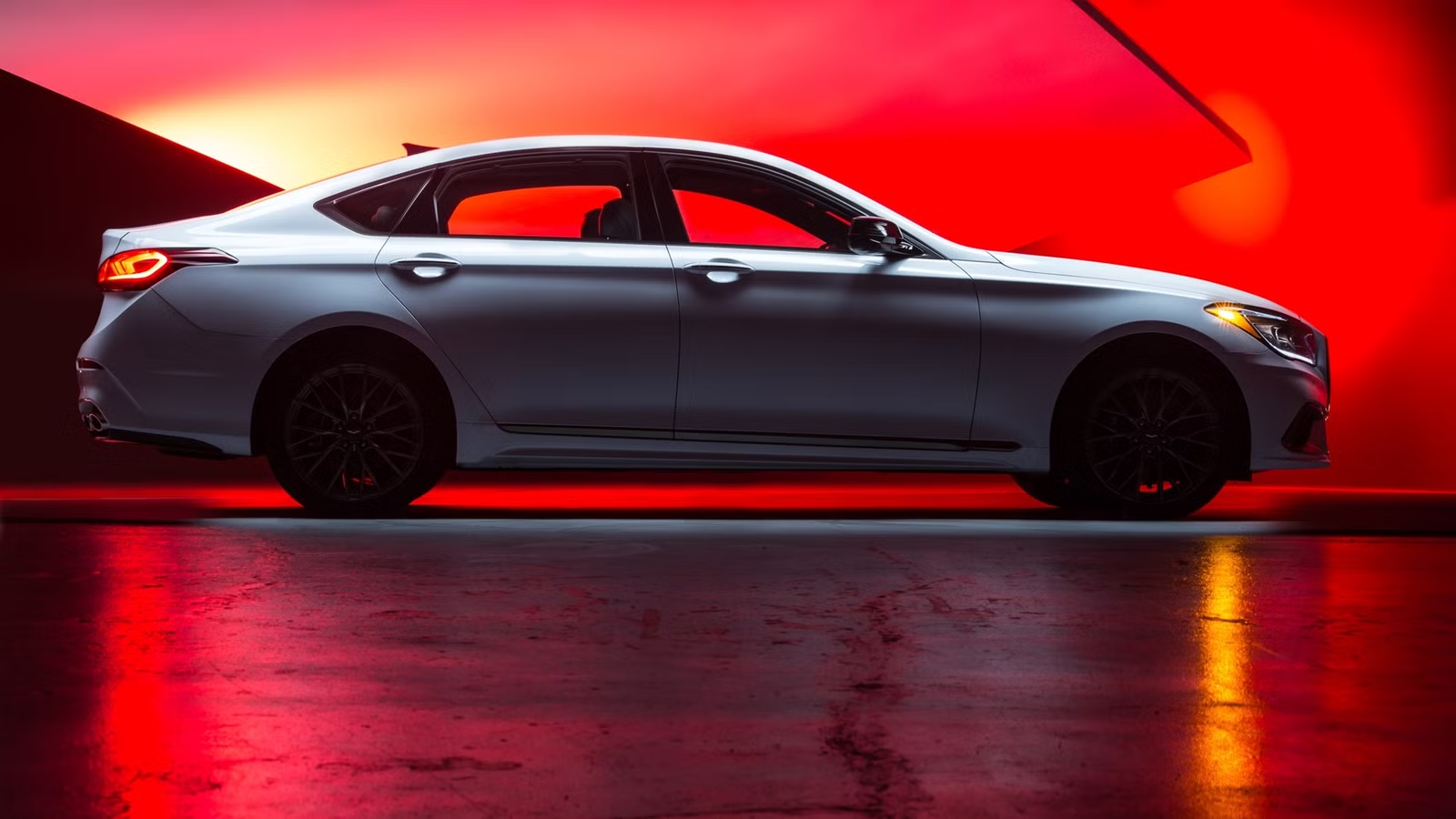
According to an iSeeCars study, this car depreciates 54.1 percent after five years, which leaves it at an average resale value of about $26,200. Losing over 50 percent of the original value of any new car in less than five years feels bad, but a diligent shopper entering at the bottom of the curve could take advantage of a huge opportunity. The sedan in question is the first-generation Genesis G80, specifically the 2018 to 2020 3.3T Sport trim. Buyers discovering it now are getting a deal that almost seems unreal, considering the features that are offered at that price.
The Genesis GV80 starts $10,000 cheaper than the BMW X5 while offering comparable luxury and performance features.
For about $20,000, you can buy a 365-horsepower, RWD luxury sport sedan with Nappa leather and adaptive suspension for almost $10,000 less than a new Camry. The Genesis G80 3.3T Sport is a genuine enthusiast sedan that impresses more than it disappoints, and its value proposition has reached undeniable levels.
According to Kelley Blue Book, a 2018–2020 Genesis G80 3.3T Sport can be found between $19,750 and $25,700. For a 2020 G80 3.3T Sport, Kelley Blue Book's private party value is $23,900 with a trade-in value of $21,700. That means that a 2020 Sport, the final model year of the first-generation G80, can be easily found at the $25,000 price point, with the 2018 model offering sub-$20,000 value. Remember that the 232-horsepower Camry XSE costs about $35,000.
Considering the 4.9-second zero-to-60 mph time and 13.5-second quarter-mile time of the G80 3.3T Sport, it's amazing to get this level of luxury and performance at this price. With adaptive dampers and bigger brakes than the standard G80, 'sport mode' actually means something. Few performance sedans on the market are as undervalued as the G80 3.3T right now.
The performance alone is outstanding, but the ownership costs are what seal the deal. Buying a used German performance sedan is always a gamble, and that's why most people avoid them. Repair costs for German luxury vehicles only increase with every passing year of ownership, and there are no real exceptions. There is a cost to pay for the experience of both luxury and speed in the same package.
Yet, in comparison, the G80 seems like a sane and reasonable alternative. RepairPal gives the G80 a reliability rating of 3.5 out of 5.0, ranking it seventh out of 30 in the luxury full-size car segment, with an average annual repair cost of $565. Compared to the $976 annual average for full-size luxury cars, the G80 will save you hundreds every year. The average annual insurance cost for a Genesis G80 is about $3,939, according to CarEdge.
That is not cheap, but it is less than you would pay for a similar year BMW 5 Series or Mercedes E-Class. Genesis' Lambda II twin-turbo V-6, the same engine found in the Kia Stinger GT, has proven to be an impressively reliable power unit. With proper service intervals, there is no reason why these engines could not last to the 200,000-mile mark and beyond.
This elegant option is often overlooked but pound-for-pound, it beats German rivals at their own game.
Every day, someone discovers the steal that is the 2018–2020 G80 3.3T Sport, and inventory is shrinking. As far as market pricing is concerned, it is likely that the G80 3.3T Sport has already reached the lowest point in its depreciation.
According to Kelley Blue Book, the 2020 G80 3.3T Sport has depreciated $12,587 over the last three years, with a current fair purchase price of $25,700. Because 2020 was the last year of the generation, many owners sell theirs to upgrade. At this point in the G80 3.3T's lifespan, the owner pool has matured.
Since then, Genesis as a brand has matured as well, with the G80 earning J.D. Power scores of 85 or higher consistently in terms of quality and reliability. The 2018 model earned an 85 out of 100 in J.D. Power's quality and reliability category and an 87 out of 100 in the driving experience category. The 2024 model earned an 88 out of 100 in the quality and reliability category, equaling the highest score in the category since the 2017 model year. Genesis continues to earn mainstream credibility, and prices will likely increase (or rise toward market levels) as stigma fades.
The 3.3T Sport was not the only trim available for the first-generation G80. However, this is why it is the one to get out of all the available options. The 2020 3.3T Sport is unique because it is the sport-focused trim in the lineup. This is the only way to get the sport-tuned adaptive suspension, RWD, and performance-tuned eight-speed transmission. On the inside, you can tell a 3.3T Sport by its exclusive sport seats and sport steering wheel with contrast copper stitching, carbon fiber trim, and alloy sport pedals.
Other key features include the Surround View Monitor, heated rear seats, panoramic sunroof, wireless charging, and the Lexicon 14-speaker system. Despite being a popular trim, there are certainly fewer 3.3T Sport models than base models. As awareness is growing about how good a deal these are, the available supply is steadily diminishing. The Genesis G80 3.3T Sport is not a secret anymore, and it delivers on a genuinely amazing luxury sport sedan experience for the price of a new compact economy car from a budget brand.
Found an error? Send it info@www.topspeed.com so it can be corrected.
Sources: Genesis, Kelley Blue Book, Edmunds, iSeeCars, CarEdge, RepairPal, J.D. Power
Source: https://www.topspeed.com/affordable-luxury-sedan-used-buyers-hunt-down/
Cars
Genesis G80 3.3T Sport: The Hidden Gem Uncovered
Article Top Ad Zone
Article Middle Ad Zone
Article Bottom Ad Zone
Original Source: www.topspeed.com
Share
Comments
Comment system is currently disabled.