Most buyers walk into a dealership thinking they have only two choices: buy a brand-new mainstream SUV or settle for a used vehicle that feels like a compromise. However, the used market has subtly reversed this logic. Thanks to brutal depreciation, many luxury SUVs now cost the same as — or even less than — a brand-new mainstream crossover.
Follow and Like top authors, topics, and trends
Browse with fewer ads across the site
Personalize your profile to showcase your activity
Get a content feed tailored to your interests
By creating an account, you agree to our Terms of Use and Privacy Policy. You also agree to receive our newsletters; you can unsubscribe any time.
*Required: 8 chars, 1 capital letter, 1 number
Luxury SUVs take their biggest financial hit within the first three to five years. That’s terrible news for the original owner — but fantastic news for the second owner. After depreciation, vehicles that once comfortably cost over $50,000 suddenly fall into the same price bracket as a brand-new mainstream crossover. And that changes the conversation completely. The reality is that luxury SUVs and mainstream SUVs are engineered very differently. One is built around cost efficiency and mass-market appeal. The other is built around refinement, performance, and driver comfort. That difference becomes obvious the moment you step inside.
Mainstream SUVs have improved massively over the years; there’s no denying that. Vehicles like the Toyota RAV4 have become incredibly competent all-rounders. But once you spend time in a properly engineered luxury SUV, it becomes difficult to ignore the difference in polish. And because depreciation hits luxury vehicles so hard, second-hand buyers benefit massively. In many ways, depreciation becomes your performance upgrade.
Find out which BMW models from the past decade are the smartest buys for enthusiasts and practical shoppers alike.
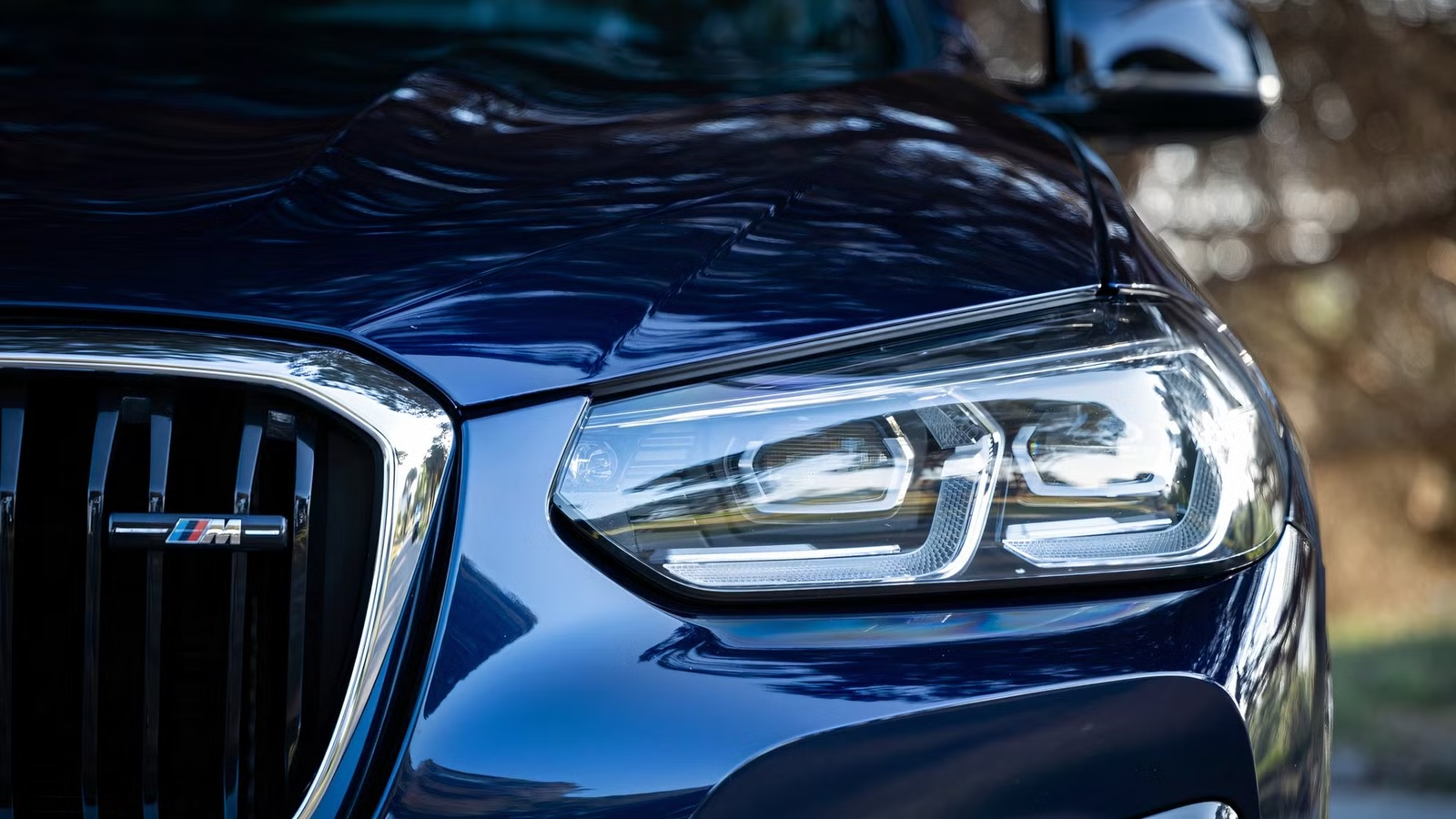
Among used luxury SUVs, the 2020-2023 BMW X3 hits a sweet spot few rivals manage to balance properly. It’s not overly large and intimidating like some luxury SUVs, yet it still feels spacious enough for daily family life. It’s easy to drive around town, easy to park, comfortable on long trips, and still manages to feel premium. That’s a difficult balance to achieve. The design has also aged remarkably well. Even older X3 models still look modern and understated without trying too hard. There’s a clean German simplicity to the styling that helps it avoid looking dated too quickly.
Inside, the cabin immediately feels a class above most mainstream SUVs. The dashboard layout is driver-focused, materials feel expensive, and there’s a level of solidity that BMW tends to do extremely well. Everything feels tightly assembled and engineered with intent. Then there’s the driving experience.
Engine options range from efficient turbocharged four-cylinders all the way up to the muscular BMW X3 M40i, which remains one of the best all-round performance SUVs BMW has built in recent years. The M40i’s turbocharged inline-six engine completely changes the personality of the X3.
It feels effortless. Overtaking becomes addictive, highway cruising feels relaxed, and there’s a smoothness to the power delivery that mainstream SUVs rarely match. Even the standard X3 models from this time still feel composed and refined in a way many modern rivals struggle to replicate. This is the kind of SUV that makes you question why so many people still buy brand-new mainstream crossovers.
10-Year-Old German SUVs are not only alluring for their exquisite designs, but they can also make for some pocket-friendly bargain buys.
I’ve driven both the standard BMW X3 and the BMW X3 M40i back in 2022, and the difference between them and mainstream SUVs becomes obvious almost immediately. The M40i is especially a revelation — smooth, quick, and effortlessly powerful. Under the hood sits BMW’s superb 3.0-liter turbocharged inline-six B58 engine paired with an eight-speed automatic transmission and xDrive all-wheel drive. Producing 382 horsepower and 369 pound-feet of torque, the M40i delivers its performance in a way that feels muscular yet incredibly refined.
My journey with it was eventful, to say the least. I was in the Free State, South Africa, attending NAMPO Harvest Day, Africa’s largest agricultural festival. Leaving in the dark around 5 a.m., my co-pilot, Daneel Rossouw, and I were roughly 30 minutes from our destination when we suddenly heard a loud pop.
The left rear tire slammed into a pothole — essentially a crater in the road, as many South Africans would describe it — and suffered a puncture. Thankfully, the run-flat tires allowed us to continue safely at a reduced speed until we reached the venue. Being stranded out in the bitter cold, however, meant BMW roadside assistance took nearly an entire day to finally reach us.
The following day, after a hearty breakfast, I began the roughly 160-mile drive back to Johannesburg. On a mix of gravel and tar roads, disaster struck again. Pop, pop. Both tires on the left-hand side gave up. “It’s raining punctures,” immediately crossed my mind. After several frustrating hours, I eventually managed to get help and finally arrived home around 10 p.m. with three damaged tires riding in the trunk and rear seats alongside me. Despite the chaos, the X3 itself still left a strong impression on me.
Even the standard BMW X3 — in my case, a diesel-powered xDrive20d model with BMW’s 2.0-liter turbocharged four-cylinder producing around 188 horsepower and 295 pound-feet of torque — feels quiet, composed, and surprisingly engaging for a family SUV. The ride remains comfortable even on larger wheels; long-distance cruising feels effortless, and the strong low-end torque suits the X3’s character perfectly. When the road finally opens up, it reminds you exactly why BMW built its reputation around driving dynamics. There’s a weightiness and precision to the steering that many SUVs simply don’t have anymore. And the BMW X3 M40i? That thing feels alive.
The turbocharged inline-six pulls hard from virtually anywhere in the rev range, the chassis stays beautifully composed, and despite weighing close to two tons, it somehow shrinks around you when the road gets interesting. With a 0-60 mph time of around 4.4 seconds, it has the pace to embarrass far sportier machinery while still carrying all the practicality of a family SUV. It’s rare for an SUV to feel both relaxing and genuinely entertaining. That’s what makes the X3 special.
As it builds up its SUV roster, Mazda has steadily elevated quality and engineering, and one of its new SUVs has the goods to rival one of BMW’s best.
Put the X3 and the Toyota RAV4 side-by-side, and you’re comparing two very different ideas of what an SUV should be. The BMW X3 focuses on refinement, performance, driving engagement, and premium feel. The Toyota RAV4 prioritizes efficiency, reliability, practicality, and low running costs.
Neither approach is wrong. They simply target completely different buyers. The RAV4 is incredibly competent. Toyota has perfected the art of building dependable transportation that simply works. Fuel economy is excellent, maintenance is predictable, and resale values remain incredibly strong. That’s exactly why so many people buy them. But emotionally, the X3 plays a completely different game.
The BMW feels more planted, more composed, and significantly more rewarding from behind the wheel. The cabin feels richer, the seats are more supportive, and road trips feel noticeably more relaxed. The X3 is the one that makes you want to take the long way home. Meanwhile, the RAV4 is the one that quietly gets the job done without drama. And honestly, that’s the real comparison here: German elegance versus Japanese practicality.
Here’s the part that surprises most people: a used 2020-2023 BMW X3 often costs less than a brand-new Toyota RAV4. A used BMW X3 from 2020-2023 typically falls somewhere between $20,000 and $30,000, according to KBB, depending on mileage, trim level, condition, and model year. Even on Bring A Trailer —where cleaner, enthusiast-owned examples often command stronger prices — older X3 models regularly sell well below the cost of a brand-new mainstream SUV. Meanwhile, a brand-new Toyota RAV4 starts at roughly $31,900 in the U.S. before options, destination fees, or higher trims push the price much further north.
That overlap creates one of the most interesting value propositions in today’s SUV market. Luxury SUVs like the X3 depreciate heavily; three-to-seven-year-old examples suddenly become attainable to mainstream buyers despite originally costing far more when new. And unlike many used vehicles that already feel outdated after a few years, the X3 still feels modern, polished, and expensive from behind the wheel. You’re getting a far more premium cabin, stronger engine options, better ride quality, improved refinement, and a genuinely rewarding driving experience. All for the price of a brand-new mainstream crossover.
Running costs, reliability, and fuel economy still heavily favor Toyota. J.D. Power’s data consistently places Toyota near the top of the industry for dependability, while the RAV4 itself earned strong quality and reliability scores. BMW ownership also requires realistic expectations. Tires are expensive, servicing costs are higher, and neglected examples can quickly become problematic if previous owners skipped maintenance.
Even J.D. Power ratings show the BMW X3 sitting lower than the RAV4 in long-term ownership metrics, which shouldn’t come as a surprise given the added complexity and performance focus. But if you buy carefully and maintain the vehicle properly, the X3 becomes an incredibly compelling used luxury SUV. Depreciation has effectively transformed what was once a near-$60,000 premium SUV into something attainable for used-Toyota money, yet it still delivers a far more engaging driving experience, a richer cabin, and significantly stronger performance. And that’s exactly why the BMW X3 makes so much sense right now.
Sources: BMW, Bring A Trailer, J.D. Power, KBB
Found an error? Send it info@www.topspeed.com so it can be corrected.
Source: https://www.topspeed.com/bmw-suv-cheaper-than-new-toyota-rav4/
BMW
BMW X3: The Used Luxury SUV That's Now Cheaper Than A New RAV4
Article Top Ad Zone
Article Middle Ad Zone
Article Bottom Ad Zone
Original Source: www.topspeed.com
Share
Comments
Comment system is currently disabled.