It’s the sort of thing car enthusiasts all over the world, at every age, debate and boast unendingly. Which cars are quickest? Which cars are the fastest in a straight line? What model will lay down the fastest lap at the storied Nürburgring Nordschleife? Then there’s the follow-on verbal sparring about tire types, conditions, rollout, the list goes on and on.
Follow and Like top authors, topics, and trends
Browse with fewer ads across the site
Personalize your profile to showcase your activity
Get a content feed tailored to your interests
By creating an account, you agree to our Terms of Use and Privacy Policy. You also agree to receive our newsletters; you can unsubscribe any time.
*Required: 8 chars, 1 capital letter, 1 number
Between ferocious ICE engines, hybrid drive systems, and snappy battery electric architecture, these European supercars and hypercars have some of the quickest 0–60 mph times of recent years. The cars are listed in order from the quickest to the, well, less quick but still ludicrously swift.
Depending on who you talk to (and what metric you use), you won’t find much out there with the same bragging rights as the Rimac Nevera R. Harnessing the Rimac’s four permanent-magnet electric motors, grippy all-wheel drive, the company says the Nevera R will hit 60 mph (with a one-foot rollout) in 1.66 seconds. If that wasn’t enough, Rimac says the Nevera R will keep accelerating all the way up to over 186 mph in 7.89 seconds. The niche automaker also asserts that the Nevera R will do the full quarter mile in just about that same timeframe: 7.9 seconds. Speed like that establishes the Nevera R as even quicker than the standard Nevera, an already ballistic EV supercar capable of hitting 60 mph in 1.74 seconds, according to the automaker.
Let’s dissect the name Pininfarina Battista real quick. For starters, the name Pininfarina is inextricably associated with timeless Italian design, like the Alfa Romeo Spider, Ferrari Testarossa, and Fiat 124 Spider. “Battista,” on the other hand, is a nod to Battista “Pinin” Farina himself, the firm’s founder. Big shoes to fill. And the Battista certainly puts its best foot forward. Using a 120-kWh battery architecture, four electric motors, and all-wheel drive with torque vectoring, Pininfarina says the Battista manages to shift its considerable, 5,075-pound curb weight to 60 mph in 1.86 seconds. It’s a big swing from the first Pininfarina-badged car (we’re talking every badge, not the handsome little Pininfarina design badge).
Wanna rearrange the faces of four people at the same time using European thrust alone? Well, here’s the Koenigsegg Gemera, a wild, dare I say family-compliant, departure for the already bonkers car marque. The Swedish brand calls the four-seater a “Mega GT” with the claimed ability to fit four (tall) adults and a carry-on suitcase per occupant. As far as power goes, Koenigsegg claims the twin-turbo 5.0-liter V8 and the “Dark Matter” e-motor will generate a combined 2,300 horsepower. That’s not the only substantial claim, either. Launched just right, the Gemera is capable of hitting 60 mph in a mere 1.9 seconds. That’s rarefied air, especially for a four-seater.
Twin-Turbocharged 5.0-Liter V8 And 1 Electric Motor
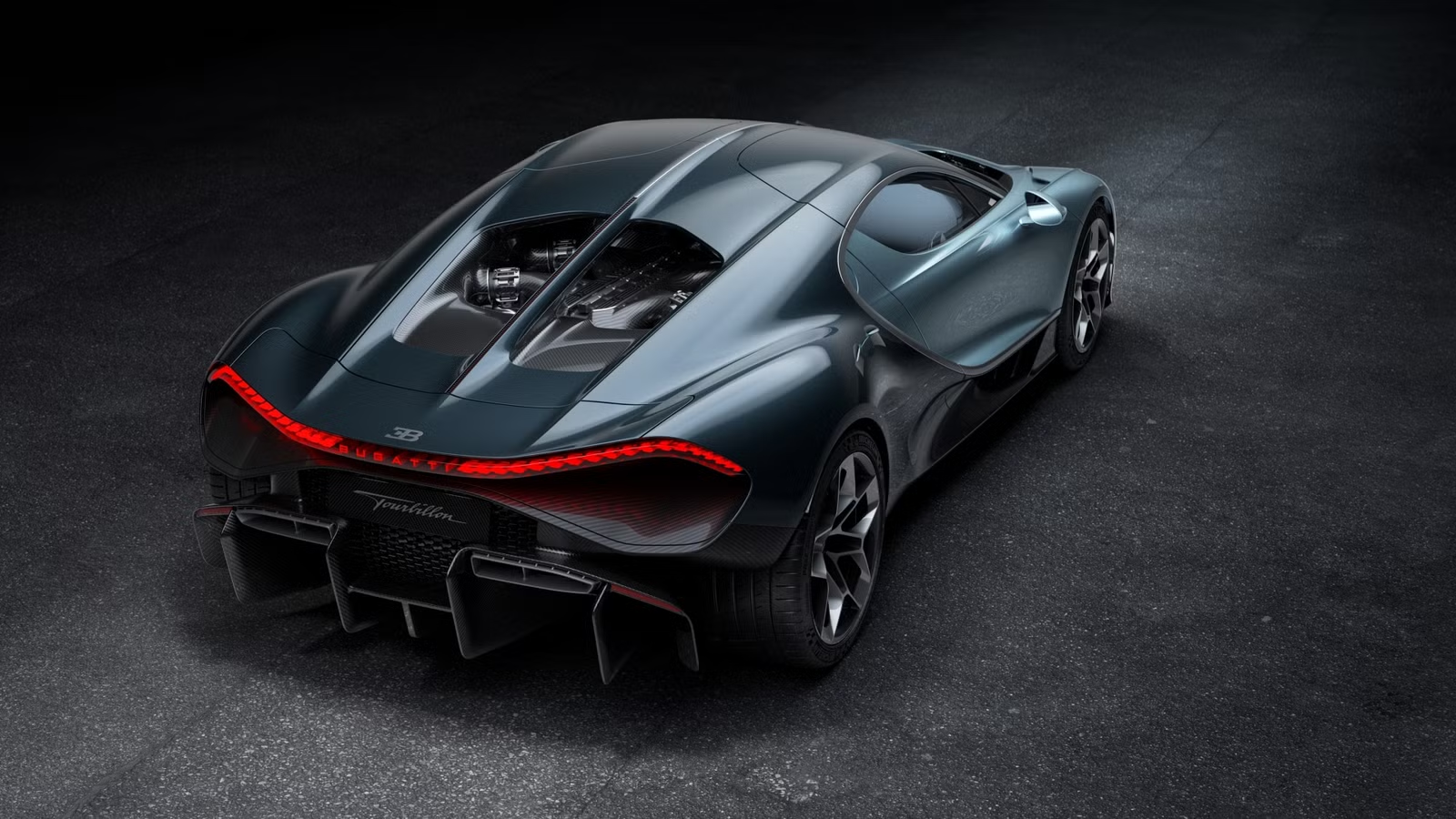
Bugatti is no stranger to the record-setting speed club. One of the marque’s latest entries? The 1,775-horsepower, multi-million-dollar Tourbillon returns for 2026 as a hybrid, and it’s properly quick. Unlike the Bugattis of recent years, the 2026 Tourbillon drops the W16 in favor of an 8.3-liter V16 paired to three electric motors. Bugatti says it’s enough to motivate the $4.6 million Tourbillon hybrid from zero to 60 in a scant two seconds on its way to 250 mph in 25 seconds. Subtlety isn’t part of the equation.
Naturally Aspirated 8.3-Liter V16 With 3 Electric Motors
Call it a supercar. Don’t call it a supercar. That’s on you. The 992.2-generation Porsche 911 Turbo S doesn’t care. In the conversation of European performance cars, the 911 Turbo and Turbo S are perennial talking points. For 2026, the 911 Turbo S gets Porsche’s 9A3B6 T-Hybrid setup: a twin-turbocharged 3.6-liter flat-six backed up by an electric motor. It’s enough to summon 701 horsepower, and, paired with sure-footed all-wheel drive, enough to launch the 911 Turbo S to 60 mph in a face-melting two seconds.
Twin-Turbocharged 3.6-Liter H6 With 1 Electric Motor
The Ferrari SF90 has a reputation for breaking acceleration records. The Ferrari nameplate posted an explosive launch from 0-60 mph in just two seconds back on a closed track in 2021, defeating a 2.1-second run record previously held by the Porsche 918 Spyder. More recently, the SF90 Stradale Assetto Fiorano managed a 2.1-second dash to 60 mph, confirming that the SF90 hasn’t lost much of its fire over the years. And just how does the SF90 Stradale manage that sort of speed? All-wheel drive is standard equipment, as is a 986-horsepower hybrid 4.0-liter V8 application. If that wasn’t enough, the SF90 XX bumps power output up to 1,016 horsepower.
Twin-Turbocharged 4.0-Liter V8 With 3 Electric Motors
It might be one of the wildest-looking hypercars around. The F1-inspired Ferrari F80 looks like a cyberpunk reimagining of the iconic F40. But instead of the F40’s orchestral, twin-turbo 2.9-liter flat-plane V8, the F80 makes use of a twin-turbocharged V6 and a trio of electric motors. Sounds sacrilegious in the context of Ferrari. But it works. The result? The F80 produces 1,184 horsepower between the V6 and the electric motors. It’s enough to catapult the hybrid Ferrari hypercar to 60 mph in 2.1 seconds. Though further testing might put Ferrari’s belief-beggaring $3.735 million hypercar at the benchmark in under two seconds.
Twin-Turbocharged 3.0-Liter V6 With 3 Electric Motors
What list of European supercars and hypercars is complete without mention of Lamborghini? For 2026, Lamborghini has the Revuelto, a V12-powered continuation of the Italian marque’s love affair with 12 cylinders. However, rather than sticking with a naturally aspirated 6.5-liter V12, the Lamborghini Revuelto adds a tri-motor hybrid electric system for a massive 1,001 combined horsepower. Rev up to the Revuelto’s 9,500-RPM redline, and the whole thing is something of an event. As for quickness, the V12-powered Lamborghini managed a lightning-fast 2.2-second sprint to 60 mph and a 9.7-second quarter-mile in testing.
Naturally Aspirated 6.5-Liter V12 With 3 Electric Motors
Back-to-back bulls. Unlike the previously mentioned Revuelto, the Lamborghini Temerario sticks with eight cylinders and adds forced induction with two turbochargers. As you might expect from the spiritual successor to the popular Huracán, the Temerario takes things to the next level. Instead of relying on an ICE powerplant alone, Lamborghini added three axial-flux electric motors. Combined horsepower output is 907, and the redline is a stratospheric, if also orchestral, 10,000 RPM. Better yet, it’s enough to keep the Temerario up to Revuelto standards of acceleration. 60 mph went by in just 2.2 seconds in testing.
Granted, Ferrari has a history with the V12. But times change, and so did Ferrari. The 296 GTB packs a twin-turbocharged 3.0-liter V6 backed by a single-motor hybrid system. It’s not, however, an all-wheel drive system. Still, the 296 GTB and 296 GTB Speciale manage to put down blistering acceleration times without the addition of four-wheeled grip. In testing, the Ferrari 296 GTB managed to hit 60 mph in just 2.3 seconds on its way to a 9.6-second quarter-mile. Properly quick. And though it’s the end of the list, a 2.3-second sprint to 60 mph and a sub-10-second quarter-mile is hardly something to dismiss. It is, after all, a list of some of the quickest cars in the world.
Found an error? Send it info@www.topspeed.com so it can be corrected.
Twin-Turbocharged 3.0-Liter V6 With 1 Electric Motor
Sources: Ferrari, Koenigsegg, Lamborghini, Pininfarina, Rimac, Car and Driver, MotorTrend
Source: https://www.topspeed.com/quickest-european-supercars/
Cars
10 Quickest European Supercars and Hypercars in 2026
Article Top Ad Zone
Article Middle Ad Zone
Article Bottom Ad Zone
Original Source: www.topspeed.com
Share
Comments
Comment system is currently disabled.