The middleweight adventure bike market continues to defy all expectations, and each year we are treated to yet another bike promising more. All these added features can be a good thing, and with the market this competitive, it certainly puts pressure on manufacturers to offer us the best deal. Unfortunately, in the world of adventure riding, more is not always "more."
The more features you add to these bikes, the more weight you add. These machines are all already compromised off-road thanks to how heavy they are, and adding more weight only serves to make them worse at the one thing that sets them apart from a conventional touring bike. It eventually reaches a point where all you are getting is a touring bike that has been fitted with the wrong tires.
Variety is the spice of life, but there is most certainly a limit to how much “spice” one really needs. We currently live in the golden age of the adventure bike, with every manufacturer offering something, and several manufacturers offering more than one model. With so many options, it can get a little overwhelming, but for those looking for a “low-drama” option, there are a couple of bikes that should be on your radar.
There is a certain kind of peace of mind that comes with owning any Honda motorcycle. The Transalp is no exception. It is a little different in the sense that the base model is pretty much a blank canvas with several nice-to-have features left off the bike in an effort to keep the cost down. If you know that you will be covering more miles on paved roads, this is a great option.
If paved roads are a secondary concern, and you want to explore the road less traveled, then the Kawasaki KLR 650 Adventure might be ideal. While slow, this dual-sport disguised as an ADV offers us an almost ideal exploration tool straight from the factory. It is tough, uncompromising, and not particularly comfortable on the highway. The bike in question offers us the best of both worlds, and that is what makes it so special.
The Transalp has become easier than ever to ride. That too, for just a minor price revision
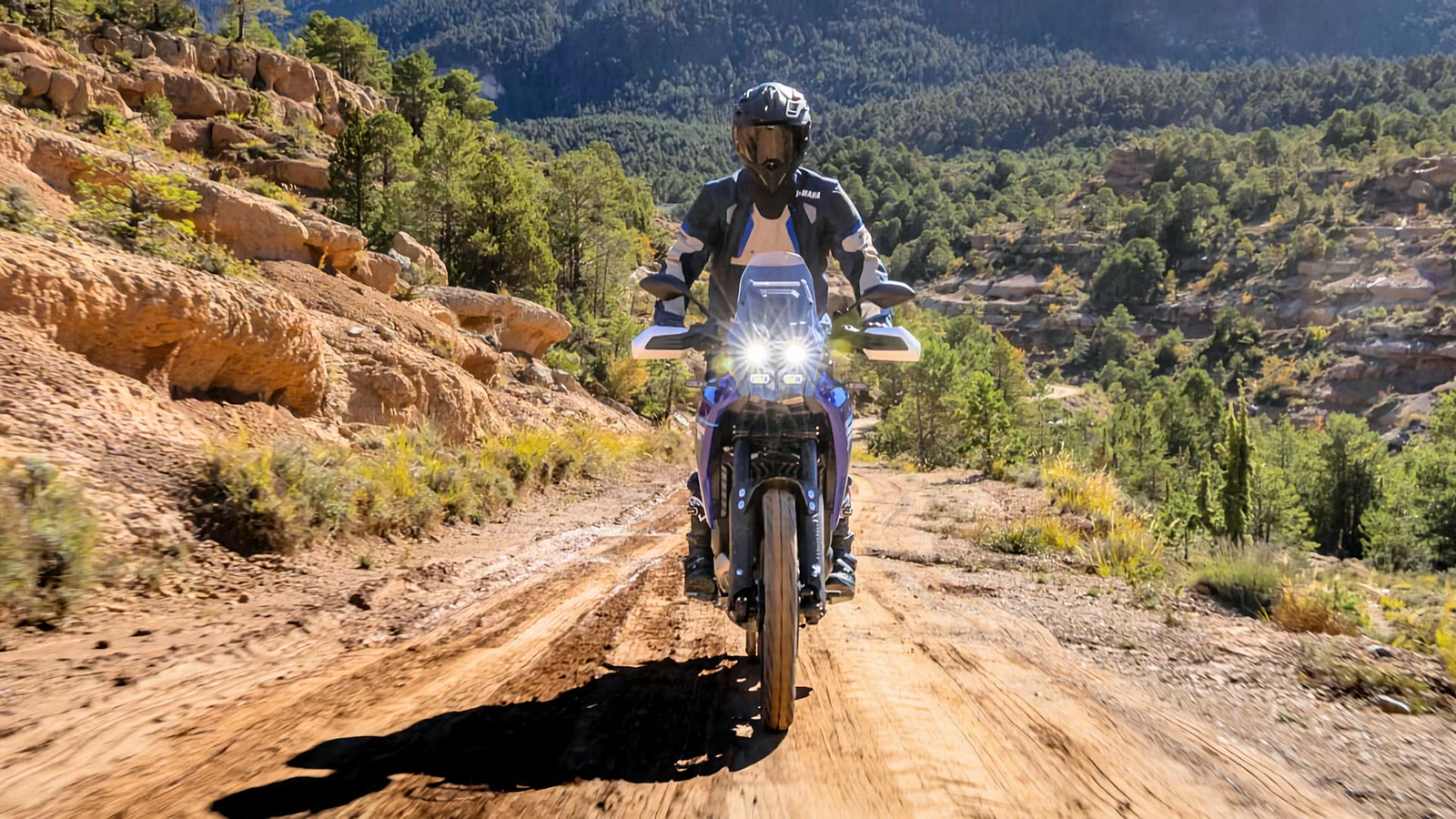
When the Tenere came out, it captured the imagination of adventure riders all over the world. It promised a balance between off-road performance and touring competence that previously did not exist. The same holds true for the latest model, and even though it has been updated with a few tech features, it is still light, and incredibly competent off-road. Its CP2 has also proven that it is just as reliable off-road as it is on the street.
Today, there are several adventure bikes on the market that make in excess of 100 horsepower. While there is no denying that this kind of power is nice-to-have on the road, it is superfluous off-road. Engines that make over 100 horsepower add weight, and the price you pay for that additional power is rarely worth it. Just looking at specs is also misleading. The CP2 delivers so much of its torque low down in the rev range, it is fantastically quick off the mark, and will get to 60 in around 4 seconds. Unless you plan on doing track days on your ADV, the Tenere is plenty fast.
If you are going to be taking a motorcycle on long rides far away from home, and far away from civilization, it needs to be reliable. By the time the Tenere went into production, the CP2 had already proven to be perfectly reliable. The rigors of off-road riding can expose some flaws in engines developed for street riding, but the CP2 has proven to be just as reliable in the Tenere. The kind of peace of mind you get with a bike that you just know will get you there and back is a genuine point of difference.
Yamaha's CP2 seems to be the Japanese brand's one engine to rule them all.
When the Tenere was first introduced, it was very much a back-to-basics kind of motorcycle. Yamaha has buckled to consumer demand and added a few features, namely traction control and a supersized TFT dash. The World Raid version takes the tech a step further with an IMU as well as uprated suspension, which all add almost 30 pounds of weight to the platform. To the right buyer, theworld raidis a great option, but for others, those 30 pounds are better spent elsewhere. With the recent updates, Yamaha was also able to address the soft rear suspension, so as much as the uprated suspension of the World Raid version might be tempting, it isn't expressly necessary.
While the spec sheet may not impress, ask anyone who owns or has ridden this ADV, and you'll hear a different story.
Neither the ABS nor the traction control is designed for off-road use. While other manufacturers offer more sophisticated setups, Yamaha simply offers us the option to switch both systems off completely. This puts control back in our hands, and while it demands a certain level of skill from the rider, that is part of the thrill of riding off-road. Anyone looking for a no-nonsense kind of ADV will love the Tenere.
43mm inverted fork, fully-adjustable (8.3-in travel)
Single shock, adjustable preload and rebound damping (7.9-in travel)
That said, the Tenere won’t be for anyone. Anyone who thinks this is an appropriate bike to start on is wildly mistaken. Even though it is fairly light for a street bike, it is a heavy bike for off-road use, and has the potential to ruin the whole motorcycling experience for a novice rider. It also isn’t the best touring bike, with a hard seat designed for optimal grip while standing off-road as opposed to actually sitting on. Long highway stints will almost certainly result in some level of numbness pretty much everywhere.
Found an error? Send it info@www.topspeed.com so it can be corrected.
Source: https://www.topspeed.com/low-drama-adventure-bike-for-real-riders/
Cars
Yamaha Tenere 700: The Low-Drama Adventure Bike For Real Riders
Article Top Ad Zone
Article Middle Ad Zone
Article Bottom Ad Zone
Original Source: www.topspeed.com
Share
Comments
Comment system is currently disabled.