You perhaps heard that the Sony-Honda forever EV project, called Afeela, is now dead. This comes along with Honda's decision to axe its in-house, Made-in-U.S. EVs, too, writing off billions. But having just had a week of test-driving the Prelude, at least the PlayStation partnership death makes more sense.
That's because the Prelude simulates all sorts of analogue experiences in this hybrid sports car. Upshifts, downshifts, and engine sonics are all in part or wholly augmented or altered. And yet, because they're physically accompanied by stimulation such as acceleration, deceleration, and g forces, your brain responds to these faux mechanics as if they were identical to what you might've experienced in the O.G. Prelude from the 1980s.
Moreover, unlike any other sports car on the road right now, the Prelude entirely splits its hybridized personality. It can stretch from being as utterly placid as a base Civic (since this car is built on that very strong chassis), to becoming nearly as hyper-engaging as entertaining as the Civic Type R. Which proves that this game-ified Prelude is indeed the PlayStation car Honda had been promising. And even if it's not a "pure" sports car, I might just believe it's better than that. Here's why.
The Prelude, especially in lighter Comfort Mode, which I'll explain shortly, has a completely smooth and placid personality. The hybrid system seldom invades the sanctuary of this sports coupe, the suspension remains compliant, and while the powertrain will readily provide plenty of oomph for merging onto the freeway, this remains a shortish version of the Civic four-door.
Nope, I wouldn't attempt to put anything in the second row other than perhaps a small dog or a small human, but there's enough utility to the hatch configuration to readily accommodate luggage, groceries, or a stroller. Think of it like a very affordable ($43,195) Porsche Boxster that gets extraordinary fuel economy. Hey, 46 city/41 highway and 44 combined is nothing to sneeze at. A car the Prelude competes more directly against, the very fun Mazda Miata, only manages 26/34, and 29 MPG combined. If math isn't your thing, the Prelude gets 51 percent better fuel economy. And the Honda is a far more practical, comfortable commuter car than that Mazda, no question.
This isn't a conventional hybrid. Honda's twin-motor system combines a 2.0-liter four-cylinder engine with an output of 141 horsepower with an electric motor. Combined output equals 200 horsepower, juicing the front wheels. Combined torque: 232 foot-pounds. But the way the system functions is unique.
Unlike a conventional hybrid, where the engine and hybrid motor combine to turn the wheels, or an EREV (or parallel hybrid), where the engine only recharges the battery and isn't connected to the wheels, the twin-motor system is constantly in flux. Power can flow directly to the wheels from the electric motor, which is especially useful from a standstill; the gas engine can join the party along with the electric motor, sending additional power as you accelerate; or the gas motor can fly solo, driving the front wheels, which is especially advantageous at steady-state highway speeds, when gas engines are more efficient than electric ones.
Most of the time, you can't tell which system is powering the car. Sure, from a stoplight, you can feel electric propulsion zip you up to speed, but in the mayhem of traffic or in the free-flow of a curvy back road, the partnership between electric and gas goes down like cream in your coffee. You don't know what's cow and what's roasted bean, it just tastes good.
Now that the Prelude has been confirmed, here's what you need to know about its hybrid system that will be offered on Honda's future models, too.
Honda doesn't use a CVT in this car, thank goodness. But they don't use a traditional slushbox, either. Honda's Step Shift is entirely different, and it's part of the gamification going on here. First, on acceleration, when you pounce on the accelerator, the vehicle simulates the equivalent acceleration and "harder" gear holding you'd traditionally get in an autobox, with revs climbing quickly, then a more abrupt shift, and this cycle would continue as long as you were deep on the throttle. Honda actually uses the electric motor to retard the gas engine briefly, to simulate the equivalent of a gear change, even though theoretically no such interval is necessary.
Honda includes a system called S+ Shift, which allows the driver to initiate more engaging simulated shifts in two ways. Just tapping S+ Shift increases the revs as well as perceptible (but fake) shift shocks as you accelerate or decelerate. Stab the throttle hard, and these shocks are more palpable. Likewise, "downshifts" are automated during aggressive braking. But there's a further, complicating factor.
The effect of these programmed, simulated transmission step changes can be increased if you also toggle a small switch from the softest setting, Comfort, to more aggressive GT and Sport settings. Simultaneously, GT and Sport stiffen the suspension and tighten the Prelude's steering feel. And you can layer in even more control by using the paddles that bracket the steering wheel. In Sport mode, downshifts come with the most pronounced gear holding. No, the car isn't really holding a "gear." Instead, the electric motor runs the gas engine, spiking RPM, which leads to engine braking and more driver control.
In addition to all of the above, Honda layers on what they call Active Sound Control. This isn't just piping the 2.0-liter's vocals through the speakers. It's far more complex. Honda engineers designed a system that analyzes the music of that engine and has enhanced some parts of this spectrum, heightening the bass-y exhaust, and suppressing raspier, harsher tones.
The carmaker's engineers also focused on directionality, so you'll perceive and distinguish "engine" from the front of the car and "exhaust" from the rear. The intensity or suppression of this soundtrack is derived from the drive mode you've chosen, whether you're using S+ Shift, and how aggressively or passively you're behaving at the wheel.
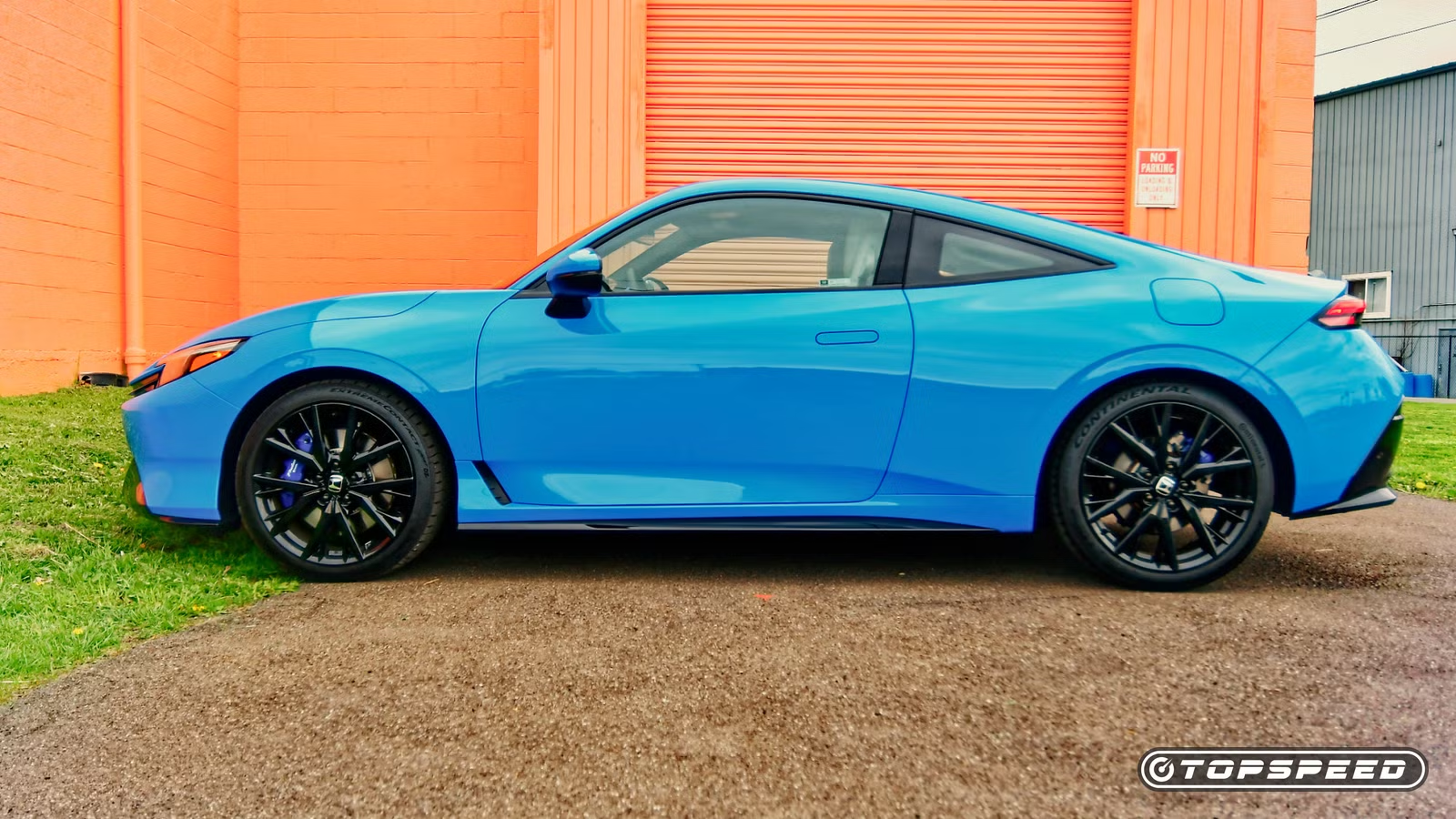
The 2026 Honda Prelude blends hybrid performance, sharp design, advanced tech, and a driver-focused cabin into a modern, engaging sports coupe.
You might think this whole stew, designed to simulate a purely analogue machine, would fall hopelessly flat. It doesn't. And even though I would prefer to have genuine sounds from my car, and to also have a legit manual gearbox, especially because Honda makes a Civic Type R with a gold-standard six-speed, and I was curmudgeonly hoping I'd hate the Prelude, I don't. I came away from this experience thinking that Honda may in fact be conducting a live experiment with the small-batch Prelude, showing that electrified vehicles can be a blast—and I hope other carmakers are taking note. Because we know gearboxes and gas engines will evaporate. Sorry if that's cold; it's the truth. But the Prelude proves that electrification doesn't preordain boring cars. It shows the exact opposite, that if carmakers are more creative, the cars we get can be as playful, engaging, and grin-inducing as any video game.
Found an error? Send it info@www.topspeed.com so it can be corrected.
Source: https://www.topspeed.com/honda-prelude-rolling-playstation/
Cars
Honda Prelude: The PlayStation Car That Proves Electrification Can Be Fun
Article Top Ad Zone
Article Middle Ad Zone
Article Bottom Ad Zone
Original Source: www.topspeed.com
Share
Comments
Comment system is currently disabled.