In 2026, the U.S. pickup truck market remains the dominant force in the automotive landscape. Q1 sales reports reveal that it accounts for 28 percent of all new vehicle sales, despite a complex economic environment. The segment has faced recent headwinds, such as rising fuel costs that exceed $4.40 per gallon. Elevated financing rates also have an impact, forcing consumers to shift toward versatile, multipurpose platforms that blur the line between rugged utility and premium luxury.
The target audience has expanded significantly from traditional commercial and rural buyers to include lifestyle consumers and urban commuters. They typically prioritize advanced technology and sophisticated driver-assistance systems. So far this year, overall volume has seen a modest dip compared to the distorted, high-demand peaks of early 2025. However, the market is characterized by a strategic pivot toward mid-size models and electrified powertrains as manufacturers work to balance robust towing capabilities with tightening efficiency standards.
For many truck owners, reliability is the primary metric of value because these vehicles often function as essential tools for both economic survival and personal autonomy. In 2026, the average transaction price for a new fleet truck remained high, and the cost of unplanned downtime was estimated at between $450 and $760 per day in lost productivity. Thus, a mechanical failure is viewed as a direct threat to one’s livelihood rather than a mere inconvenience.
This reliability-focused mentality is further intensified by the rising complexity of modern electrified and turbocharged powertrains. Modern trucks are transitioning toward more sophisticated electrified architectures, meaning owners prioritize brands with a proven track record of durability to mitigate the risk of expensive, specialized repairs. The target audience ranges from small business contractors to remote lifestyle adventurers. Regardless, a truck's worth is defined by its ability to perform under high-stress conditions, such as heavy towing and off-road hauling, without experiencing the cascading costs of a breakdown.
In the U.S. market, Honda’s approach to light trucks and SUVs is defined by a philosophy that prioritizes real-world versatility and passenger comfort over traditional, rugged body-on-frame metrics. Honda applies sophisticated unibody architectures across its larger platforms. These focus on delivering car-like handling, superior ride quality, and space efficiency, appealing to lifestyle consumers who need a versatile daily driver.
This strategy is anchored by a decades-long commitment to mechanical longevity, where reliability is treated as a core design constraint rather than a secondary feature. In 2026, this manifests in the use of proven powertrains and advanced torque-vectoring all-wheel-drive systems. Honda engineers these systems to withstand or endure decades of use with minimal maintenance.
These midsize pick-ups take very different routes to excellence.
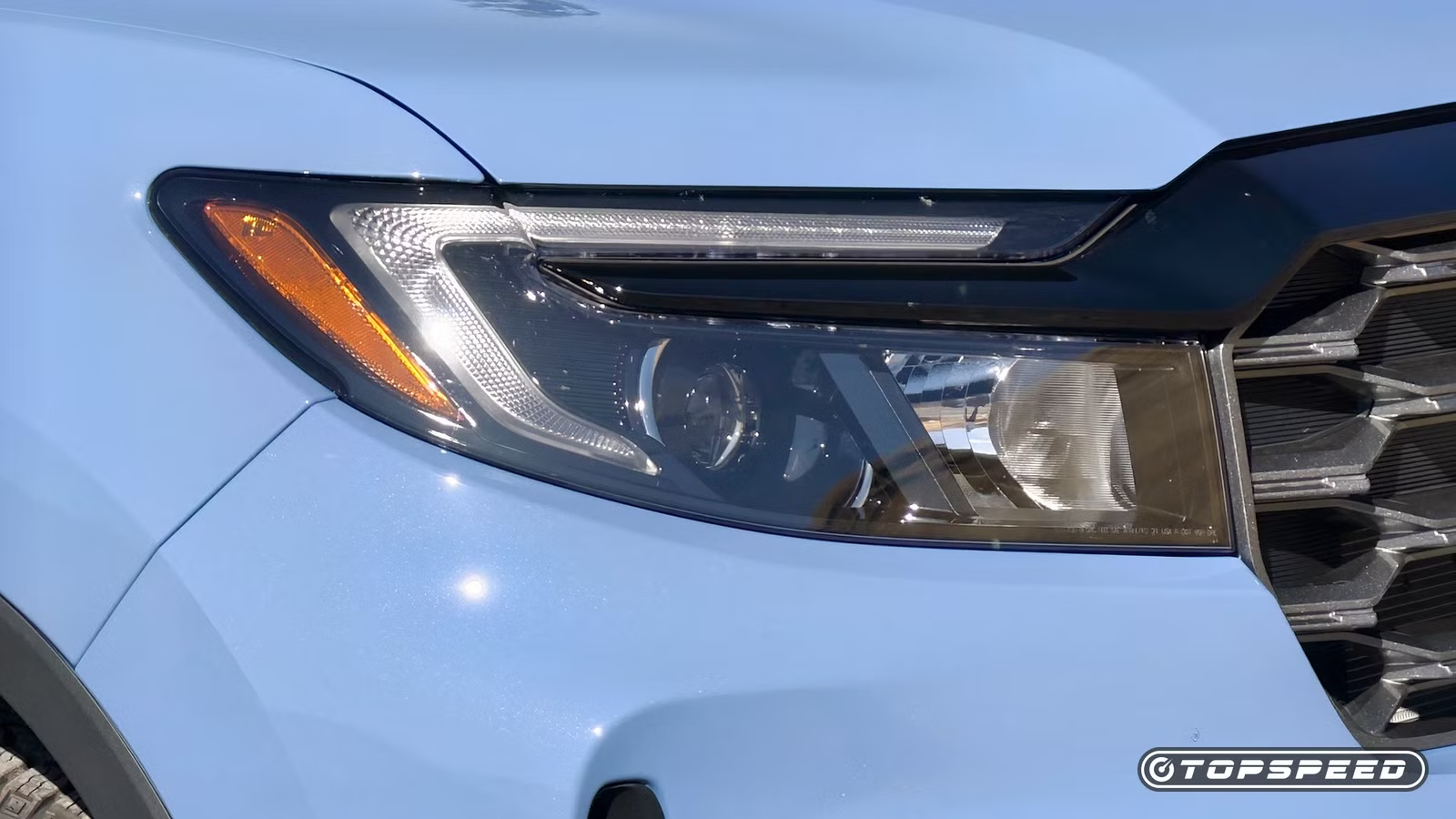
The 2026 Honda Ridgeline continues to serve as the brand's specialized entry in the mid-size pickup segment. It functions as a versatile bridge between the Pilot SUV and a traditional work truck. Its key demographic typically resides in urban and suburban areas, consisting of professionals who value the unibody's superior ride quality. It also earns praise for its 1,583-pound payload capacity and innovative in-bed trunk.
In terms of market performance, Honda sold 10,980 examples in the first quarter of 2026, representing a slight 0.3 percent increase compared to the same period in 2025. While these figures demonstrate a loyal and stable niche, the Ridgeline remains a specialized player when compared to segment titans. For instance, the Toyota Tacoma significantly leads the mid-size category with 69,263 deliveries in Q1, while the full-size Ford F-150 maintains its position as the overall market leader with 159,901 units sold during the same timeframe.
The 2026 Honda Ridgeline is built on a unibody platform featuring a fully independent suspension. This consists of a MacPherson strut in the front and a multi-link setup in the rear. Honda's configuration is a stark contrast to the traditional body-on-frame and solid-rear-axle configurations found in most mid-size pickups. This design is a point of significant controversy among dedicated truck enthusiasts, who often dismiss the Ridgeline as a fake truck. Its integrated body and frame lack the extreme torsional rigidity required for heavy-duty rock crawling or high-stress articulation.
While providing superior on-road handling and a cloud-like ride, critics argue that the independent rear suspension makes the Ridgeline more prone to sagging under heavy tongue weights. It also lacks the mechanical simplicity and durability of a leaf-sprung live axle for off-road applications. This fundamental architectural difference has led to relatively lower demand compared to segment leaders. Many traditional buyers equate a truck’s value with its ruggedness and high towing capacities.
Discover the powerhouse V6 engine that keeps this underrated pickup truck going strong, despite its unique approach to rugged work.
The 2026 Honda Ridgeline is powered by a naturally aspirated 3.5-liter V-6 engine that produces 280 horsepower at 6,000 RPM and 262 pound-feet of torque at 4,700 RPM. This refined powerplant is mated to a nine-speed automatic transmission with shift-by-wire technology and paddle shifters. As standard, the brand includes an i-VTM4 all-wheel-drive system. In performance testing, this configuration enables a 0 to 60 MPH sprint in 6.0 seconds.
This makes it one of the quickest entries in the mid-size segment. While its unibody construction emphasizes ride quality, it remains functionally capable with a maximum towing capacity of 5,000 pounds. To support these utility tasks, every model comes equipped with a heavy-duty transmission cooler and a Class III trailer hitch, ensuring the drivetrain remains reliable even when hauling near its limit.
The Ridgeline's J35Y6 is a highly evolved iteration of Honda’s legendary J-Series V-6 architecture that emphasizes mechanical simplicity and material density. The engine features a high-pressure die-cast aluminum alloy block with cast-iron cylinder liners for enhanced thermal management and wear resistance. Honda pairs this with aluminum alloy cylinder heads that integrate the exhaust manifolds directly into the casting to reduce weight and complexity.
Internally, the engine utilizes a forged steel crankshaft, high-strength connecting rods, and aluminum pistons with low-friction coatings to ensure longevity under sustained loads. What sets this design apart from many modern rivals is its commitment to natural aspiration and a single overhead cam layout. Most of Honda's competitors have pivoted to small-displacement, twin-turbocharged engines that operate under extreme internal pressures and heat. The Japanese brand combats this by avoiding forced‑induction components such as turbochargers that are common failure points in other trucks. The J35Y6 minimizes the risk of oil dilution and premature component fatigue. This conservative engineering approach includes a refined i-VTEC system that optimizes valve lift and timing for efficiency without the need for forced induction.
Can you get everything you want and pay less for a five-year-old Honda Ridgeline? Here's how much this truck is worth today and what it offers.
The 2026 Honda Ridgeline is available in four primary trim levels. The entry-level Sport starts at $40,795, followed by the RTL at $43,595, the off-road-oriented TrailSport at $45,995, and the top-tier Black Edition at $47,395. The base Sport trim includes a 9.0-inch touchscreen featuring wireless Apple CarPlay and Android Auto, triple-zone automatic climate control, and a seven-speaker audio system.
Stepping up to the RTL adds significant comfort through leather-trimmed seating, heated power-adjustable front seats with driver memory, and a one-touch power sunroof. The TrailSport introduces rugged aesthetics and ambient lighting, while the Black Edition serves as the luxury flagship, boasting a 540-watt premium eight-speaker audio system, ventilated front seats, heated rear outboard seats, and red ambient LED lighting. You also get the Honda Sensing suite and the signature dual-action tailgate and lockable in-bed trunk across all trim levels.
While the Ridgeline may not be popular in terms of truck sales, it gains a lot of praise from reviewers and owners. J.D. Power gives the truck an 81/100 consumer-verified overall score, consisting of 82/100 for quality and reliability, 72/100 for the driving experience, 86/100 for resale, and 83/100 for the dealership experience.
iSeeCars's valuation reveals an incredible reliability rating of 8.9/10, indicating that the Ridgeline will cover an average lifespan of 13.2 years or 183,324 miles, with a 39.4 percent probability of reaching 200,000 miles. The truck currently holds a 4.5/5 overall score on the Edmunds consumer review portal. Most of these submissions highlight their ride quality, driving experience, and comfort as key strengths.
Found an error? Send it info@www.topspeed.com so it can be corrected.
Sources: Honda, J.D. Power, iSeeCars, and Edmunds.
Source: https://www.topspeed.com/unpopular-pickup-300000-miles-without-drama/
Cars
The Unpopular Pickup That Regularly Crosses 300,000 Miles Without Drama
Article Top Ad Zone
Article Middle Ad Zone
Article Bottom Ad Zone
Original Source: www.topspeed.com
Share
Comments
Comment system is currently disabled.