Right up until the mid-70s, Suzuki exclusively produced two-stroke motorcycles. Although two-stroke engines offer an exceptional power-to-weight ratio and are cost-effective to manufacture, they are maintenance-heavy, loud, and not particularly fuel-efficient. Once the oil crisis hit, this strategy rather clearly needed a rethink.
Follow and Like top authors, topics, and trends
Browse with fewer ads across the site
Personalize your profile to showcase your activity
Get a content feed tailored to your interests
By creating an account, you agree to our Terms of Use and Privacy Policy. You also agree to receive our newsletters; you can unsubscribe any time.
*Required: 8 chars, 1 capital letter, 1 number
It all started with the GS750. While it didn’t exactly offer anything new in terms of engineering, it was simple and reliable. It needed to be because Suzuki had already dropped the ball with a failed rotary experiment, and customer confidence was at an all-time low. What the GS750 did was restore the brand’s reputation. It was the foundation upon which Suzuki would build an inline-four dynasty.
By the 80s, speed had captured the imagination. The fastest motorcycles are sold in large numbers, but building a fast motorcycle requires a certain level of overengineering. Everything needed to withstand the rigors of speeds in excess of 150 MPH. Every part needed to be stronger, because even a minor failure could lead to a fatality. After almost two decades' worth of experience in manufacturing a wide variety of overengineered high-performance engines, we got one that would effectively define a generation.
What would an American cruiser and a Japanese sports bike have in common? They both became pop culture icons.
In many respects, the first-generation Hayabusa has become the ultimate blue-collar performance bike. It offered unmatched performance for an unmatched price back when it was new, and today, on the used market, the same is true. You can still pick one of these up for less than $5k, and it will still have a lot of life left in it. Thousands of these bikes were sold through the 00s, and the fact that these bikes are so ubiquitous is a big part of the reason they remain affordable.
It is also why some bikes are able to accumulate so many miles. New parts will only get a bike so far. Once a model is discontinued, it is left up to OEM suppliers, and if the market is too small, that won’t last long either. Suffice to say, the market is big enough, with thousands of first-gen bikes still running around. Those that are not are broken up, and their parts also help keep the rest going, seemingly indefinitely.
It might not be the "fastest motorcycle in the world" today, but the 'Busa is still a force to be reckoned with 25 years on
Motorcycle engines, most especially those of the high-performance variety, are not usually designed to accumulate over 100,000 miles. But, in the case of the Hayabusa, the engine internals needed to withstand the extreme stress put on an engine that is capable of speeds close to 200 MPH. Everything inside is built to these tolerances, and these tolerances far exceed what any normal motorcycle ridden at the speed limit would ever need.
This saying doesn’t often hold water in the motorcycle industry, with some bikes offering enormous performance potential from relatively small displacement engines. But here with the Hayabusa, the added displacement helps with longevity. As far as engines go, this 1298cc DOHC inline-four is relatively simple, but still able to produce an impressive 173 horsepower. What is more impressive is the fact that it has over 100 pound-feet of torque, and the vast majority of that torque is distributed evenly through the rev range.
While smaller displacement inline-four sport bikes need to work harder to make power, with the Hayabusa, it is effortless; the power is always there when you need it, and over time, this means less stress is put on the internals (well, unless you lug the thing around in the wrong gear, but that is a separate matter).
If you already own a Hayabusa, then you already have more than enough speed, but there are a few simple mods that will make it even better
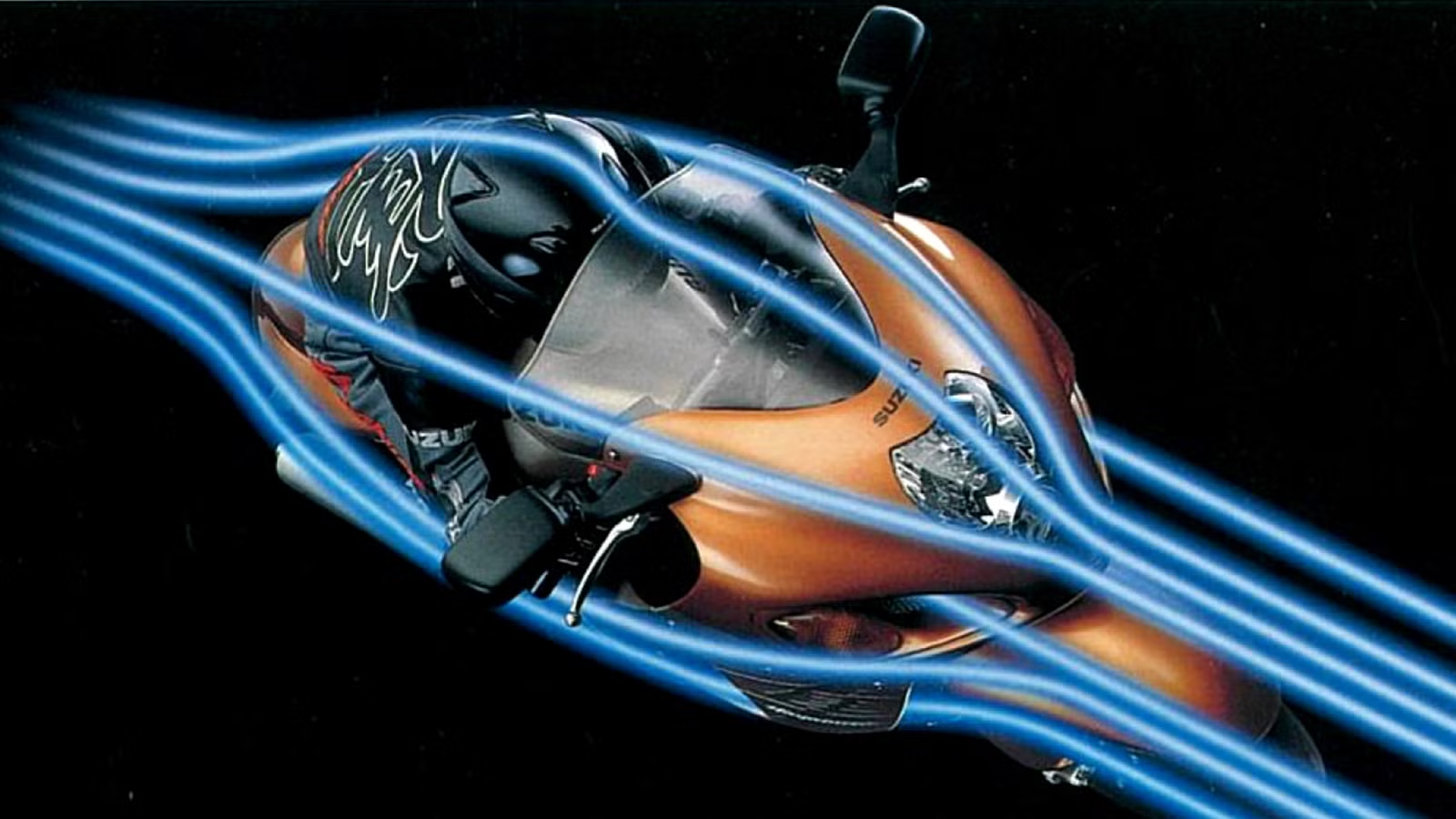
Some motorcycles really are too fast for their own good, and the Hayabusa is most certainly one of them. What made the bike so incredibly fast was its slippery design. Unlike most modern sport bikes (with wings), which need to take into account a wide variety of conditions throughout the design process, the Hayabusa was simply designed to go as fast as possible in a straight line.
The end result certainly is not pretty, but this ugly duckling became a symbol of speed, and its ugly silhouette became a badge of honor. Underneath the fairings lay an unremarkable chassis, and suspension and braking components were all around a decade behind the bike’s performance potential. In the wrong hands, the “Busa” is a genuinely dangerous motorcycle. Over two decades later, bikes in poor condition sell for next to nothing and are even more dangerous.
Look hard enough, and you can have these powerful motorcycles for cheap.
Mercifully, most bikes in poor condition are taken off the road and parted out to help keep the rest alive. In recent times, the venerable sport bike has found a new lease on life as a budget-friendly sport tourer. While the ergos are still relatively sporty, they are not as aggressive as modern sport bikes, and the seat is comfortable enough for long-distance riding. The fact that these bikes are devoid of modern tech might be a dealbreaker for some, but for others, just taking care of basic maintenance has led to these bikes regularly going past the 100,000-mile mark. In some cases, riders have accumulated well over 200,000 miles.
Found an error? Send it info@www.topspeed.com so it can be corrected.
Source: https://www.topspeed.com/suzuki-does-200000-miles-without-complaining/
Cars
The Suzuki That Does 200,000 Miles Without Complaining
Article Top Ad Zone
Article Middle Ad Zone
Article Bottom Ad Zone
Original Source: www.topspeed.com
Share
Comments
Comment system is currently disabled.