We have more motorcycles at our disposal today than ever before. There really is a bike out there for everyone. Unfortunately, not everyone actually wants a motorcycle. Thus, fewer and fewer people are buying motorcycles these days. Sales have slowed in every motorcycle segment, bar one.
Follow and Like top authors, topics, and trends
Browse with fewer ads across the site
Personalize your profile to showcase your activity
Get a content feed tailored to your interests
By creating an account, you agree to our Terms of Use and Privacy Policy. You also agree to receive our newsletters; you can unsubscribe any time.
*Required: 8 chars, 1 capital letter, 1 number
For a time, adventure bikes remained something of a niche product. In the early years, this segment was dominated by BMW and KTM, while the rest of the brands were content to offer a range of different dual-sport bikes, often given added wind protection, to plug the hole. The rise in popularity of the GS model, in particular, forced other brands to take note and develop proper adventure models. This quickly evolved into something of an arms race, with each brand trying to offer more features and more power. With that, the bikes became significantly heavier, and while these bigger ADVs remain versatile, they are fairly limited in terms of off-road competence.
This is where middleweights stepped in. Offering a more balanced approach by using smaller, less powerful engines and sacrificing a few nice-to-have features here and there in an effort to keep weight down. Naturally, a new arms race evolved in the middleweight category, and some “middleweight” bikes are now heavier than some of the old full-size models! The bike in question has also gained weight, but in all the right places, one might say, and it proves that you can actually have your cake and eat it.
If you are shopping for an ADV on a budget, it is well worth considering one of these used bikes
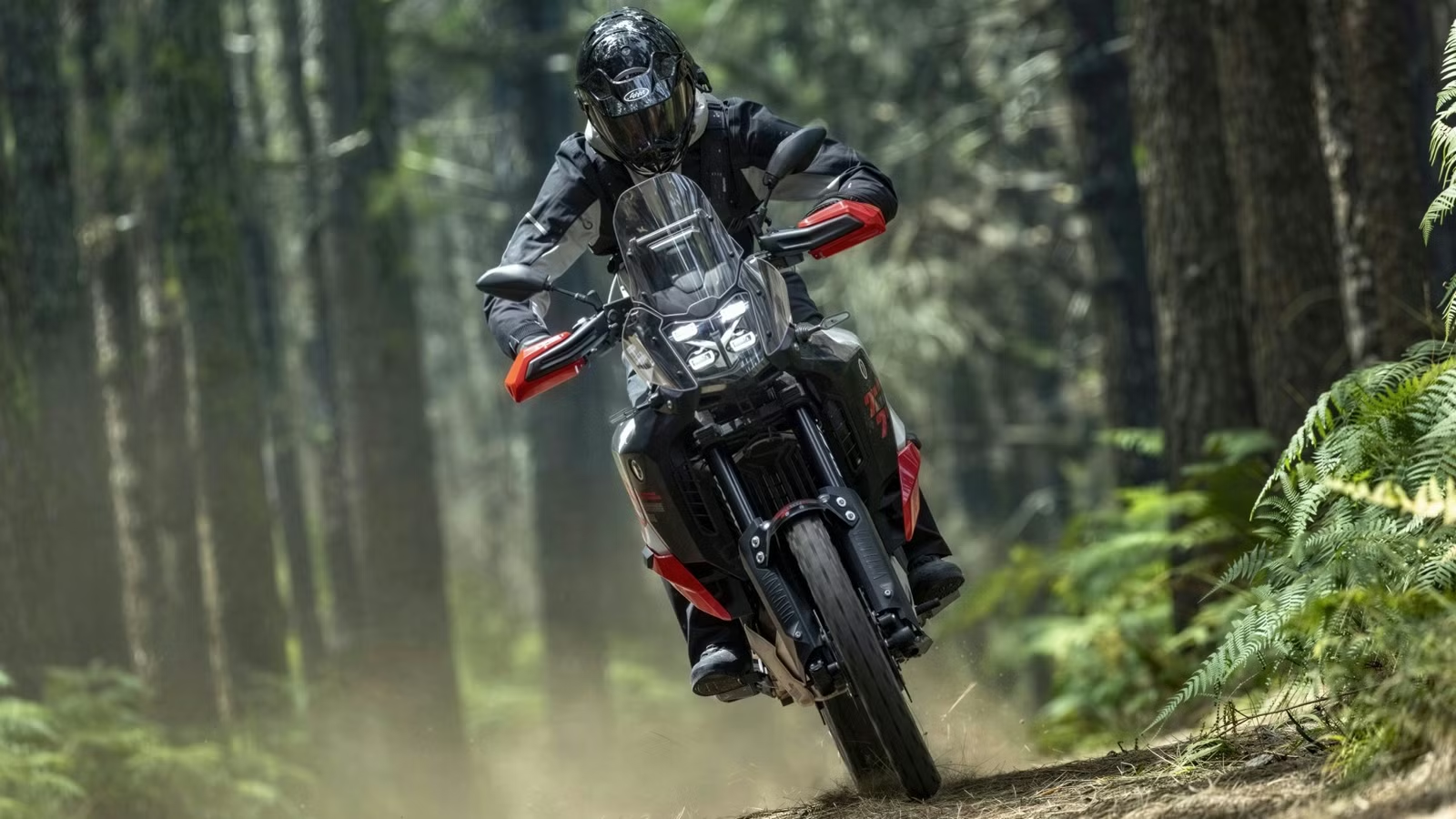
Yamaha introduced the original Tenere 700 as something of an antidote to all the big-bore adventure models. It was stripped back, and the chassis was specifically designed to perform off-road. In many ways, it was more like a giant dirtbike than an ADV. It proved to be exactly the right bike at exactly the right moment. At one point in time, Yamaha was not able to keep up with demand, but slowly, customers came to realize that it was also far from perfect.
It had no electronic rider aids, an overly soft suspension, and wasn’t particularly comfortable. Over time, Yamaha addressed these issues, but the World Raid edition takes it a step further by adding sophisticated modern electronics and uprated, fully adjustable suspension. It has the potential to be the ultimate one-bike garage.
For any motorcycle that will be used for travel, you need to start with a reliable base. Yamaha chose the CP2 for this task, and it has proven to be just as reliable as it was in all the street bikes it went into prior to the launch of the original Tenere. In terms of performance, it might seem lacking on paper, but in the real world, the CP2 is highly tractable and, under the right conditions, enormously fun. Like any good middleweight, all of its torque lives in the midrange, and you have almost instant access to it any time you want.
While it is fair to say that pretty much any modern motorcycle (with a few unique exceptions) offers mechanical reliability, the Tenere is widely regarded as one of the most reliable motorcycles on the market. The kind of peace of mind that this level of reliability gives when you are traveling far from home, or civilization in general, is impossible to put a dollar value on. It is one of those things that you will only really appreciate once you have owned a bike that doesn’t offer this level of peace of mind.
The Yamaha MT-07 proves that the best used bike isn’t always the fastest or fanciest. Sometimes, simple just works better.
In terms of electronic features, Yamaha has thrown the proverbial kitchen sink at the World Raid. It has cornering ABS, lean-sensitive traction control, slide control, ride modes, and cruise control, largely thanks to the addition of an IMU. For most riders who passed on the original Tenere, the lack of electronics was never the main concern. It was, and still is, relatively uncomfortable for a bike that you would need to use for long-distance travel. It is a compromise that off-road enthusiasts were willing to make, but they also found the limits of the stock suspension a little too easy.
The fully adjustable KYB suspension offers more travel and will allow riders to dial it in to their specific weight and riding style, thereby improving overall comfort both on and off-road. The seat is still pretty hard, but that is just part of the deal if you want an effective off-roader. It also gets a long-range tank, which has increased the fuel capacity to 6.1 gallons. Naturally, there is a weight penalty for all these added features, and it is pretty severe: just shy of 30 pounds! Or about as much as an actual kitchen sink. But, it is important to add a caveat here, and that is the fact that over half of this added weight is actually just fuel.
This Yamaha offers an ideal blend of fun and practicality, all wrapped up in an attractive retro-styled package
The Tenere 700 World Raid really does do everything well. Yamaha has pretty much solved every conceivable problem everyone had with the original. The additional cost is also far less than it would cost to modify a base model into this specification; it really is “ready to explore” straight from the factory.
The only issue you will ever have with the Tenere is the same issue shared with pretty much any dual-purpose motorcycle currently on the market. While it is able to do everything well, it can never be excellent at one particular thing. So many people go out and buy an ADV thinking it can carve up a canyon, then do some single track on the way home. Obviously, that is just not the case. Any adventure bike is a compromise, and it is important to understand the unique set of limitations that apply to each model.
Found an error? Send it info@www.topspeed.com so it can be corrected.
46mm inverted fork, fully-adjustable (9.1-in travel)
Single shock, adjustable preload with remote adjuster, and rebound damping (8.7-in travel)
Source: https://www.topspeed.com/japanese-adventure-bike-does-everything-well/
BMW
The Japanese Adventure Bike That Does Everything Well
Article Top Ad Zone
Article Middle Ad Zone
Article Bottom Ad Zone
Original Source: www.topspeed.com
Share
Comments
Comment system is currently disabled.