For the most part, the motorcycle industry was still in flux back in the 60s. Several small companies sprang up throughout Europe and seemingly vanished overnight. All the while, the British motorcycle industry went from strength to strength, reaching the peak of its powers by the mid-60s.
Naturally, all good things do eventually come to an end. It was no coincidence that the demise of the British brands coincided with the rise of the Japanese manufacturers. They made their first global moves at the beginning of the decade, and by the end of the decade, it was abundantly clear which country was making the better motorcycles.
Buying a used motorcycle always has an element of risk attached, so please do your research and proceed with caution. The motorcycles on this list go from oldest to newest.
All these motorcycles have an important place in motorcycling history
The original Bonneville isn’t just an icon of the 60s, but rather one of the all-time icons of the motorcycle industry, largely thanks to its timeless design. While the original bike made its debut in 1959, it went on to become one of the most popular motorcycles through the 60s. It is still the motorcycle that defines the Triumph brand today, with the modern Bonneville a faithful modern reinterpretation of the original design.
Pretty much every British brand was heavily invested in motorcycle racing back in the 60s, but there was nothing quite as effective as the Matchless G50. Its powerful OHC single was ahead of its time, making as much as 50 horsepower, and several esteemed frame builders also offered better chassis for the lump. Today, original bikes are hard to find and highly collectible. But, for those who just love its classic racer lines, hundreds of high-quality replicas were built long after the company went under, all of which are comparatively affordable.
The Super Cub was introduced in 1958, but it was the “You meet the nicest people on a Honda” marketing campaign that sparked a cultural revolution. Up until this point, motorcycles were vehicles of the counterculture. Most brands of the time embraced the “bad boy” image, but Honda bucked the trend and offered the Super Cub scooter to everyone. It was a stroke of genius, and it helped pave the way for future success.
The Super Cub C125 proves timeless design and reliability never go out of style.
To some, the original Vespa represents an “anti-motorcycle.” Its designer famously hated motorcycles and wanted to design a vehicle that served as basic transportation yet was also modern and stylish. No matter how much Corradino D'Ascanio “hated motorcycles”, he ended up designing one of the most iconic scooters of all time. The 60s 150 GL boasts a slight refinement of the original design, and it is the timeless silhouette most of us will conjure whenever we think of a scooter, let alone a Vespa.
A recent auction just set the bar ridiculously high for these iconic race bikes. This four-cylinder 500 was an incredibly successful racing motorcycle, with riders aboard these bikes sharing nine Championships between 1956 and 1965. The 1965 season was the last year MV ran the four-cylinder engine before switching over to Giacomo Agostini’s famed triple (a combination which would go on to win a further seven Championships in a row). Suffice to say, if you wanted to win in the 60s, you needed an MV.
While the Shovelhead engine didn’t exactly cover itself in glory, the Electra Glide became something of an icon for a different reason. Elvis Presley was one of the biggest personalities of the 20th century, and his love affair with Electra Glide from this era certainly didn’t go unnoticed. While he had other Harleys over the years and rode several different bikes in his movies, he was most often photographed riding an Electra Glide.
The Commando represented something of a swansong for the famous British brand. It sold well and offered good performance for the time, but like most British motorcycles, reliability was a major concern. The original 750cc bikes made in the late 60s and early 70s suffered from main bearing failures, a problem that only added to the mounting financial problems Norton were facing.
Like the Commando, the V4SV and V4CR also receive limited editions
Up until the late 60s, most off-road bikes were lightly modified street bikes, and the rest were dedicated motocrossers. Yamaha saw an opportunity and was quick to pounce. The DT-1 was the very first factory dual-sport. Developed from the ground up to be street legal, yet offered a level of performance on the dirt that made it competitive with factory motocross bikes. At the time, there was nothing else quite like it on the market.
While the aforementioned DT-1 may have been more than adequate for most weekend warriors, if you wanted to be a competitive open-class motocross or cross-country rider back then, you needed one of these machines. Capable of doing 100 MPH in the dirt, the 400 Cross was an absolute monster. The fact that Malcolm Smith and Steve McQueen (usually competing under the pseudonym Harvey Mushman) rode these bikes to several victories only served to preserve their legendary status.
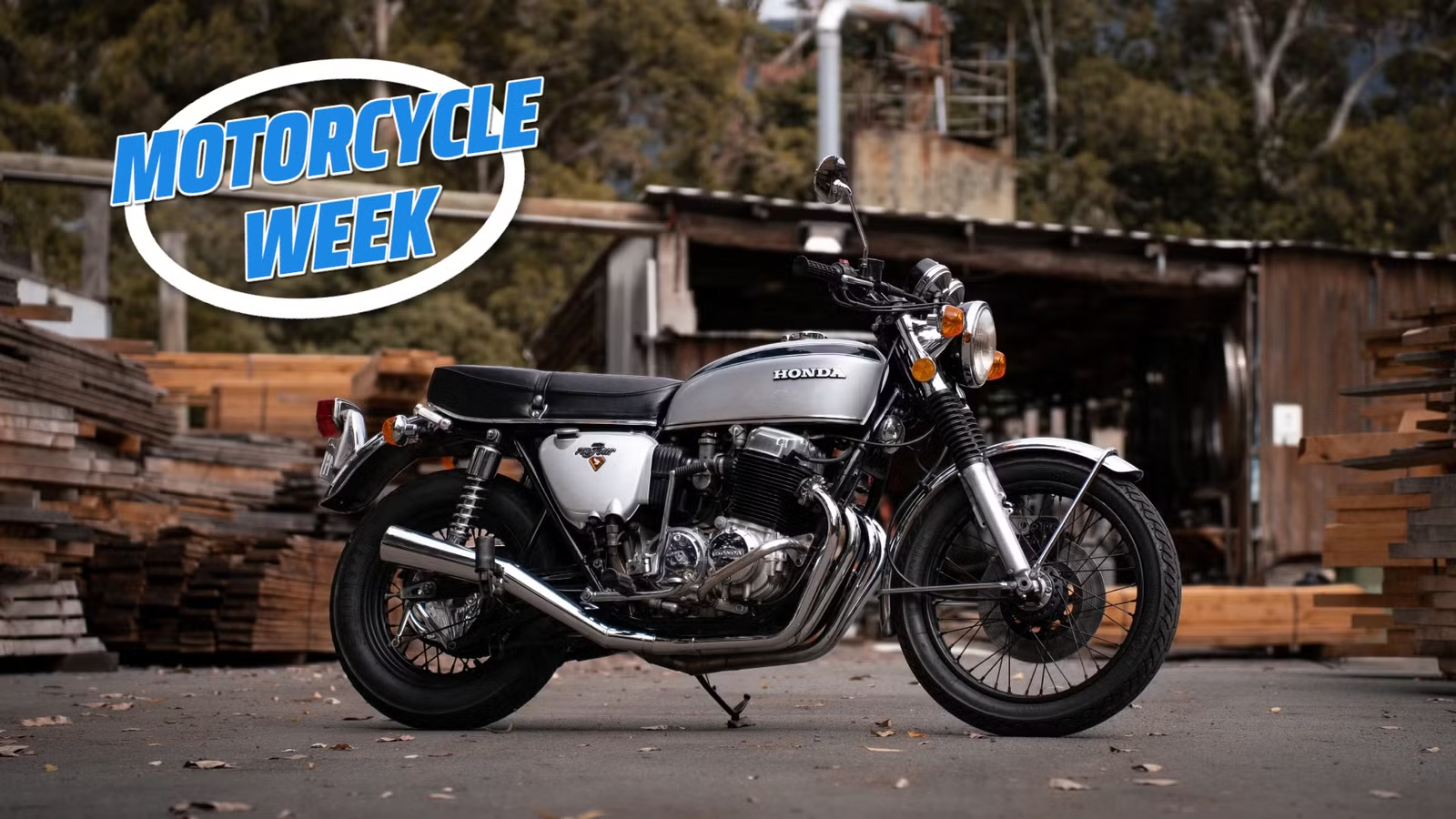
While both the Super Cub and the DT-1 were huge steps for Japanese manufacturers, neither of those bikes really bothered the major manufacturers. The arrival of the CB750 certainly did. It was faster, cheaper, and more reliable than anything else on the market. Emboldened by the success of the CB, other Japanese manufacturers were quick to hop on the bandwagon, and the “Universal Japanese Motorcycle” was born.
Found an error? Send it info@www.topspeed.com so it can be corrected.
Source: https://www.topspeed.com/most-iconic-bikes-60s/
Cars
The Most Iconic Bikes From The 60s
Article Top Ad Zone
Article Middle Ad Zone
Article Bottom Ad Zone
Original Source: www.topspeed.com
Share
Comments
Comment system is currently disabled.