The American touring market has always had a very specific idea of what a bagger should be. It should rumble. It should have a V-twin engine displacing something north of 100 cubic inches. It should carry a price tag that assumes you've already committed emotionally before you ever check your bank account. For decades, that formula went largely unchallenged, and the handful of brands that tried to break into the segment were either quietly dismissed or simply forgotten.
Follow and Like top authors, topics, and trends
Browse with fewer ads across the site
Personalize your profile to showcase your activity
Get a content feed tailored to your interests
By creating an account, you agree to our Terms of Use and Privacy Policy. You also agree to receive our newsletters; you can unsubscribe any time.
*Required: 8 chars, 1 capital letter, 1 number
Harley-Davidson has spent decades polishing a motorcycle that turned into one of the most recognizable formulas. The 2026 Road Glide is still the standard for the Bagger space in America. It is the bike everybody else has to measure against, even if they do not want to say it out loud. With a starting price of $25,999, the Road Glide makes 105 hp and 130 lb-ft of torque from its Milwaukee-Eight 117 engine, and wraps it all in the familiar Sharknose fairing and a 12.3-inch Skyline OS display.
In its latest avatar, the Road Glide gets rider-safety electronics, selectable ride modes, and Showa suspension, so this is not a bare-bones nostalgia piece. It is a very modern touring motorcycle wearing very old-school confidence. The catch is that Harley’s premium is not just about hardware. It is also about image, and that is where the Road Glide can begin to feel expensive before you have even rolled away from the dealer. For some riders, that is a feature. For others, it is the exact reason to look elsewhere.
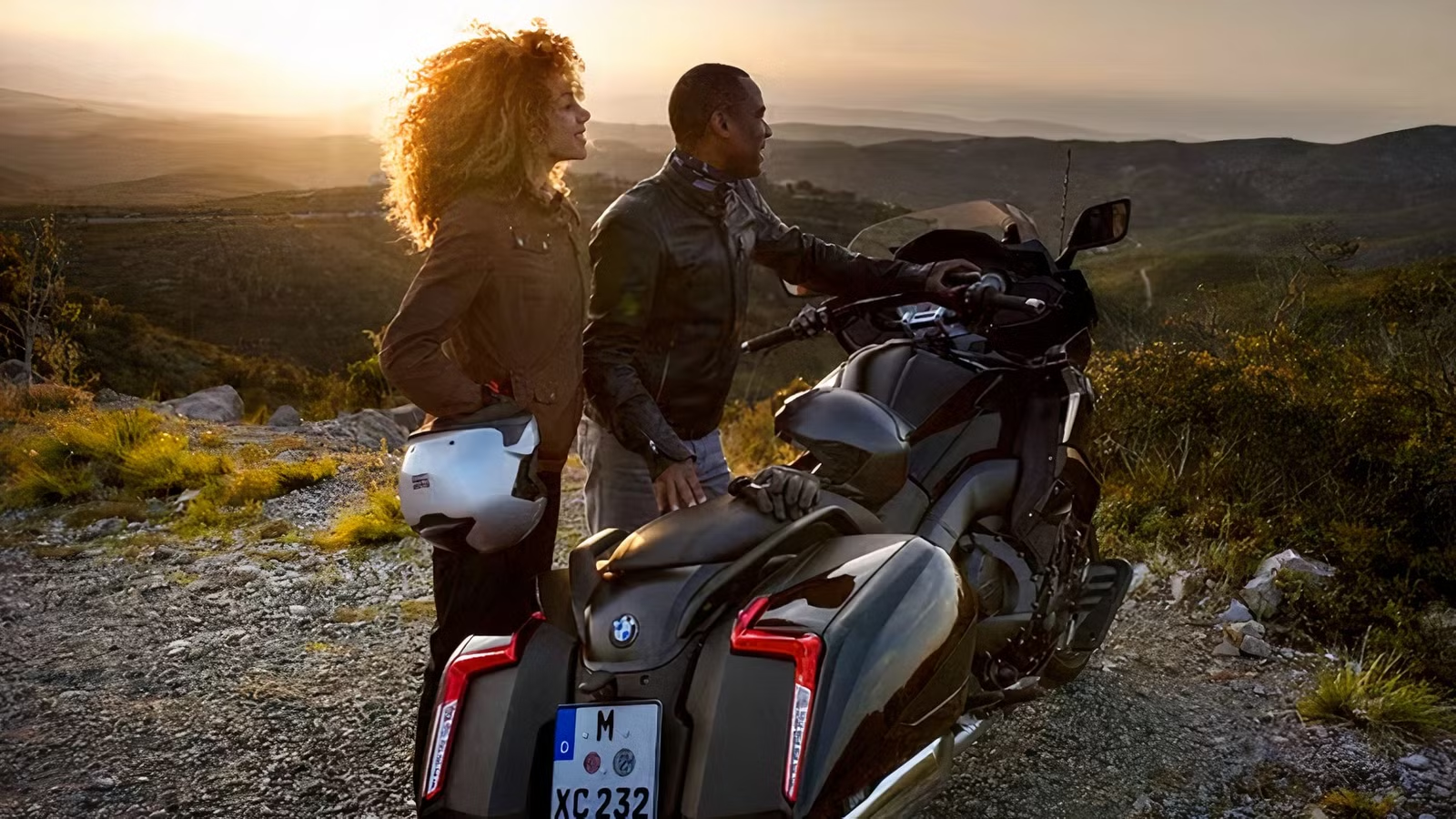
BMW does not play the bagger game the same way Harley does, and that is precisely why the K 1600 B lands with such force. At a base price of $24,975, the BMW K 1600 B lands in a curious place. It is not cheap in the absolute sense, but it is cheap relative to what it delivers. It undercuts the Road Glide on entry price while offering a six-cylinder engine, a massive display, and a more sophisticated chassis package. Here, BMW is not trying to beat Harley by looking more Harley-like. It is trying to beat Harley by offering more value.
Look at the Road Glide, and the value gap becomes easier to see. Harley’s 2026 Road Glide starts at $25,999 and, at that price, it gives you 105 hp, 130 lb-ft, 44 mpg, a 6-gallon tank, and the Skyline OS display. It is a strong package, but many of the headline features still sit inside a very brand-heavy proposition. BMW, by contrast, gives the K 1600 B a sophisticated six-cylinder powertrain and the sort of premium touring feel that typically costs more in the American bagger world. The result is a bike that can look expensive in isolation, yet strangely sensible beside the Road Glide.
If you want all the features of a Street Glide but don't want a Harley, Indian has a great alternative for you
The K 1600 B’s biggest party trick is not peak output but the way it delivers that output. BMW’s inline-six is a rare thing in motorcycling, especially in a bagger, and it gives the bike a character that is almost difficult to compare with the usual V-twin rhythm. The engine is liquid-cooled, transverse-mounted, and built for smoothness first. It does not throb or shudder the way a big American twin can; it surges.
BMW’s six-cylinder power mill churns out 160 hp and a strong 133 lb-ft of torque, and that output has long been part of the appeal. That does not make the Road Glide inferior in every emotional sense. Harley’s V-twin pulse is part of the charm, and some riders will always prefer it. However, if the question is which bike feels more mechanically refined, the BMW has the more impressive answer.
The K 1600 B’s power figure matters because it changes how the bike behaves in the real world. Six-cylinder torque is not just about bragging rights; it is about passing slower traffic without effort, climbing grades without strain, and carrying speed with almost comical ease. The K 1600 B’s engine output is exactly the kind of reserve that turns highway riding into something almost relaxed. So Harley’s 105 hp is plenty for touring, but the BMW gives you a lot more headroom.
BMW has always taken suspension seriously, and the K 1600 family reflects that thinking. The platform is known for its Duolever front end and Paralever rear design, a setup that separates it from the telescopic-fork norm most baggers still rely on. The benefit is not just technical trivia; it is composure. Brake dive is reduced, the chassis stays calmer under load, and the bike can feel strangely composed for something this large. Even BMW’s broader K-series architecture has been associated with that engineering-first mindset for years.
The K 1600 B was conceived with a low-slung bagger silhouette, a lower rear profile, and North American tastes very clearly in mind. Its shape is meant to look long and low rather than tall and bulky. That visual trick changes the emotional reading of the machine before the engine even starts. It also benefits from the same family-wide move to modern instrumentation and integrated navigation, which makes it feel less old-fashioned. In a class where size is expected, the K 1600 B at least makes its bulk feel organized rather than merely present.
The K 1600 B was built with two people in mind, and it shows. The rider's position is upright and relaxed, with wide footboards and a wide handlebar that encourages a natural, unforced posture across long days. The passenger seat is elevated slightly above the rider's, giving pillion riders a better view and more support rather than perching them awkwardly low. Optional backrests and armrests make the rear seat a genuinely comfortable place to spend several hundred miles, which is not something you can say about every bagger on the market.
This Honda touring motorcycle is the only one of its kind that can be had with an airbag.
The 10.25-inch full-color TFT instrument display is, by a meaningful margin, the best screen in the bagger segment. It's large, crisp, and configurable, with split-screen navigation that can show a zoomed-in turn-by-turn map alongside instrument data simultaneously. Smartphone integration through the BMW Motorrad Connected app handles music, calls, and navigation seamlessly. Whereas, the multi-controller wheel on the left handlebar lets you scroll through menus without taking your eyes fully off the road.
The electronics package on the K 1600 B operates with a transparency that makes it feel more like rider intuition than machine intervention. D-ESA Next Generation continuously reads road conditions and adjusts damping in real time without any perceptible transition. The lean-angle sensitive traction control intervenes in milliseconds, and the cornering ABS modulates brake pressure independently at each wheel based on lean angle.
Perhaps the most underrated safety feature is the adaptive LED headlight, which physically pivots as the bike leans into corners, illuminating the road ahead rather than pointing at the shoulder. Harley, to its credit, also leans hard into rider safety technology on the Road Glide. ABS, traction control, drag-torque slip control, vehicle hold control, TPMS, and cornering-specific assistance are all part of the package. The difference is that Harley’s tech feels like an overlay on a heritage product, while BMW’s tech feels baked into the concept from the start.
The Suzuki Boulevard M109R may be old, but its powerful engine, reliable performance, and pricing make it a smart choice for a long-term cruiser.
The Road Glide still deserves respect. It is iconic for a reason, and Harley has turned its sharknose touring formula into something that feels almost untouchable in American motorcycling. However, the K 1600 B has a different kind of authority. It is smoother, more technically interesting, more modern in its presentation, and, crucially, more convincing on a value-for-feature basis. BMW designed it for riders who care as much about the ride as the image, and that makes all the difference.
At $24,975, the K 1600 B does not merely undercut the Road Glide. It reframes the whole debate. Once you account for the BMW’s six-cylinder engine, its premium electronics, its touring composure, and its distinctively polished feel, the Harley’s higher-priced aura starts to look less like an inevitability and more like a tax on tradition. For riders who want a bagger that delivers genuine capability, not just the right silhouette, the BMW K 1600 B stands out as the smarter buy.
Found an error? Send it info@www.topspeed.com so it can be corrected.
Source: https://www.topspeed.com/bagger-makes-road-glide-look-overpriced/
BMW
The Bagger That Makes The Road Glide Look Overpriced
Article Top Ad Zone
Article Middle Ad Zone
Article Bottom Ad Zone
Original Source: www.topspeed.com
Share
Comments
Comment system is currently disabled.