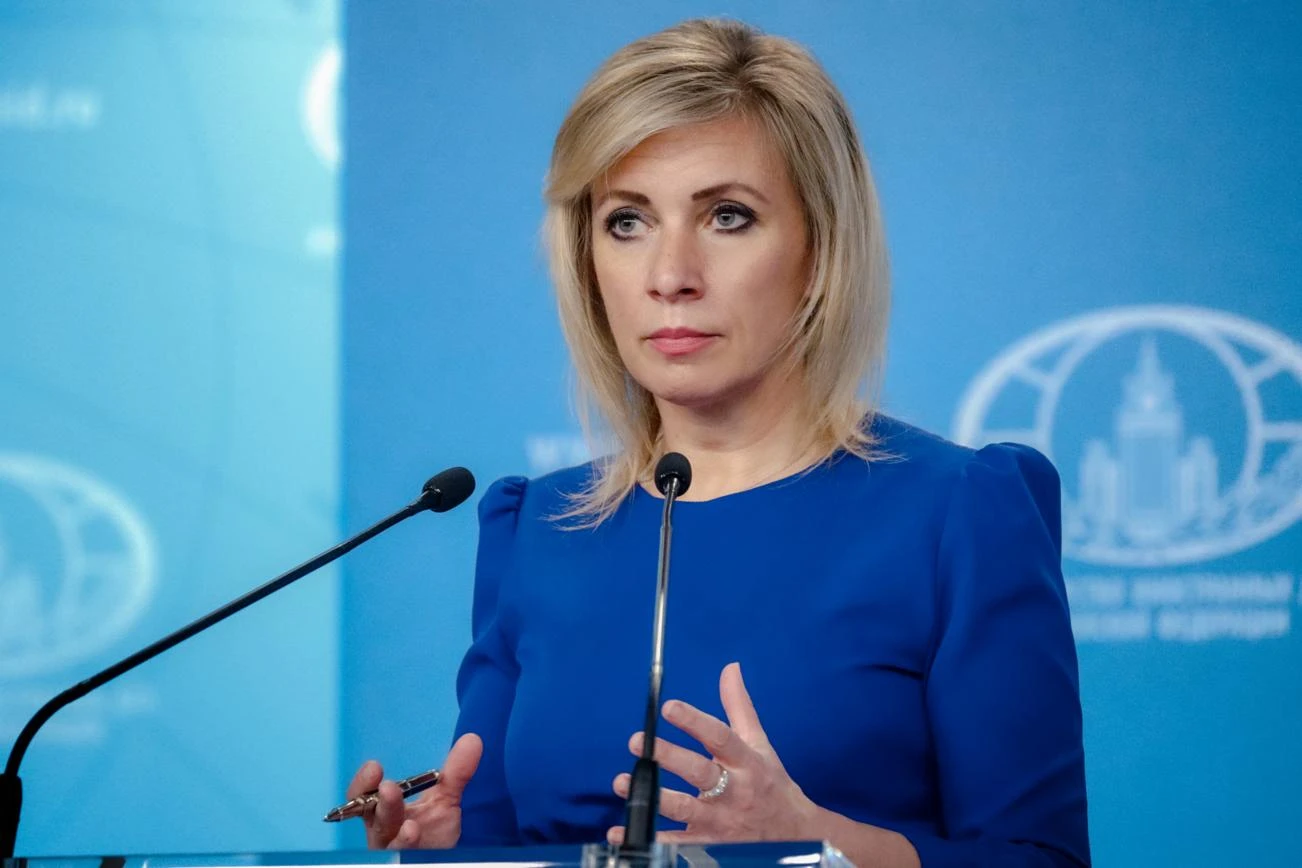
Russian Ministry of Foreign Affairs (MFA) spokesperson Maria Zakharova commented on Armenian Prime Minister Nikol Pashinyan’s absence from the upcoming meeting of the Eurasian Economic Union (EAEU) leaders, and stated that “there is no tragedy in it” for this very union, but questions arise in the context of Armenia’s future foreign policy course.
According to Zakharova, Moscow assesses the situation not by political statements, but by specific actions of the Armenian government, which are related to the implementation of a pro-European policy and their possible impact on Eurasian integration processes.
“There is, of course, no tragedy for the union; the question lies only in Armenia itself,” said the Russian MFA spokesperson.
She emphasized that the Russian side has repeatedly warned about the contradictions between membership in the EAEU and deepening integration with European organizations, especially in the context of the formation of supranational mechanisms of regulation by another integration bloc.
According to Zakharova, Moscow “said from the very beginning that it is impossible to combine membership in the EAEU with the introduction of supranational regulatory mechanisms of another integration bloc.” She noted that this position was conveyed to the Armenian side “repeatedly and exhaustively, at all levels.”
The Rusian MFA spokesperson recalled that similar assessments were previously made also by Russian President Vladimir Putin and Russian Deputy Prime Minister Alexey Overchuk.
Zakharova linked the aforesaid Russian position with the policy of the European Union (EU) towards the EAEU countries. According to her, European organizations are pursuing a “deconstructive policy” and using mechanisms of punitive pressure against states entering this Eurasian union.
“Those same western European, EU structures have adopted a destructive course and are applying illegal sanctions against the EAEU member states themselves,” she stressed.
In this regard, the Russian MFA spokesperson noted that further deepening of Armenia’s cooperation with European institutions may directly lead to a contradiction with its obligations assumed within the EAEU.
At the same time, Zakharova stressed that Moscow does not adhere to the “either-or” principle and is not against multi-vector cooperation as such. According to her, Russia has always proceeded from the possibility of “organically combining cooperation in all directions.”
However, she noted that the situation has changed after western European organizations, according to Moscow, began to take actions that harm the economy, trade, and financial system of Russia and its partners.
"All this has turned into a hybrid war, including in the trade sphere," the Russian MFA spokesperson said, referring to the West's sanctions policy.
Source: https://news.am/en/news/1037185
Armenia
Russia MFA spox reminds Armenia about impossibility of combining EAEU membership with integration into European organizations
Article Top Ad Zone
Article Middle Ad Zone
Article Bottom Ad Zone
Original Source: news.am
Share
Comments
Comment system is currently disabled.