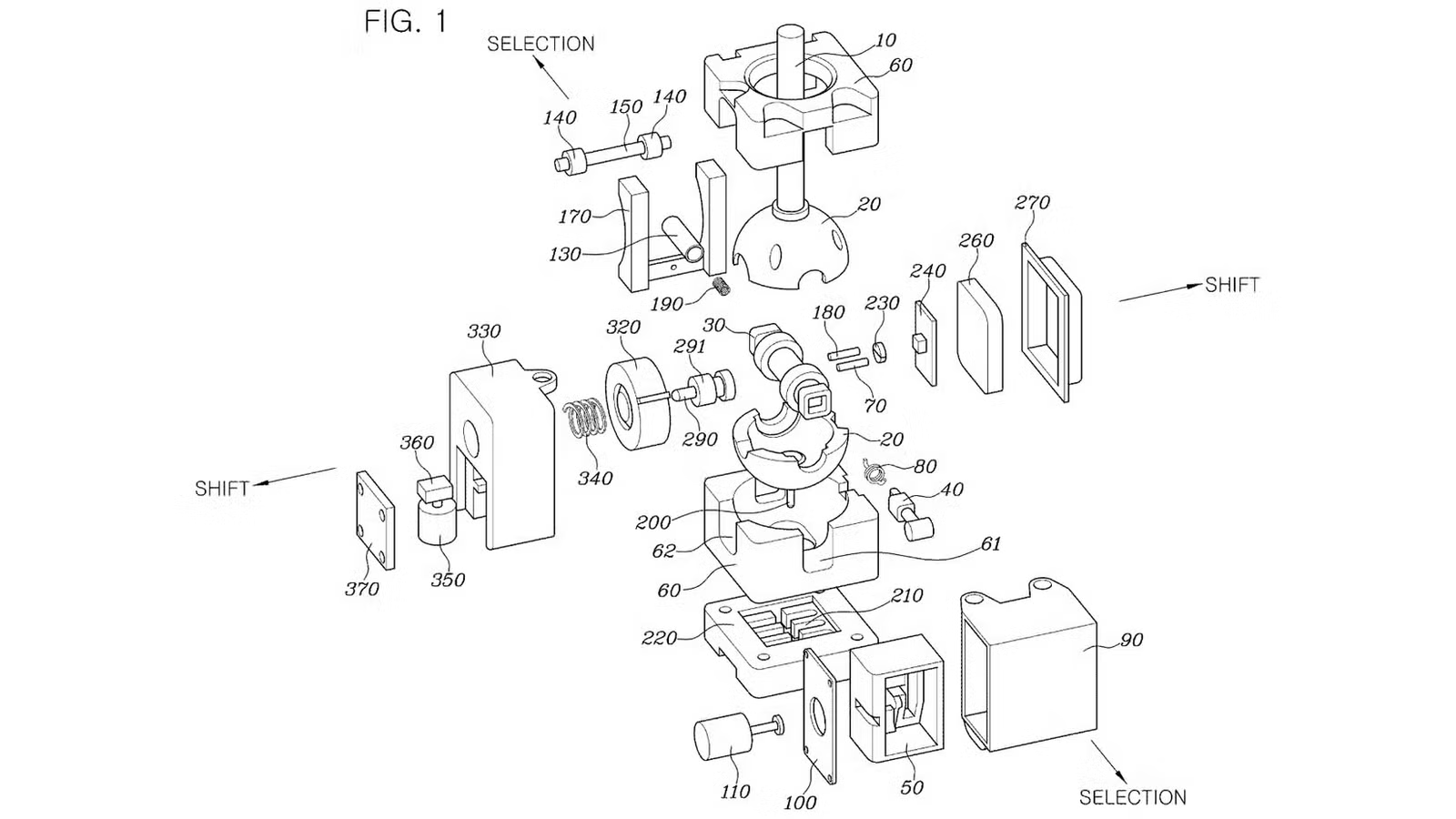
Hyundai has filed a patent for a gear shifter that looks and moves like a traditional stick but has no physical connection whatsoever to the transmission beneath it. Surfaced this week and spotted by our friends at CarBuzz, the filing describes a fully electronic, clutchless manual shifter capable of toggling between simulated manual and automatic modes entirely through software — no mechanical linkage, no hydraulic clutch circuit, nothing but signals.
For the manual-transmission faithful, this is either a promising lifeline or a provocation. The patent lands at the exact moment the industry is arguing whether drive-by-wire gear selection can preserve the soul of rowing your own — and Hyundai, with its N-line performance division and a growing Genesis performance portfolio, is now the first major automaker to put a zero-linkage electronic shifter on record with a formal patent filing.
From lightweight sports cars to high-performance muscle machines, manual transmissions continue to define some of the most beloved cars on the market.
The core claim in the patent is straightforward and significant: the shifter communicates with the transmission entirely through electronic signals. There is no physical rod, cable, or linkage connecting the lever to the gearbox. When the driver moves the stick, sensors read the input and relay it to the transmission control unit, which executes the shift or simulates one, depending on the mode selected.
The filing also describes a conversion mechanism that allows the system to switch between manual and automatic behavior. In manual mode, the driver sequences through gear positions as they would in a conventional car. In automatic mode, the same lever reverts to a standard selector. That dual-mode capability is the detail that separates this from existing paddle-shift or e-shifter systems, which typically commit to one behavior or the other.
The patent addresses the obvious objection — that a disconnected shifter is just a joystick — by describing clutch simulation as part of the system. Without a mechanical clutch pedal in the loop, the feel of engagement has to be manufactured, and the filing indicates the system is designed to replicate that sensation electronically. Whether that means haptic feedback through the lever, programmable resistance tuning, or both is not fully detailed in the available excerpt, but the intent is clearly to recreate the physical sensation of working a gearbox rather than simply pressing a button in a different shape.
This matters because resistance and feedback are what separate a convincing electronic shifter from a glorified mode switch. Porsche's PDK shift paddles and Ford's Mustang GT500's rev-matching system both simulate elements of manual driving, but neither attempts to replicate the full mechanical feel of a clutch-and-stick combination through a zero-linkage lever. Hyundai's patent is specifically targeting that gap.
Hyundai's N division has already shown willingness to engineer engagement into cars that don't technically require it. The Ioniq 5 N, for instance, includes a simulated gear-change system with fake shift points and an N e-shift function that mimics an eight-speed dual-clutch. That car uses paddle shifters rather than a physical stick, which makes this patent a logical next step — a lever-based version of the same philosophy, extended to any platform where a traditional manual is mechanically impossible or impractical.
Genesis, Hyundai's luxury performance arm, is another obvious candidate. The GV80 Coupe and upcoming performance variants of the G80 and G70 have leaned into driver engagement as a brand differentiator. A configurable electronic shifter — one that can present as a manual when the driver wants it and disappear into automatic mode otherwise — fits that positioning cleanly. No production confirmation exists yet, and patents frequently describe technology that never reaches a showroom. But the filing establishes intent, and Hyundai's recent track record with N suggests the engineering team is serious about making simulated engagement feel earned rather than cosmetic.
GM's iconic pony car could return with four doors, though enthusiasts may forgive that sin if they'll be too busy shifting their own gears.
The 'fake manual' debate has been running since paddle shifters arrived on road cars, and it sharpened considerably when Hyundai introduced simulated shifts on the Ioniq 5 N. Purists argue that mechanical connection is the point — that the reason a good manual feels good is precisely because the driver is physically coupled to the drivetrain, with all the weight, resistance, and imprecision that entails. Remove the linkage, and you're left with theater.
The counterargument is that feel is feel, regardless of what produces it. If a haptic-tuned electronic lever can replicate the resistance curve and engagement sensation of a well-sorted short-throw, the absence of a cable underneath is an engineering detail, not an experiential one. Hyundai's patent doesn't resolve that argument — no filing can — but it does confirm that at least one major automaker believes the simulation can be convincing enough to patent and, eventually, sell.
The patent was filed and surfaced this week. Whether it reaches production, and in which model, remains to be seen. But the direction is clear: Hyundai is betting that the stick shift has a future even in cars where the gearbox no longer needs one.
Source: https://www.topspeed.com/hyundai-just-patented-a-stick-shift-with-zero-connection-to-the-gearbox/
Cars
Hyundai Patents Electronic Manual Shifter With No Gearbox Link
Article Top Ad Zone
Article Middle Ad Zone
Article Bottom Ad Zone
Original Source: www.topspeed.com
Share
Comments
Comment system is currently disabled.