On Saturday, tens of thousands of anti-immigration protesters are expected to march through the streets of London under the banner “Unite the Kingdom”.
Leading it will be Stephen Yaxley-Lennon, known as Tommy Robinson, the oft-described combative Luton-born, anti-Islam activist who has long rejected the label “far right”. He frames himself instead as a defender of free speech and as a patriot.
Robinson’s supporters have turned the denial into a rallying cry of their own, often carrying banners that say “We’re not far right, just right”.
But academics who have spent years studying the anatomy of far-right movements and organisations like HOPE not hate - which track the far right closely - tell a different story.
Their argument is not simply about Robinson; it is about the term itself, because “far right” is not a precise classification. Its meaning shifts depending on who uses it, and that ambiguity is something individuals like Robinson have learned to exploit.
Understanding the label before one uses it is important, experts say. Applying it loosely to moderate views risks sanitising the far right. And when actors who do meet the scholarly definition successfully reject the label, their politics can appear more palatable than they should.
While today’s debates often centre on figures like Robinson, the modern use of “far right” has deeper roots in European political history.
As European election results lit up television maps on June 17, 1984, the mood of election-night commentary shifted from routine to disbelief. Returns poured in from across France, defying expectations, especially for one party.
That party was the National Front (FN), led by Jean-Marie Le Pen, a combative former paratrooper widely described at the time as part of the “extreme droite” - the far right.
The label “extreme droite” emerged in French political language and was often used to describe a political conservatism focused on ethnic nationalism, anti-Semitism, and anti-republicanism.
Founded in 1972, the FN pulled in figures with explicit wartime fascist ties, including Pierre Bousquet, a former member of a French volunteer unit that fought for Nazi Germany in the final months of the war. Bousquet became the FN’s long-serving treasurer.
The early 1980s were a turbulent period in France. Unemployment was high, the socialist-led government had swung abruptly to austerity, and bitter infighting weakened the traditional right.
Le Pen was clear about where he laid the blame: “One million unemployed equals one million too many immigrants,” read one slogan.
His message - mixing ethnic nationalism with an anti-immigration stance - was clearly landing.
The FN had already made gains in local elections the year before, but few had anticipated the scale of Le Pen’s breakthrough in 1984: His party won nearly 11 percent of the vote and 10 seats in the European Parliament.
By the next morning, French newspaper Le Monde had settled on the headline that captured the scale of the result: “Seisme politique” - political earthquake. Another newspaper, Liberation, declared simply: “Le Choc” — the shock.
This was a party that fused anti-immigrant nationalism, anti-establishment fury, and promises to restore national pride - ideas considered taboo after World War II.
Le Monde and other papers used “extreme droite” to describe the FN, distinguishing it from traditional conservatives while also evoking fascist ghosts. As Dutch political scientist Cas Mudde later explained, this era marked a pivotal shift - a term once reserved for outright fascists began being used to characterise parties operating within democracies, blurring lines in a way that continues today.
Two years later, in the 1986 French legislative election, the FN won 35 parliamentary seats (through proportional representation), confirming its shift from protest party to political player.
Similar scenes would soon unfold elsewhere in Europe.
That same year, Jorg Haider - a charismatic firebrand politician - took over Austria’s Freedom Party, transforming it from a mix of liberal-nationalist and pan-German traditions into a new far-right brand of nationalist, anti-immigration and anti-establishment politics.
Despite repeatedly making statements that appeared to minimise aspects of Nazi rule - drawing international condemnation - Haider’s party soared from 4.9 percent in the 1983 national election to 22.5 percent by 1994.
In Belgium’s 1991 federal elections, the far-right Flemish ethno-nationalist party Vlaams Blok had a breakthrough - later known as Zwarte Zondag, or Black Sunday - and gained 17 seats in parliament.
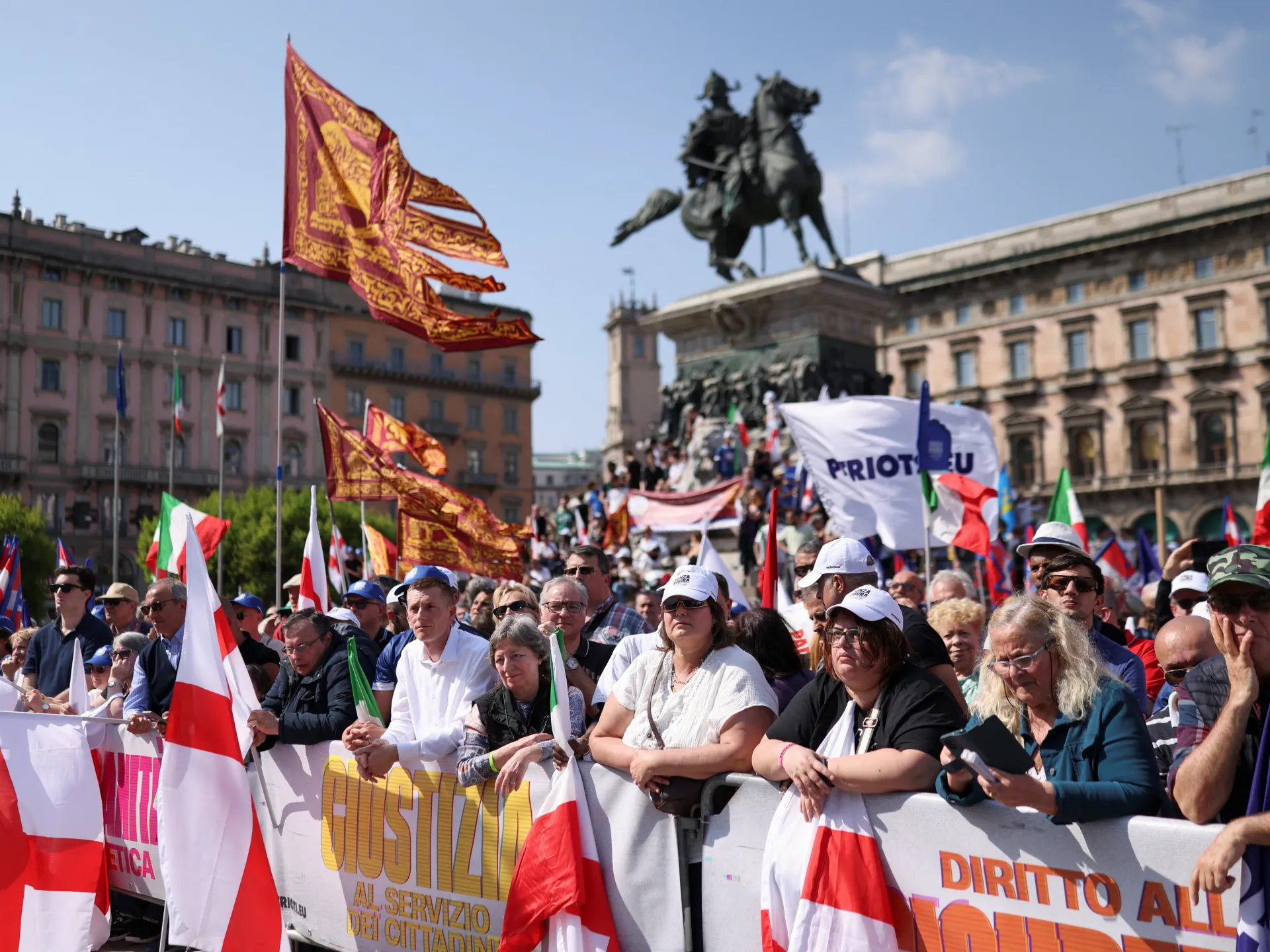
Today, from Italy in the south, where far-right populist Giorgia Meloni heads the nation’s right-wing coalition, to Europe’s north, where the once-ostracised Sweden Democrats prop up the government, the far right has become an unavoidable political force driving national debates over migration, identity and sovereignty. Several European Union states have far-right parties in government or supporting coalitions.
Once seen as fringe, some of the far right’s ideas have gradually come to be viewed as common sense by many. Mainstream conservative parties, wary of losing voters, often co-opted elements of the far right’s agenda - helping legitimise its place in mainstream politics.
The term dates back to the origins of the left-right political divide in the late 18th century, when one of Europe’s most powerful kingdoms underwent a period of profound political upheaval.
During the French Revolution, a literal divide emerged in the National Assembly, the country’s parliament. Defenders of the monarchy and the old order sat to the right, while revolutionary advocates of republicanism, secularism and equality occupied seats to the left.
From that seating plan grew the political language we still use today.
By the late 19th century, the left-right divide born in revolutionary France had become part of Europe’s political vocabulary.
German Reichstag records from the period already referred to deputies on the left (links) and right (rechts), while Italian newspapers used sinistra and destra as routine political labels.
The term extreme droite, in turn, came to be used as a label for the ultra-royalists, or hardline monarchists who rejected the Republic and sought a return to strong monarchical authority. Their stance sat well beyond traditional conservatives, who emphasised preserving existing institutions, gradual reform and participation in constitutional politics.
By the late 19th century, European newspapers and political commentators were already using “far right” to describe anti-republican and nationalist movements, even though the label had not yet acquired a fixed meaning. Over time, it came to describe movements that rejected liberal democracy and embraced nationalism - the belief that the nation, often defined in ethnic or cultural terms, should take precedence over pluralism and individual rights.
In the 1920s and 30s, fascism gave the term “far right” a more modern ideological shape and used populist messaging to gain power. Movements like Benito Mussolini’s National Fascist Party in Italy and Adolf Hitler’s Nazi Party in Germany embodied the traits that would define the far right for decades. This involved rejecting liberal democracy and communism, hostility to pluralism, and the rise of ultranationalism, which placed the nation’s interests above all else. Anti-Semitism, of course, was core to Nazi ideology.
After World War II, the political mood shifted across Europe.
The liberation of the concentration camps, revelations about the Holocaust, and the collapse of Nazi Germany and fascist Italy left the continent confronting the consequences of racial hatred and authoritarian rule. Fascist parties were banned, dissolved or pushed out of government and public life, but the ideas themselves did not vanish.
In some places, they survived through authoritarian nationalist regimes, most notably Francisco Franco’s Spain, where a tightly controlled one-party state blended Catholic traditionalism, militarism and fierce anti-communism until the 1970s.
Elsewhere, they re-emerged in new forms, such as Le Pen’s FN, a renewed strain of nationalism, combined with anti-immigrant sentiment, rather than the overt fascism of the interwar years.
Today, political scientists largely use “far right” as an umbrella term and rely on the three main criteria as laid out by Mudde, author of Populist Radical Right Parties in Europe and The Far Right Today.
Nativists believe states should be inhabited and governed primarily by members of the “native” group - often defined in ethnic, cultural or religious terms.
In an interview with Al Jazeera in 2017, Mudde stated that “nativism is about the ethnic ‘us’ and ‘them’, about wanting a [monocultural] state and seeing alien things and people as threatening”.
Although Mudde’s definition is widely accepted, it is not set in stone, and there are nuances in how political scientists apply it.
For example, Daphne Halikiopoulou, chair in comparative politics at the University of York in England, believes the term nativism is too narrow. She prefers to use “nationalism” because some modern, more moderate far-right parties project an “inclusive nationalist agenda” that is no longer based on race.
Mudde and Chilean political scientist Cristobal Rovira Kaltwasser’s book Populism: A Very Short Introduction, describes it as a “thin-centred ideology that considers society to be ultimately separated into two homogenous and antagonistic camps, ‘the pure people’ versus ‘the corrupt elite’.”
They said populists see democracy as betrayed rather than broken - something to be reclaimed from corrupt elites rather than overthrown.
Marta Lorimer, a lecturer in politics in the School of Law and Politics at Cardiff University, told Al Jazeera that populism can be “an aspect of a party’s ideology or of their messaging, but it’s not the core that makes them recognisable”.
The term alone does not define what you believe - but how you frame politics, she explained.
Charismatic leaders often use populism - as is the case with Greece’s Syriza party - to frame citizens as victims of elite corruption while positioning themselves as champions of the people.
The third criterion of “far right” ideology is authoritarianism, a preference for order, obedience and strong, highly centralised leadership, as opposed to pluralism or liberal democracy.
Mudde, in his book, Populist Radical Right Parties in Europe, said that in an authoritarian system, infringements of authority are to be “punished severely”.
But even within the far right, there are distinctions to be made.
Political scientists have identified two subgroups within the far right: “radical far right” and “extreme far right”.
Paul Jackson, a professor of the history of radicalism and extremism at the University of Northampton, said this distinction began to emerge with the formation of West Germany’s constitution after World War II. That was when legal definitions were drawn up to clarify which far-right groups were a threat to the democratic order.
Anton Shekhovtsov, a Ukrainian political scientist and author of New Radical Right-Wing Parties in European Democracies, explained that while radical right-wing parties might criticise the democratic order, they do not seek to undermine it as extreme far-right parties do.
So extreme far-right parties may use populist rhetoric, but they cannot be classified as populist. Populism is centred on a critique of existing democracy, not a rejection of it.
For example, Greece’s now-defunct extreme far-right Golden Dawn party, which espoused neo-Nazi ideology, was authoritarian and nativist. But it was not classified as populist by political scientists because it rejected democracy outright.
There are examples of radical far-right political parties in Europe today, including the National Rally (RN, formerly NF) in France, now helmed by Jordan Bardella, who took over from Marine Le Pen, the daughter of the 1984 chief, Jean-Marie Le Pen. The party’s core ideas focus on anti-immigration, including critiques about Islam’s compatibility with France’s secular identity, as well as nationalist welfare policy and Euroscepticism. Today, the RN is a formidable opposition force and maintains a strong parliamentary presence.
Belgium’s Vlaams Belang (VB), one of the largest parties in the Flemish region, is excluded from governing coalitions. It campaigns on Flemish nationalism, anti-immigration policies, nativism, populism and law-and-order authoritarianism.
In Spain, the Vox party promotes Spanish nationalism, anti-feminism, anti-immigration policies and is opposed to regional autonomy. It also promotes Catholic traditionalism and is represented in parliament and in regional coalitions.
The Brothers of Italy (Fratelli d’Italia) focuses on Italian nationalism, “God-country-family”, anti-migration policies and traditionalism, and it is the ruling party in Italy today under Meloni.
Further along on the political spectrum are far-right extremist parties that reject democracy, and there are examples of these in Europe as well.
The German domestic intelligence services (BfV), a leading voice on the topic, says that far-right extremists “allege that a person’s value is determined by the ethnic group or nation they belong to; a notion that is fundamentally incompatible with the Basic Law”.
Going back to Greece’s Golden Dawn party, it was considered neo-Nazi and focused on ethnic Greek nationalism while messaging anti-immigrant, anti-Semitic and anti-leftist views. The party came in third in the 2012 elections, but after being criminalised in 2020, Golden Dawn has largely been prohibited from engaging in politics.
The Our Homeland Movement, or Mi Hazank Mozgalom, in Hungary, espouses extreme nationalism and is anti-Roma, anti-immigration, anti-LGBTQ+, irredentist - meaning it seeks to reclaim and annex territory it believes rightly belongs to a “Greater Hungary” - and Eurosceptic. The party has been represented in parliament since 2022, having won 5.9 percent of the vote.
Some parties straddle both definitions, radical and extreme. The Alternative fur Deutschland (AfD) in Germany, for example, espouses an anti-immigration, Eurosceptic, nationalist and increasingly authoritarian rhetoric, but it is largely defined as a radical far-right party. Its state branches in Thuringia and Saxony-Anhalt, however, are classified by the BfV as right-wing extremist.
In May 2025, the BfV classified the entire AfD as a right-wing extremist organisation. It cited the AfD’s ethnonationalist - a political ideology that defines the nation primarily in ethnic terms and the belief that shared ancestry forms the basis of national belonging - and xenophobic tendencies. But this label was paused by the courts in February 2026 to await a final ruling over the matter.
Halikiopoulou, at the University of York, told Al Jazeera that in recent decades, several European extreme far-right political parties have gradually altered their rhetoric and successfully repackaged themselves as radical far-right or even borderline far-right.
She points to the Sweden Democrats, which was founded in the 1980s by Nazi sympathisers and used to rally under the slogan “Keep Sweden Swedish”. Over the years, it has “cleansed itself of its extremist elements”, she said, and even rebranded itself with an innocent-looking flower as its logo, rather than a Viking.
Other political parties have arguably moved in the opposite direction, she says. These include the United Kingdom Independence Party, or UKIP, which began as a single-issue Eurosceptic party. Since Brexit, however, it has sought to remain relevant by etching out a new identity, with more extreme far-right rhetoric.
Shekhovtsov, the Ukrainian political scientist, says there is a sense of betrayal and grievances among voters who are drawn to far-right parties.
He breaks them down into three phases of social and economic discontent.
The first was a backlash against globalisation, which began in the 1980s.
As manufacturing moved abroad and traditional industries shrank, unemployment rose among workers, and wages stagnated for those who stayed.
In France, for example, the share of manufacturing reliant on imported inputs climbed from 9 percent in 1977 to 14 percent in 1993. Experts say that change explained roughly a quarter of the drop in employment among low-skilled factory workers.
The impact was social as much as economic: Towns built around factories saw stable jobs disappear, one-earner households weaken, and generational career paths collapse. For many in these communities, it triggered resentment towards the elites who had moved industry and jobs abroad at the expense of local blue-collar workers.
The second was the 2008 financial crisis. One of the worst-affected European countries was Greece, which saw unemployment surge from 8 percent in 2008 to 27 percent by 2013. Youth unemployment reached nearly 60 percent.
In Italy and Spain, poverty among low-income groups increased by more than 50 percent during the same period. In Ireland, unemployment rates in the deprived areas of its capital doubled between 2007 and 2012.
Across the UK, child poverty rates increased, local economies contracted and public spending cuts reduced support for struggling families. Meanwhile, the British government helped bail out several banks, including the full nationalisation of institutions, such as the Lloyds Banking Group.
This further strengthened a sense of betrayal by suggesting that authorities prioritised banks and financial institutions over the people who were worst affected, Shekhovtsov said.
In Hungary, before 2008, Viktor Orban’s Fidesz was a mainstream conservative party. But the financial crisis and the EU-International Monetary Fund (IMF) bailout that followed devastated the country’s economy, discrediting the ruling socialist government.
Orban seized the opportunity to promote a populist, nationalist narrative, and Fidesz was in power for 16 consecutive years from May 2010 to May 2026.
The third factor was the refugee crisis of 2015, which saw an estimated 1.3 million asylum seekers arrive in Europe.
In Sweden, 162,000 asylum seekers arrived in 2015, roughly double the figure from 2014 and the highest annual figure in Swedish history.
Germany received around 890,000 asylum seekers, more than any other EU country.
Shekhovtsov said that once again, there was a sense of betrayal, especially among conservative voters in countries such as Germany. They perceived conservative Chancellor Angela Merkel as breaking from her image of steady and cautious leadership and allowing in large numbers of asylum seekers. This came at a time when, after the financial crisis, many Germans were already feeling economically insecure.
Merkel’s government had abandoned longstanding centre-right commitments to stability, border control and gradual change.
The AfD was able to use the 2015 refugee crisis to transform the party from a small Eurosceptic one into a major far-right force by exploiting public fears about migration, identity and security.
The AfD doubled its support by 2017 with a message portraying Merkel’s refugee policy as a betrayal and asylum seekers as a danger to Germany’s security and cultural identity - thus positioning itself as the only party prepared to defend the country’s borders.
Far-right actors, parties and movements that placed a huge emphasis on connecting migration with various grievances have driven up demand, but the “supply-side” of far-right politics has also become a more formidable force, according to Cardiff University's Lorimer.
The movements are not only capitalising on existing grievances; they have also become more effective at delivering their message.
Far-right parties that were once disorganised and prone to unpalatable comments by politicians that might have scared off voters have now become more streamlined, media-savvy and experienced in knowing “what is acceptable to say and do in public”, she said.
This success also has a knock-on effect, she explained, with centre-right and mainstream parties “copying” the far right’s messages as they try to win back voters. This further legitimises far-right ideas in mainstream politics.
One example is in Denmark, where the centre-left Social Democrats adopted several of the Danish People’s Party’s hardline immigration positions in an effort to win back voters. These included everything from strict asylum limits to controversial “ghetto laws” focused on dismantling stigmatised, immigrant-heavy neighbourhoods through housing restrictions, policing and special education requirements.
That shift matters because it helps explain how the far right moved from the margins into the political mainstream.
In France, the breakthrough of Jean-Marie Le Pen’s National Front in the 1984 European elections was not just an electoral upset; it marked the point at which themes once treated as taboo - immigration, national identity and hostility to elites - began to look increasingly legitimate in public debate. From there, the question was no longer only how far-right parties won votes, but how their ideas reshaped the language and priorities of the parties around them.
Not only was the left-right divide born from the seating plan of an 18th-century French assembly, but the next concept in Europe’s political vocabulary also came from the French language, though this one was borrowed from medicine.
The cordon sanitaire, originally a barrier used to stop the spread of disease, was adopted by Belgian politicians in the late 1980s to describe a political quarantine around the far-right Vlaams Blok. All major democratic parties signed an agreement explicitly refusing any cooperation with Vlaams Blok due to its 70-point plan, a hardline immigration programme calling for wide-scale exclusion and removal of non-European immigrants from Belgium.
Before that, similar exclusions existed informally across Europe, but Belgium was the first to formalise the quarantine. This turned an unwritten norm into a political strategy in which parties collectively agreed to exclude a party from cooperation, coalitions and formal alliances.
In Europe, at the turn of the last century, there was a list of far-right parties that fell within either a cordon sanitaire or an informal one, where mainstream parties refused to work with them. Today, these once-shunned political parties have entered mainstream politics, normalising the presence of far-right parties, Halikiopoulou said.
The Sweden Democrats (SD), once a pariah in Sweden’s political scene, for example, are now the second-largest party in parliament.
Sweden’s Prime Minister Ulf Kristersson once told a holocaust survivor in 2018 that he would never cooperate with the SD, which has a history of anti-Semitism. Now, he relies on the party to prop up his coalition government.
Another example of the cordon sanitaire being breached was in 2000, when Austria’s centre‐right Osterreichische Volkspartei (OVP) entered into a governing coalition with the far-right Freiheitliche Partei Osterreichs (FPO). That broke what had been a longstanding informal agreement among mainstream Austrian parties to exclude the FPO.
Still, across the continent, there are nuances in how far-right movements have emerged as a political force.
When it comes to immigration, an area where many far-right parties have placed a huge emphasis, demographics have played a key role in regional differences, according to Halikiopoulou.
In Western Europe, where multiculturalism and waves of migration have existed for decades, there has been a shift from what she describes as nativism to a form of civic nationalism, where the emphasis is placed less explicitly on race or ethnicity.
But whether this reflects a genuine ideological transformation among voters or is purely a strategic softening of rhetoric, she said, is not always obvious.
What can happen, however, is that exclusion is repackaged in forms more palatable to voters. This is especially true in countries with a more multiethnic makeup, often around the idea that groups - for example, Muslims - don’t espouse the same Western values.
In contrast, in many Eastern European countries, where society is more ethnically homogeneous, and societal migration is not a salient issue, the careful packaging of civic nationalism doesn’t work the same way with voters, Halikiopoulou said.
Instead, conservative nationalist ideologies will focus on internal minorities, such as the LGBTQ+ or Roma communities.
In southern Europe, which was particularly affected by the 2008 financial crisis, there is a greater focus on the economy, with Greece’s Golden Dawn having supported an interventionist state economic policy. This favoured strong state control in areas such as wages, welfare and key industries.
Despite the various ways in which the far right rose, the use of the term can still be muddled.
Experts say the term “far-right” can be misused as a catch-all, especially in media or political debates, and applied to parties or figures with any mix of nationalist, conservative or anti-immigration positions - even when they do not meet academic definitions.
Tim Bale, a politics professor at Queen Mary University of London, said that because it is an umbrella term that is also a “loaded, weaponised term”, it’s bound to “cause confusion and controversy in equal measure”.
Shekhovtsov said mislabelling can also originate on the left, where there is sometimes a tendency to deliberately conflate moderate views on migration with far-right positions as a political tool to “stigmatise and delegitimise” opponents.
That resulted in mainstream parties ignoring genuine discussions about migration because they feared being labelled “far-right”. But in doing so, they allowed the far-right to set the tone and agenda on the issue.
Bale said not articulating which strain of far-right views a party espouses can also lead to confusion.
He used the example of Nigel Farage’s Reform UK party, founded in 2019, which is expected to mount a serious challenge to Labour in the next UK general election after it made sweeping gains in May’s local elections.
Bale explained that their objection to media organisations using “far right” to describe them was, in some ways, understandable, because they know it is a label that might put off more moderate voters.
He added that, in the sense academics use the term, it is accurate to call the party “far right”, but the problem is that the term encompasses both strains - extreme right and populist radical right.
“Reform UK is definitely in the latter camp, but worries about being lumped in with the former if they’re labelled far right by journalists - and of course by their opponents, who are well aware that labelling them as such helps toxify them,” he said.
In his work, Mudde also warns that mislabelling far-right actors - for example, calling them “fascist” without clear criteria, not only weakens the term’s meaning but also allows these parties to cast themselves as victims of an unfair establishment.
Halikiopoulou said mislabelling right-wing or centre-right politicians or parties as far-right not only obscures what they stand for but also inflates the influence and reach of the far right.
She said the media needs to better clarify the lines between the right and the far right, rather than “merge and blend them”, which only serves to increase the perception that their views have a wider, more expansive reach.
University of Northampton's Jackson believes that there are contexts in which it’s not wrong for the term “far right” to emerge as a negative or pejorative term, as it is just part of democratic debate about different political positions. But people need to understand that these positions don’t always fit with academic criteria.
He uses the example of a UK parliamentary debate last November when Member of Parliament Zarah Sultana called the UK Home Secretary Shabana Mahmood's asylum reforms “straight out of the fascist playbook”.
Jackson said neither Mahmood nor her reforms, which include a rule that refugees will be removed as soon as their home countries are deemed safe, were fascist by any academic definition. But the term was still used as a form of political pejorative.
Mudde, in a 2024 opinion piece published in Swedish newspaper Aftonbladet, also said the media should not misrepresent the average far-right voter as a white, male “left behind” who is lower-educated and economically and socially marginalised. This is often visually portrayed as the eternal skinhead with overt extreme right symbols, but far-right voters are now often part of the mainstream voter base, not “left behind”.
While this was already a lazy stereotype in the 1980s, it is miles away from the average far-right supporter today, who is, in almost all ways, the “guy next door”, he wrote.
Moreover, the far-right is also still portrayed as a political challenger, fundamentally different from the political mainstream, even though it has been largely mainstreamed, if not outright normalised, he said.
Understanding where the term “far right” comes from - and what it does and does not mean - matters because it shapes how voters, parties and the media frame very real debates over immigration, identity and sovereignty. As reflected in this weekend’s march in London, those themes are central to European and British politics today.
Being able to spot a confused use of the term is key to cutting through the noise - and to judging whether a movement is challenging the system from within, or seeking to undermine it.
Source: https://www.aljazeera.com/features/longform/2026/5/15/how-the-far-right-got-its-name?traffic_source=rss
World
How the far right got its name
Article Top Ad Zone
Article Middle Ad Zone
Article Bottom Ad Zone
Original Source: www.aljazeera.com
Share
Comments
Comment system is currently disabled.