Ukraine has prevented Russian arms and fuel from reaching the frontline in a successful interdiction campaign.
Russia launched more than 1,400 drones and 56 missiles into Ukraine on Wednesday and Thursday.
Much of the onslaught was aimed at the capital Kyiv, days after Russia threatened to do so only if Ukraine attacked its Victory Day parade in Moscow’s Red Square on May 9. It is a major Russian holiday commemorating the end of the Second World War.
list 1 of 4Zimbabweans lured into Russia’s war as families plead for their return
list 2 of 4UN aid convoy hit by drone strikes in Ukraine’s Kherson
list 3 of 4Latvian prime minister resigns after drone incident
list 4 of 4Finland ends drone alert amid regional fears of Ukraine war spillover
Ukraine President Volodymyr Zelenskyy had proposed a ceasefire, beginning as early as May 5.
Moscow did not respond until May 7, and presented its peace proposal as a unilateral initiative, accompanied by threats to punish Kyiv if it did not respect its terms.
Moscow said Russian front line units would “launch a massive missile strike” on central Kyiv if attacked.
Forty-three Russian drones and a number of ballistic missiles were launched into Ukraine on May 9, and another 27 drones on May 10. It was not until May 11 that Ukraine had a day of peace.
Moscow justified these attacks as reciprocity for Ukrainian assaults. Kyiv accused Moscow of breaking its own ceasefire.
Once the ceasefire was over, on the night of May 11, Russia launched 216 drones and followed up with a massive strike involving 892 drones overnight on May 12 and during the day on May 13.
The night of May 13-14 was worse with 675 drones accompanied by 56 missiles.
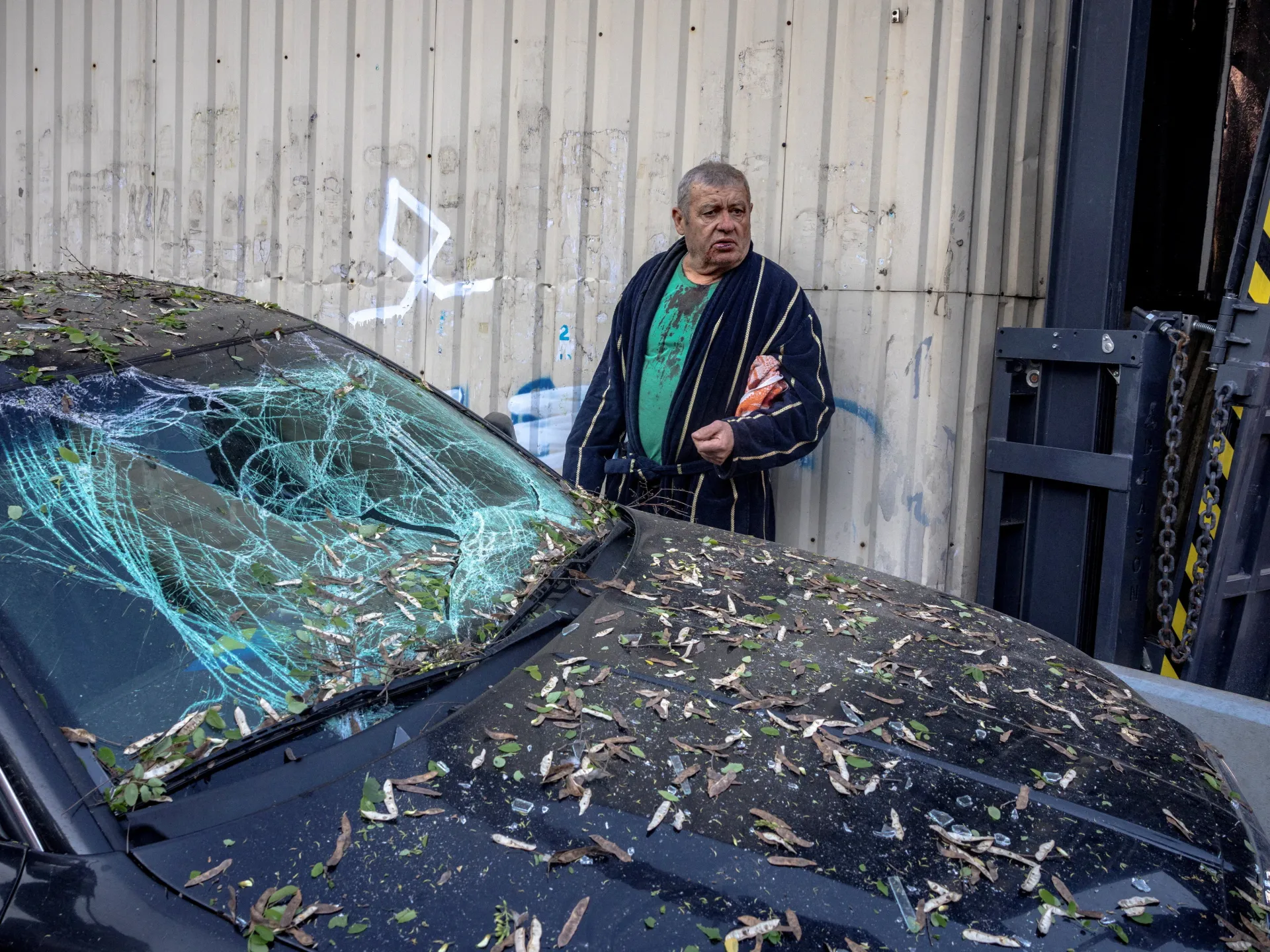
Official Ukrainian reports recorded strikes in at least 20 locations in the capital, including a nine-storey apartment building where 12 people were killed in the collapse.
“These are ordinary residential buildings, a school, a veterinary clinic, and other purely civilian infrastructure,” wrote Zelenskyy on his Telegram messaging channel. “These are definitely not the actions of those who believe that the war is coming to an end.”
Throughout the week, Ukraine said it shot down 92 percent of the 1,930 drones launched, close to Zelenskyy’s 95 percent kill target, with 41 out of 57 missiles downed.
Russia’s onslaught of came as its armies in eastern Ukraine slowed down.
The Institute for the Study of War, a Washington-based think tank, estimated they had advanced by an average of 2.9 sq km (1.1 sq miles) in the first four months of 2026, compared with 9.76 sq km (3.76 sq miles) a day in the first third of 2025 and 14.9 sq km (5.8 sq miles) a day between October 2024 and March 2025.
Two weeks into May, that daily average had already dropped to 2.63 sq km (1 sq mile), suggesting Russia’s advance is slowing almost daily.
The ISW recently estimated that Ukraine made net territorial gains of 116 sq km (45 sq miles) in April – its first such advance since a September 2023 counteroffensive.
Some of that success is attributed to Ukraine’s successful use of drones behind the front lines.
On May 8, the Azov Corps of Ukraine’s National Guard announced it had “returned to Mariupol”, four years almost to the day since it surrendered control of the city to Russian forces.
The Corps filmed drone strikes on Russian diesel tankers, army trucks and other logistics 160 km (99 miles) behind the front line along the T-0509 highway, which feeds the Russian war effort in the Donetsk region.
“The strike depth will increase,” said the Azov Corps.
Their strikes are part of a broader Ukrainian campaign to hit Russian logistics at middle ranges of about 120-150 km (75-90 miles) from the front line as announced by Zelenskyy at the end of April.
“This primarily involves military logistics, enemy warehouses and headquarters, air defence systems and other components,” he said, adding that Ukraine had increased its strikes at this depth five-fold during the past year.
“We’re already carrying out about five thousand successful strikes at a depth of 20 plus km (12 miles) every month,” said Ukrainian Defence Minister Mykhailo Fedorov this week.
Also this week, a Russian military reporter said Ukrainian Hornet drones were targeting Russian logistics on roads closer to the frontlines.
“Although the front line is more than 35 km away from the M-30, it is currently paralysed due to enemy [First Person View drone] surveillance,” wrote the Russian reporter.
“In 2014-2015 the front line was closer, but the M-30 was safer,” he added. “This is because many people think that if the front line moves away from large cities and logistics routes they become safer, but for some reason no one takes into account that the range of enemy drones, even FPV surveillance, increases more rapidly relative to the movement of the front line.”
Russia’s declining performance is not due to lack of effort.
“The enemy has intensified offensive actions along almost the entire front and is regrouping its troops,” said Ukrainian commander-in-chief Oleksandr Syrskii on May 8. “The most tense area is currently the Pokrovsk direction, where the Russian aggressor has concentrated about 106,000 personnel,” he said.
Since March, Ukraine has increased strikes against Russian oil infrastructure as many as 1,700 km (1,056 miles) inside Russia, in an effort to starve its war machine of diesel and export revenue.
Andriy Kovalenko, the head of Ukraine’s Center for Countering Disinformation, said the Ukraine Security Service (SBU) hit the Yaroslavl oil refinery and Perm oil pumping station on May 8 – Perm sends oil in four directions across Russia to refineries and export terminals.
Russian media reports said the fire from a previous strike on the pumping station was not put out until May 11.
The SBU also said it hit the Perm refinery that day.
During the week, Ukrainian forces struck drone bases and a radar research centre in Rostov-on-Don, the Bryansk chemical plant, an explosives warehouse in Nizhny Novgorod and other targets.
Fedorov on Monday thanked Germany for investing $1bn in Ukraine’s deep strike capabilities, when his German counterpart, Boris Pistorius, visited Kyiv.
“Overall, Ukraine’s positions right now – on the front line, in our long-range sanctions, and in our joint results with partners – are the strongest they have been in years,” said Zelenskyy.
Source: https://www.aljazeera.com/news/2026/5/15/russia-pounds-kyiv-as-its-war-machine-grinds-to-a-near-standstill?traffic_source=rss
World
Russia pounds Kyiv as its advance in eastern Ukraine slows to a crawl
Article Top Ad Zone
Article Middle Ad Zone
Article Bottom Ad Zone
Original Source: www.aljazeera.com
Share
Comments
Comment system is currently disabled.