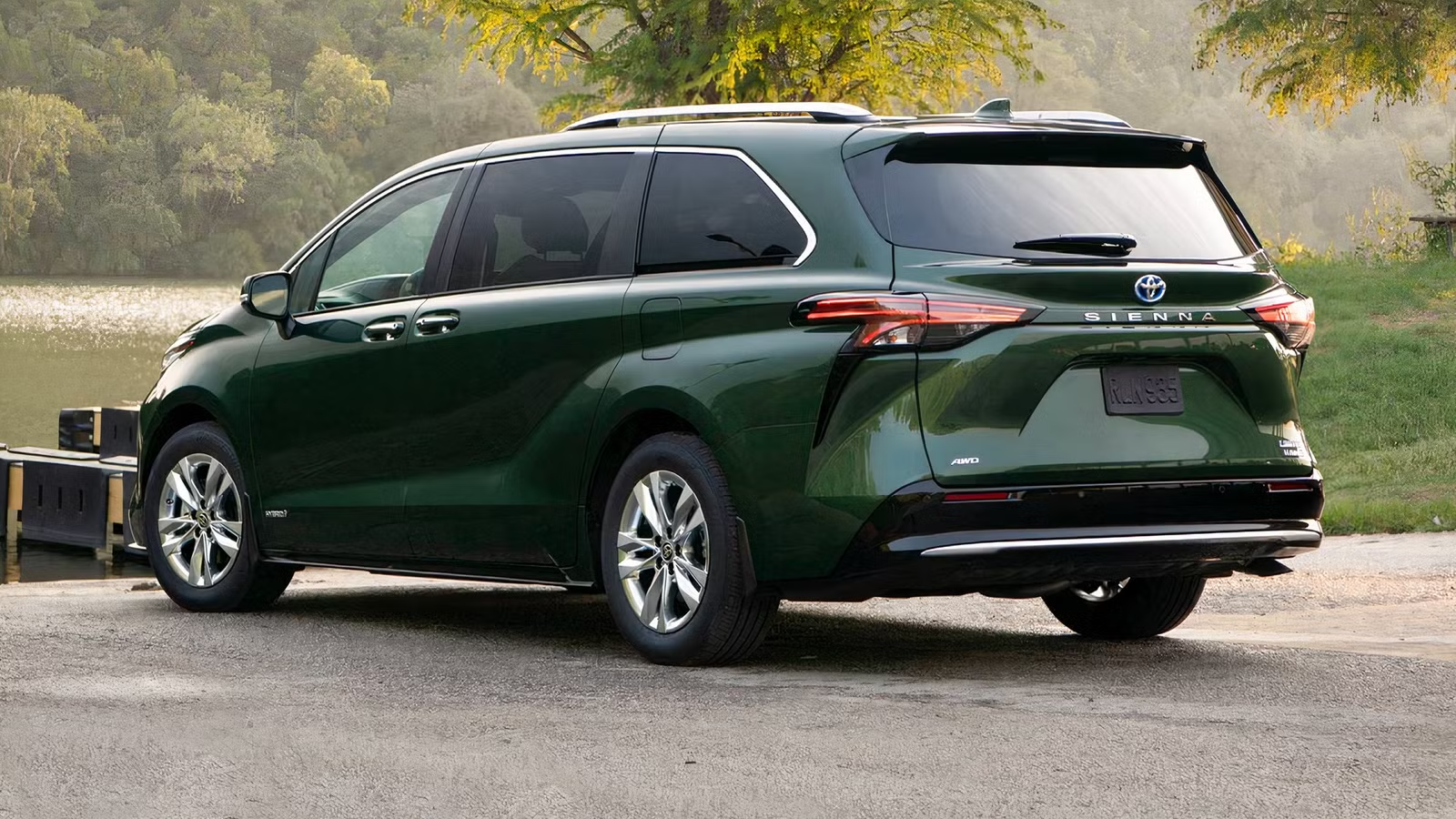
The 2026 Toyota Sienna serves as the brand's practical option in its extensive hybrid catalog. This model year serves as the ultimate people-moving alternative to the brand's expansive SUV roster. While Toyota’s crossovers like the RAV4 and Grand Highlander dominate the mainstream market, the Sienna remains the specialized champion. It perfectly suits modern and active families and multi-generational households who prioritize maximum interior volume and accessibility over rugged aesthetics.
It continues to defy the SUV takeover in the U.S. and remains a top-tier seller. Toyota achieves this by leaning into the unique niche of being the only minivan in its class to offer a standard hybrid powertrain across all trims. It blends this class-leading fuel economy with available Electronic On-Demand All-Wheel Drive, making it the perfect lifestyle-minded MPV.
The minivan segment in the U.S. has drastically shrunk in recent years, but it has also evolved into a high-stakes battle of specialization. As of 2026, only four brands offer this type of vehicle, with the Sienna being the most dominant option by a massive margin. Starting at $40,420 for the LE trim, the Sienna is a value leader, especially when you consider its long-term fuel savings.
Toyota’s strategic decision to transition the Sienna to a hybrid-only platform started in 2021, and was the driving force behind its Beyond Zero carbon neutrality goals. The Japanese brand's desire to provide a clear competitive advantage in efficiency led to the eventual elimination of the traditional V‑6. In doing so, Toyota successfully addressed the primary consumer complaint regarding minivans and their poor fuel economy. This bold move transformed the van from a standard family hauler into a modern efficiency statement, solidifying its position in a market increasingly wary of rising fuel costs.
Toyota’s multi-pathway electrification strategy in the U.S. centers on the belief that hybridization is the most effective tool for immediate, large-scale carbon reduction. Prioritizing hybrid electric vehicles has successfully helped American consumers. This direction balances a desire for better efficiency with a hesitation toward charging infrastructure and range anxiety.
This approach has worked remarkably well in its favor, as evidenced by 2026 sales figures. Toyota's electrified models now account for over half of the brand's total U.S. volume. It effectively showcases how battery resources required for one long-range EV can instead power multiple hybrids. Toyota has framed its conservative EV rollout as a mathematically superior environmental strategy, resulting in better resale values and keeping its lineup accessible to the average buyer.
The Toyota Sienna proves that you don't have to love minivans to appreciate one.
While Toyota offers most of the hybrids in the lineup as a powertrain choice, the current-generation Sienna is exclusively available as an HEV. This hybrid-only status makes a high-voltage battery replacement an eventual certainty for every owner rather than a statistical risk. According to January 2026 data from RepairPal, replacing the battery pack in a current-generation Sienna is a significant financial undertaking.
Total costs range between $6,853 and $7,087. While the battery itself carries a price tag of approximately $6,353, labor adds another $500 to $734 to the bill. For a vehicle marketed on long-term family utility, this $7,000 fee represents a critical piece of ownership math that distinguishes the Sienna from its internal combustion rivals.
The timing of this expense is particularly poignant given that the typical hybrid battery lasts eight to 10 years or 100,000 to 150,000 miles. It aligns almost perfectly with the expiration of Toyota’s 10-year or 150,000-mile warranty for 2020 and newer models. This creates a narrow window where the first generation of hybrid-only Sienna owners may find themselves facing a massive out-of-pocket cost just as their factory protection vanishes.
However, there is a silver lining for patient owners. The aftermarket trajectory for older Toyota models like the Prius and Camry suggests that relief is on the horizon. With remanufactured batteries for those legacy hybrids currently retailing between $1,449 and $2,549, it is highly likely that third-party specialized providers will eventually drive down the cost of keeping these high-mileage Siennas on the road well into the next decade.
The 2026 Sienna combines hybrid efficiency, refined comfort, advanced tech, and versatile design for a smarter, family-friendly driving experience.
The 2026 Toyota Sienna features the Hybrid Synergy Drive system, consisting of an Atkinson-cycle 2.5-liter Dynamic Force four-cylinder engine. In isolation, this produces 189 horsepower and 176 pound-feet of torque. Toyota pairs this with two permanent magnet synchronous electric motors in front-wheel-drive models, or three in Electronic On-Demand All-Wheel Drive configurations. These bring the total system output to a net 245 hp.
Power is managed by an electronically controlled Continuously Variable Transmission, which trades the mechanical shifts of a traditional automatic for seamless acceleration. While it isn't the fastest in its class, an AWD Sienna Limited can sprint from 0 to 60 MPH in 7.5 seconds. Toyota limits its top speed to 117 MPH.
The 2026 Toyota Sienna sets the benchmark for efficiency in the minivan segment. The EPA estimates a class-leading 36/36/36 MPG result on its city/highway/combined cycle for front-wheel-drive models. Opting for all-wheel drive across trims like the Woodland Edition or Platinum results in only a marginal dip to 35/36/35 MPG.
With its 18-gallon fuel tank, the Sienna offers a massive cruising range of approximately 630 to 648 miles per fill-up, significantly reducing the frequency of gas station visits compared to V-6 rivals. Based on current 2026 fuel averages of $4.39 per gallon, it costs roughly $3.05 to drive 25 miles and approximately $79.00 to fill the tank from empty. Over a five-year ownership period, the EPA estimates the Sienna can save owners upwards of $5,235 in fuel costs compared to the average new vehicle.
This Toyota proves consumers care more about function than form.
Data from major automotive analysts suggests a strong balance between high initial value and class-leading operational savings when evaluating the long-term financial commitment of the 2026 Toyota Sienna. According to Edmunds’ True Cost to Own calculator, a base Sienna LE is projected to have a five-year ownership cost of $52,210, while the top-tier Platinum trim climbs to roughly $64,488 due to higher financing and insurance premiums.
CarEdge estimates that a Sienna will cost about $47,621 over its first five years, noting that depreciation remains the largest factor at roughly $19,282. This is significantly offset by the vehicle's excellent residual value. Kelley Blue Book reinforces this with a five-year Cost to Own estimate of $61,026, placing it in the top 25 percent of its segment for affordability. To keep the vehicle running, RepairPal estimates an average annual maintenance and repair cost of just $554, which is notably lower than the $647 average for the minivan segment.
Owners of the 2026 Toyota Sienna can generally expect their high-voltage battery to last between 10 and 15 years or roughly 150,000 to 200,000 miles. This is especially true if you strictly adhere to recommended maintenance, like cleaning the hybrid battery cooling vents. As the pack begins to degrade, the most immediate warning is a noticeable drop in fuel economy. This is because the gasoline engine must operate more frequently to compensate for the battery's inability to hold a charge.
Other red flags include erratic charging behavior. You can expect the dashboard energy monitor to show the battery level swinging wildly from full to empty. There will also be a sluggish feeling during low-speed acceleration when the electric motor should be doing the heavy lifting. While the 2026 model currently has no active safety recalls, you should remain aware of past Sienna campaigns. These included a sliding-door latch fault and a fuel-system component fault in 2021 to 2024 models.
According to J.D. Power, the Sienna sits with a 78/100 consumer-verified rating. This includes 76/100 for quality and reliability, 74/100 for the driving experience, 85/100 for resale, and 78/100 for the dealership experience.
According to iSeeCars, the Toyota Sienna range sits with an 8.6/10 overall score. It awards the van 8.1/10 for reliability, 8.6/10 for retained value, and 9.0/10 for safety. The publication indicates that the model benefits from an 11.8-year or 168,547-mile average lifespan with a 32.7-percent probability of reaching 200,000 miles. It also suggests that on average, the van will lose $15,129 or 38.6 percent of its value over five years and 60,000 miles, which is substantially less than the bulk of its rivals.
Found an error? Send it info@www.topspeed.com so it can be corrected.
Sources: Toyota, RepairPal, Kelley Blue Book, Edmunds, J.D. Power, the EPA, and CarEdge.
Source: https://www.topspeed.com/toyota-sienna-hybrid-battery-replacement-costs/
Cars
How Much It Costs To Replace A Toyota Sienna Hybrid Battery In 2026
Article Top Ad Zone
Article Middle Ad Zone
Article Bottom Ad Zone
Original Source: www.topspeed.com
Share
Comments
Comment system is currently disabled.